


Medical Accuracy Verified
This article has been written and clinically verified by Dr. Michelle Uzor, OB-GYN (Southern Crescent), an expert in obstetrics and gynecology.
Medical Disclaimer: The content on Healthy Post is for educational and informational purposes only and does not substitute for professional medical advice, diagnosis, or treatment. Evaluating birth control effectiveness, post-procedure failure rates, and reproductive health concerns requires personalized clinical assessment. Always consult a qualified gynecologist or healthcare provider for regular evaluations, post-procedure semen analyses, and tailored medical guidance.

🏥 Medical Review Board Member
Dr. Michelle Uzor, MD
Board-Certified Obstetrician-Gynecologist | Southern Crescent Women’s HealthCare
Dr. Michelle Uzor, MD, is a board-certified Obstetrician-Gynecologist with extensive clinical experience dedicated to comprehensive women’s healthcare, obstetrics, and reproductive medicine. Practicing with Southern Crescent Women’s HealthCare, she is committed to providing evidence-based patient guidance and clinical oversight. Dr. Uzor ensures that every piece of women’s health content she reviews meets the highest standards of medical accuracy, safety, and clinical integrity.
A vasectomy is one of the most effective forms of permanent birth control, but it is not a 100% guarantee. The chance of getting pregnant after vasectomy depends largely on whether the procedure has been confirmed successful and how much time has passed since surgery. In particular, a post-vasectomy semen analysis (PVSA) matters because sperm can remain in the reproductive tract for weeks after the procedure.
For couples who have chosen vasectomy, that waiting period can feel surprisingly uncertain. The operation may be over, recovery may be going well, and yet another contraceptive method is still necessary. That is because vasectomy works by blocking sperm from reaching the semen—not by removing sperm instantly.
Current U.S. guidance reports a typical first-year vasectomy failure rate of about 0.15%, or roughly 1.5 pregnancies per 1,000 users. Once semen testing confirms azoospermia (no sperm) or an accepted very-low level of non-motile sperm, the estimated pregnancy risk falls to approximately 1 in 2,000.
1. What Is the Chance of Getting Pregnant After Vasectomy?
For a couple whose male partner has undergone vasectomy, pregnancy is very unlikely once sperm clearance has been confirmed. Still, the possibility is not zero.
The most useful figures are:
| Situation | Approximate risk or guidance |
|---|---|
| Typical first-year vasectomy failure rate | 0.15% |
| Pregnancy after confirmed azoospermia | About 1 in 2,000 |
| Vasectomy effectiveness | Over 99% |
| First post-vasectomy semen analysis | Generally 8–16 weeks after surgery |
| Pregnancy before confirmed clearance | Possible because residual sperm may remain |
The numbers should not be confused with one another. The 0.15% figure is a typical-use first-year failure rate. It includes the period when a man may still have sperm in his reproductive tract. The approximately 1-in-2,000 estimate applies after documented post-vasectomy azoospermia.
The Centers for Disease Control and Prevention states that semen analysis should generally be performed 8–16 weeks after vasectomy. Until successful clearance is confirmed, patients should abstain from intercourse or use another contraceptive method such as condoms.
A large 2025 study published in the PubMed-indexed literature also illustrates why failure statistics can vary. Researchers analyzed records from 489,277 vasectomized men and found an overall post-vasectomy pregnancy rate of 0.58% at six months. Importantly, the researchers defined failure differently from the CDC’s typical-use measure, showing why statistics should always be interpreted in context.
For patients, the practical message is simpler: a vasectomy is highly effective, but semen testing confirms whether it has actually achieved contraceptive clearance.
2. Why Can a Vasectomy Fail?
The vasectomy failure rate is low, but failure can happen for several different reasons. Understanding the timing helps explain why a pregnancy shortly after surgery is different from a pregnancy several years later.
Early or technical failure
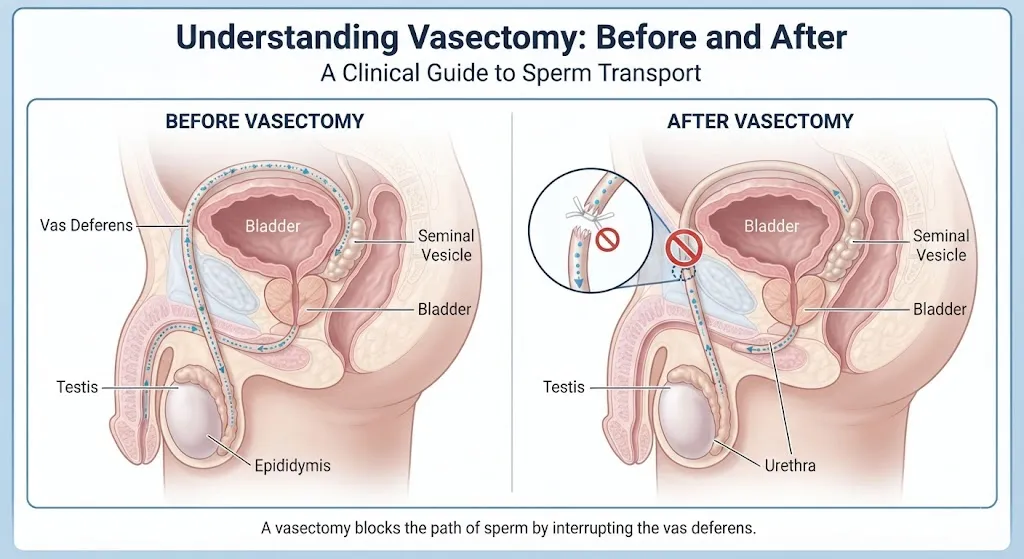
Immediately after vasectomy, sperm that were already beyond the blocked portion of the vas deferens can remain in the reproductive tract. These sperm may continue to appear in semen until they are naturally cleared.
Technical problems can also contribute to early failure, including:
- Incomplete occlusion of one vas deferens
- An incorrectly identified structure
- Persistent sperm in the semen
- Failure of the blocked ends to heal as intended
- Early recanalization, in which a passage forms across the blocked area
The American Urological Association (AUA) has emphasized that another contraceptive method is required until post-vasectomy semen analysis confirms occlusion.
Late failure
Late failure is different. It happens after a vasectomy initially appeared successful.
The most likely explanation is vasectomy recanalization. In rare cases, microscopic channels can develop between the separated or sealed ends of the vas deferens. If sperm can once again pass through that connection, pregnancy becomes possible.
The AUA estimates pregnancy caused by recanalization after documented azoospermia at approximately 1 in 2,000 vasectomies or less often.
This is why a pregnancy years after vasectomy should not automatically be dismissed as impossible.
3. How Long After Vasectomy Can You Get Pregnant?
One of the most important questions couples ask is how long after vasectomy can you get pregnant?
The answer is: potentially immediately after the procedure if intercourse occurs without another contraceptive method.
That does not mean the vasectomy has failed. It means the procedure is not immediately effective.
Sperm can remain in the reproductive tract after the vas deferens has been blocked. The body needs time to clear those sperm. The CDC recommends a semen analysis approximately 8–16 weeks after surgery and advises continued contraception until success is confirmed.
A simplified timeline looks like this:
Immediately after surgery:
Pregnancy remains possible.
First several weeks:
Residual sperm may still be present.
Around 8–16 weeks:
A post-vasectomy semen analysis is generally performed.
After confirmed clearance:
The pregnancy risk becomes extremely low.
Years later:
Rare late failure can still occur because spontaneous recanalization is possible.
There is no universal number of ejaculations that guarantees sterility. The CDC specifically notes that ejaculation count is not a reliable substitute for semen analysis.
This is one reason our medical editorial team emphasizes a simple rule: do not use the calendar alone to decide when to stop contraception. Follow the semen-test result and your clinician’s instructions.
This also fits into broader reproductive-health questions, including Clinical Accuracy in Modern Cycle Tracking, because pregnancy timing can become confusing when one partner assumes that sterilization is immediately effective.
4. Post Vasectomy Semen Analysis: The Test That Matters
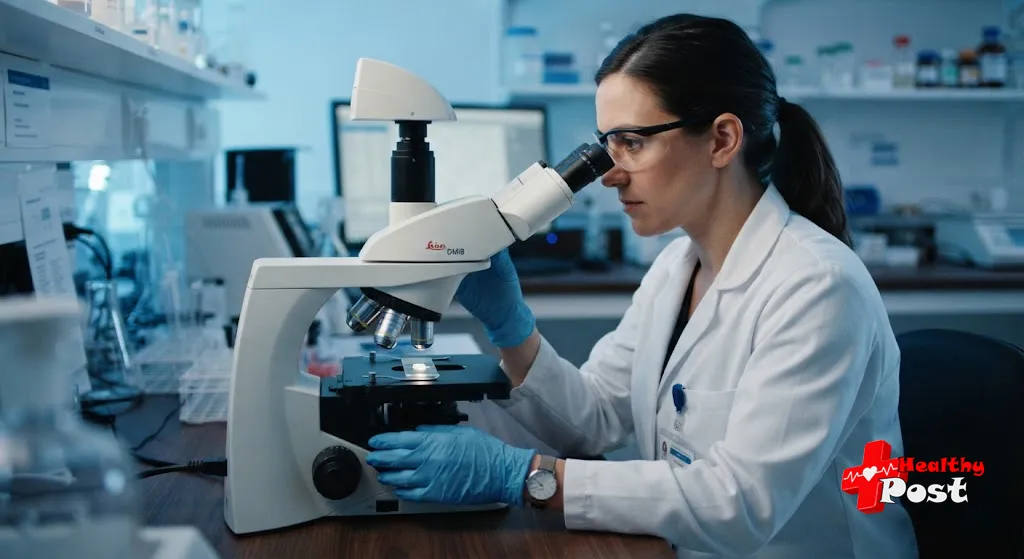
A post vasectomy semen analysis examines a semen sample under laboratory conditions to determine whether sperm are still present and whether they are moving.
The main results may include:
- Azoospermia: no sperm detected.
- Rare non-motile sperm: a very small number of sperm that are not moving.
- Persistent sperm: sperm continue to be detected and may require repeat testing.
- Motile sperm: moving sperm remain present and contraceptive protection should continue.
The CDC reports that by approximately 12 weeks, about 80% of men in the evidence reviewed have azoospermia, while most of the remainder have only rare non-motile sperm.
The exact laboratory criteria can differ by country, laboratory, and clinical guideline. For example, several NHS services commonly request testing at least 12 weeks after surgery and after a specified number of ejaculations.
If motile sperm are found, the next step is usually continued contraception and repeat testing according to the treating clinician’s instructions.
A small amount of non-motile sperm may be handled differently under specific guidelines. Patients should therefore rely on the official clearance decision from their clinician or laboratory rather than interpreting the laboratory report themselves.
5. Can a Vasectomy Reverse Itself?
Yes, but extremely rarely.
When people ask, can a vasectomy reverse itself, they are usually talking about spontaneous recanalization rather than a planned vasectomy reversal.
A surgical reversal is an intentional procedure in which a specialist attempts to reconnect the reproductive tract. Spontaneous recanalization is different: microscopic tissue channels may form between the blocked portions of the vas deferens without another operation.
If those channels allow sperm to pass, sperm may eventually reappear in the semen.
The American Urological Association considers vasectomy a permanent contraceptive procedure and recognizes a small residual pregnancy risk even after successful semen testing.
Therefore, vasectomy should be approached as permanent contraception—not as a procedure that can safely be assumed to reverse naturally.
6. Can Pregnancy Happen Years After a Vasectomy?
Yes. It is exceptionally uncommon after confirmed sperm clearance, but it can happen.
Pregnancy after vasectomy years later may be associated with late recanalization. It may also have another explanation entirely.
If pregnancy occurs, possible causes include:
- Residual sperm because clearance was never confirmed.
- Persistent motile sperm after surgery.
- Technical failure of the original procedure.
- Early recanalization.
- Late spontaneous recanalization.
- A pregnancy unrelated to the vasectomized partner.
The 2025 study of nearly 489,000 men found that lack of post-vasectomy semen analysis was associated with increased odds of documented failure, reinforcing the importance of follow-up testing.
A pregnancy does not, by itself, prove exactly why a vasectomy failed. If determining biological paternity is medically or legally important, appropriate professional testing should be discussed rather than relying on assumptions.
7. What Are Vasectomy Failure Symptoms?
There is an important misconception here: vasectomy failure often causes no symptoms.
A man may feel completely normal even if sperm have returned to his semen. Recanalization is not necessarily associated with pain, swelling, changes in ejaculation, or visible differences in semen.
Potential reasons to contact a healthcare professional include:
- A pregnancy occurs after vasectomy.
- A semen analysis shows motile sperm.
- Sperm reappear after previous documented clearance.
- The original semen test was never completed.
- The surgeon has concerns about the original procedure.
The presence of sperm after vasectomy should be interpreted by the clinician who knows the timing, laboratory findings, and surgical details.
It is also important to distinguish failure from ordinary recovery issues. Pain, bruising, swelling, infection, bleeding, or persistent discomfort can occur as vasectomy complications, but these symptoms do not necessarily mean that sperm are present or that contraception has failed.

8. What Should Couples Do After Vasectomy?
The safest approach is practical and straightforward.
First, follow the surgeon’s post-operative instructions. Recovery recommendations vary depending on the procedure and individual circumstances.
Second, do not assume the vasectomy is immediately effective. Another contraceptive method should be used until clearance is confirmed.
Third, complete the post-vasectomy semen analysis at the recommended time. In the United States, CDC guidance recommends testing at 8–16 weeks.
Fourth, follow up if sperm remain present. A repeat test may be necessary.
Finally, take a later pregnancy seriously. Even after years of successful contraception, an unexpected pregnancy warrants medical evaluation rather than being dismissed because of a previous vasectomy.
For additional patient education, the vasectomy effectiveness information from the National Health Service explains that vasectomy is more than 99% effective while also emphasizing its permanent nature.
Readers researching reproductive symptoms may also encounter related topics such as Vaginal Discharge, Lower abdominal pain in women isn’t always a sign of menstruation, or common gynecological diseases in women. Those symptoms have many possible causes and should not be used to determine whether a vasectomy has worked.
Frequently Asked Questions
1. Can you get pregnant immediately after a vasectomy?
Yes. A vasectomy does not provide immediate contraception because sperm can remain in the reproductive tract. Another contraceptive method should be used until semen analysis confirms successful clearance.
2. What is the chance of getting pregnant after vasectomy once the semen test is clear?
After documented azoospermia, the CDC estimates the pregnancy risk at approximately 1 in 2,000. This is extremely low but not zero.
3. Can sperm come back after a vasectomy?
Rarely. Spontaneous recanalization can allow sperm to cross the previously blocked vas deferens. This is one explanation for late vasectomy failure.
4. How long after vasectomy can you get pregnant?
Pregnancy is possible during the early period before sperm clearance has been confirmed. After a successful semen analysis, the risk becomes extremely low, although rare late failure remains possible.
5. What happens if sperm are found in the semen test?
Continue using contraception and contact the treating clinician. Depending on whether sperm are motile or non-motile and on the amount detected, repeat testing or further treatment may be recommended.
6. Is vasectomy 100% effective?
No. It is one of the most effective contraceptive methods, with a typical first-year failure rate of about 0.15%, but no contraceptive method provides an absolute guarantee.
Key Takeaway: Chance of Getting Pregnant After Vasectomy
The chance of getting pregnant after vasectomy is very low, but it is not zero.
The most important distinction is between a vasectomy that has simply been performed and one that has been confirmed successful through semen analysis. Until sperm clearance is documented, residual sperm can still result in pregnancy.
The current CDC guidance recommends post-vasectomy semen analysis at approximately 8–16 weeks and continued contraception until successful clearance. After documented azoospermia, the estimated pregnancy risk is approximately 1 in 2,000.
Rare late vasectomy failure can occur because of spontaneous recanalization. That is why pregnancy years after surgery should be medically evaluated rather than automatically considered impossible.
For people looking at the wider reproductive-health picture, topics such as Ultrasound during pregnancy may become relevant if conception occurs, while Clinical Accuracy in Modern Cycle Tracking can provide useful context when interpreting fertility timing. The important point is to avoid assuming that a previous sterilization procedure eliminates every possibility of pregnancy.
The chance of getting pregnant after vasectomy is therefore best understood as exceptionally small after confirmed clearance, but never literally zero. Completing the recommended semen analysis is one of the most important steps a patient can take to make that risk as low as possible.
Medical note: This article is intended for general educational purposes and does not replace individualized medical advice, diagnosis, or treatment. Anyone with persistent sperm after vasectomy, concerns about surgical complications, or a pregnancy after a partner’s vasectomy should consult a qualified healthcare professional.
Trusted References
- post vasectomy semen analysis — CDC guidance on timing, contraception, and pregnancy risk after vasectomy.
- vasectomy failure rate — 2025 large-scale study examining contemporary vasectomy failure and pregnancy rates.
- vasectomy — NHS patient information on effectiveness and permanence.