

Clinical Authorship & Verification
This article has been written and verified by Harpreet Kaur (Physiotherapist, Anatomie ↗), specializing in musculoskeletal rehabilitation, joint mobility, and physical therapy.
Medical Disclaimer: The information provided on Healthy Post is for educational and informational purposes only and does not constitute formal medical or physical therapy advice. Performing new physical movements with arthritic joints carries risks if done improperly. Always consult a qualified physiotherapist, orthopedic specialist, or physician before beginning any new exercise routine.

🏥 Medical Review Board Member
Harpreet Kaur
Physiotherapist | Clinical Specialist at Anatomie
Harpreet Kaur is a dedicated physiotherapist with extensive clinical expertise in musculoskeletal health, physical rehabilitation, and joint mobility. Practicing at Anatomie, she is committed to translating evidence-based physical therapy and wellness strategies into clear, authoritative guidance. Harpreet ensures that health and movement content meets the highest standards of medical accuracy, clinical integrity, and patient safety.
Knee arthritis can make everyday movements such as walking, climbing stairs, standing from a chair, or getting up after sitting feel uncomfortable. Stiffness may also make people hesitant to move, but avoiding activity altogether can contribute to muscle weakness and reduced function. For many people, knee exercises for arthritis are an important part of managing symptoms and staying mobile.
The aim is not to force the knee through severe pain or perform difficult exercises simply because they look challenging. A better approach is gradual, controlled movement combined with strengthening, flexibility work, and low-impact aerobic activity. NICE recommends tailored therapeutic exercise for people with osteoarthritis, including local muscle strengthening and general aerobic fitness.
This guide explains practical exercises that may help with knee mobility and strength, gentle stretches, senior-friendly activities, physical therapy, and warning signs that mean you should seek professional advice.
Why Exercise Can Help Knee Arthritis
Osteoarthritis commonly causes pain, stiffness, and difficulty moving the affected joint. Symptoms can fluctuate rather than steadily worsening, and the amount of pain does not always perfectly reflect the structural changes in the joint.
Exercise can address several problems at once.
Strengthening exercises help maintain the muscles that support the knee. The quadriceps at the front of the thigh are particularly important for movements such as standing and climbing stairs, while the hips and glutes also contribute to lower-limb control.
Range-of-motion exercises gently move the knee through a comfortable range and can help maintain flexibility.
Aerobic activities such as walking, cycling, or swimming improve general fitness without requiring high-impact movement.
Balance exercises can be useful for older adults whose strength or stability has declined.
Current guidance does not identify one universally superior exercise program. Instead, NICE recommends exercise that is adapted to the individual’s needs and abilities.
For readers interested in the wider range of musculoskeletal conditions, this overview of orthopedic diseases and their symptoms provides additional background.
10 Knee Exercises for Arthritis
These movements are examples of knee exercises for arthritis that can often be modified for beginners. Move slowly and stay within a range that feels manageable.
1. Heel Slides
Heel slides are simple range-of-motion exercises that encourage gentle knee bending and straightening.
How to do them:
- Lie on your back with both legs comfortably extended.
- Slowly slide one heel toward your body.
- Allow the knee to bend as far as comfortable.
- Pause briefly.
- Slide the heel back until the leg is comfortably straight.
The movement should be smooth rather than forced. Heel slides can be particularly useful when stiffness is more troublesome than weakness.
2. Quad Sets
Quad sets activate the quadriceps with very little knee movement.
How to do them:
- Lie down with the affected leg straight.
- Gently tighten the muscles at the front of your thigh.
- Press the back of your knee gently toward the supporting surface.
- Hold the contraction briefly.
- Relax slowly.
This can be a useful starting point for people who find repeated knee bending uncomfortable.
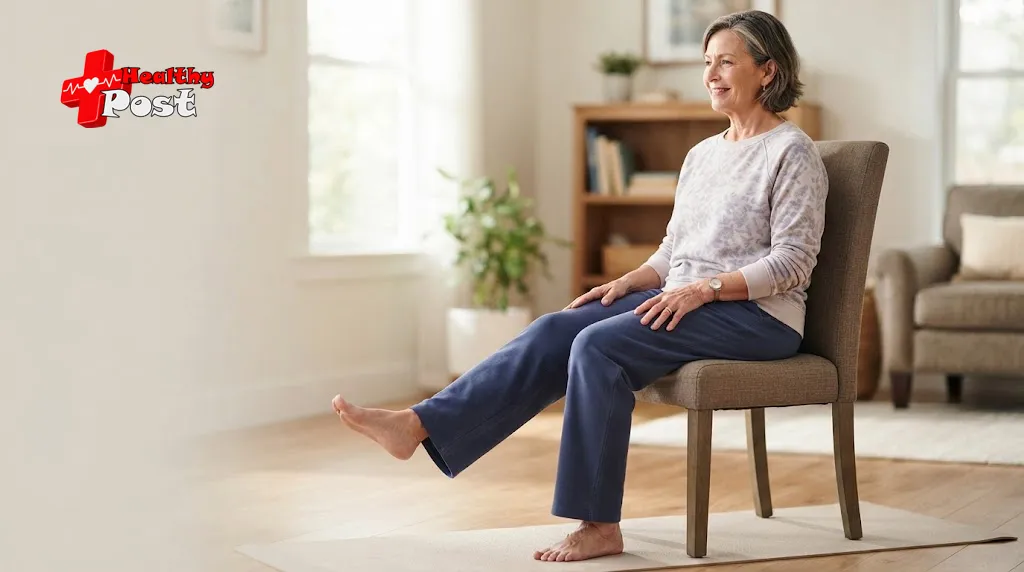
3. Seated Knee Extensions
Sit upright on a sturdy chair with your feet on the floor.
Slowly straighten one leg until you reach a comfortable position. Pause briefly, then lower the foot under control.
This movement targets the quadriceps and can be performed without getting onto the floor.
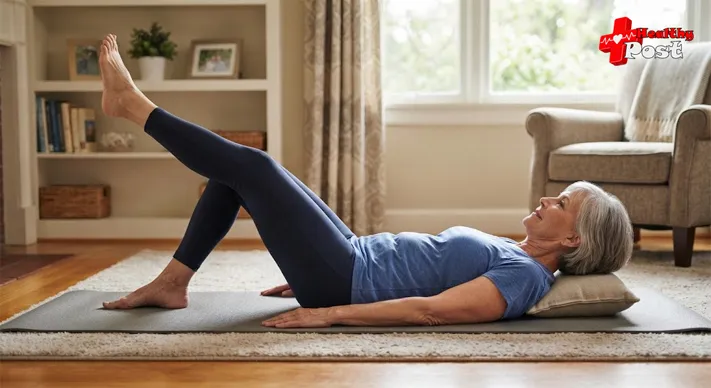
4. Straight-Leg Raises
Straight-leg raises strengthen the thigh and hip muscles without repeated deep knee bending.
How to do them:
- Lie on your back.
- Bend one knee while keeping the other leg straight.
- Tighten the thigh of the straight leg.
- Slowly lift it a short distance.
- Lower it with control.
Do not swing the leg or lift it higher simply to make the exercise harder.
5. Chair Sit-to-Stands
Sit-to-stands are especially useful because they practise a movement you use every day.
Sit on a sturdy chair with your feet positioned securely on the floor. Lean forward slightly and stand up in a controlled manner. Then slowly lower yourself back onto the chair.
If necessary, use the armrests or another stable support while learning the movement.
6. Supported Mini Squats
A deep squat is not necessary to strengthen the legs.
Stand near a sturdy chair, countertop, or other secure support. Bend your knees and hips slightly, lowering your body only as far as comfortable. Return to standing slowly.
Keep the range shallow if deeper bending increases symptoms.
7. Bridges
Bridges focus primarily on the gluteal and hamstring muscles.
Lie on your back with your knees comfortably bent. Tighten your buttocks and gently lift your hips. Pause briefly, then lower your hips slowly.
If the starting position itself causes significant knee pain, choose another strengthening exercise instead.
8. Side-Lying Leg Raises
Lie on your side with the upper leg straight. Slowly raise it without rotating your pelvis, then lower it with control.
This works the muscles around the hip, which contribute to lower-limb stability.
9. Low Step-Ups
A low, stable step can help develop functional leg strength.
Step up slowly, straighten into a comfortable standing position, and then step down under control. Use a railing or stable support if balance is limited.
10. Gentle Knee Bends and Extensions
Simply bending and straightening the knee within a comfortable range can help maintain mobility.
Do not force the knee to reach a particular angle. The objective is comfortable movement, not maximum flexibility.
The Royal Orthopaedic Hospital recommends gentle knee flexion and extension, quadriceps strengthening, sit-to-stands, mini squats, and stretching as examples of exercises used for knee osteoarthritis.
Pain Relief Knee Exercises for Arthritis
People searching for pain relief knee exercises for arthritis often want movements they can perform without turning exercise into a strenuous workout.
For a stiff or uncomfortable knee, begin with gentle mobility such as heel slides and controlled knee extensions. Once comfortable movement is established, strengthening exercises such as quad sets, straight-leg raises, and sit-to-stands can be added according to individual ability.
The key is consistency rather than intensity.
Some people experience increased joint discomfort when they first begin therapeutic exercise. NICE specifically advises that pain may increase initially but that regular, consistent exercise can provide longer-term benefits for pain, physical function, and quality of life.
That does not mean you should ignore severe pain. If an exercise causes a sharp or rapidly increasing pain, stop and reassess the movement.
Gentle Stretches for Arthritic Knees
Gentle stretches for arthritic knees can help maintain flexibility around the joint. Stretching should create a mild pulling sensation in the muscle rather than sharp pain inside the knee.
Hamstring Stretch
Sit near the edge of a sturdy chair and extend one leg with the heel resting on the floor. Keeping your back relatively straight, lean forward slightly from the hips until you feel a gentle stretch behind the thigh.
Calf Stretch
Stand facing a wall and place your hands on it for support. Step one leg backward, keep the heel comfortably down, and gently move your body forward.
Quadriceps Stretch
Hold a sturdy support while standing. Bend the knee gradually and bring the heel toward the buttock only as far as comfortable.
If this position causes knee pain, do not force it. A physiotherapist can suggest an alternative.
Knee Range-of-Motion Movement
Slowly bend and straighten the knee within your comfortable range. This can be performed while lying down or sitting.
The Arthritis Foundation recommends stretching slowly until you feel gentle muscle tension and advises against bouncing or forcing a painful stretch.
Low Impact Knee Exercises for Seniors
Low impact knee exercises for seniors should be practical, adaptable, and appropriate for the person’s balance and strength.
Walking
Walking is an accessible aerobic activity for many people. Start with a duration that feels manageable rather than immediately aiming for a long walk.
If hills or uneven surfaces increase symptoms, begin on a flatter, predictable route.
Stationary Cycling
Cycling can provide aerobic exercise while avoiding the impact associated with running. Adjust the seat and resistance so that the movement remains comfortable.
Water Exercise
Swimming and water-based exercise can be useful because buoyancy reduces some of the load on weight-bearing joints while the water still provides resistance.
The Arthritis Foundation lists walking, bicycling, and swimming among useful aerobic activities for people with osteoarthritis.
Chair Exercises
Chair-based movements can be a practical starting point for someone with limited mobility. Seated knee extensions and controlled sit-to-stands can build confidence before progressing to more demanding exercises.
Balance Exercises
Older adults with weakness or reduced stability may benefit from simple balance practice near a sturdy support. Do not perform challenging balance exercises alone if you have a significant fall risk.
| Exercise | Main purpose | Easy modification |
|---|---|---|
| Walking | Aerobic fitness | Shorter, flatter walks |
| Cycling | Cardio and mobility | Reduce resistance |
| Water exercise | Cardio and movement | Use shallow water or supervised classes |
| Sit-to-stands | Leg strength | Use armrests |
| Seated extensions | Quadriceps strength | Reduce range |
| Mini squats | Functional strength | Hold a stable support |
Strengthening the Muscles That Support the Knee
The phrase exercises to strengthen arthritic knees really refers to strengthening the muscles around the joint rather than repairing the arthritis itself.
The quadriceps, hamstrings, glutes, and hip muscles all contribute to lower-body movement and stability.
A balanced routine may include:
- Quadriceps: quad sets, seated extensions, straight-leg raises
- Glutes: bridges and side-lying leg raises
- Functional strength: sit-to-stands and supported step-ups
- Mobility: heel slides and gentle knee movements
Strong muscles can make everyday movements easier and provide better support around an osteoarthritic joint.
Physical Therapy for Knee Osteoarthritis
Physical therapy for knee osteoarthritis can be particularly helpful when you are uncertain which exercises to choose or have difficulty progressing on your own.
A physiotherapist can assess:
- Knee range of motion
- Muscle strength
- Walking pattern
- Balance
- Functional limitations
- Exercise technique
- Factors that may be aggravating symptoms
The program can then be adjusted to your goals and current ability.
NICE recommends tailored therapeutic exercise for everyone with osteoarthritis and says supervised exercise sessions can be considered.
This is particularly useful for someone with persistent pain, significant weakness, instability, limited mobility, or other health issues.
If your knee problem is not actually osteoarthritis, the appropriate exercise program may be different. For example, inner-knee pain can sometimes have other causes. This guide to pes anserine bursitis exercises explains why medial knee symptoms may require a different rehabilitation approach.
A Simple Beginner Routine
There is no single routine that suits everyone, but the following structure can help organize knee arthritis exercises at home.
Warm up
Begin with several minutes of easy movement, such as slow walking around your home or gentle knee and ankle movements.
Mobility
Choose one or two:
- Heel slides
- Gentle knee bends
- Seated knee extensions
Strength
Choose two or three:
- Quad sets
- Straight-leg raises
- Sit-to-stands
- Bridges
Flexibility
Finish with gentle:
- Hamstring stretching
- Calf stretching
- Quadriceps stretching if comfortable
Low-impact cardio
Depending on your ability, add walking, cycling, or water exercise.
Start at a manageable level and increase gradually. A physiotherapist can provide more specific guidance if you need a structured program.
How Often Should You Exercise?
There is no universal number of repetitions or sessions that is appropriate for every person with knee osteoarthritis.
The more important principles are regularity, gradual progression, and tolerability.
If you have been inactive for a long time, starting with a small amount may be more realistic than immediately following an intense program. As your strength and confidence improve, you can gradually increase duration, repetitions, resistance, or difficulty.
NHS guidance similarly emphasizes regular exercise and warns that doing too much too quickly or using an unsuitable program can aggravate symptoms.
How Much Pain Is Acceptable During Exercise?
There is no need to follow the old idea that exercise must hurt to be effective.
A new exercise can sometimes cause mild muscle fatigue, stiffness, or a temporary increase in joint discomfort. NICE acknowledges that joint pain may initially increase when therapeutic exercise begins.
However, stop and seek medical advice if you develop:
- Sudden or severe pain
- Significant new swelling
- Inability to bear weight
- True locking of the knee
- New instability or repeated giving way
- A painful pop after an injury
- Marked redness or unusual warmth with significant symptoms
- Symptoms that continue to worsen rather than settle
Knee clicking without pain is often different from clicking accompanied by swelling, locking, instability, or injury. Read more about when painless knee clicking may need medical attention
Exercises That May Need Modification
It is better to talk about modification than to label an exercise permanently unsafe for everyone with arthritis.
Depending on your symptoms, you may need to reduce or modify:
- Running
- Jumping
- High-impact aerobics
- Deep squats
- Deep lunges
- Rapid twisting movements
- Activities involving sudden changes of direction
Someone with mild symptoms and good strength may tolerate activities that another person cannot.
If an activity repeatedly causes substantial pain or swelling, replace it with a lower-impact option and discuss the problem with a physiotherapist if it persists.
For people recovering from knee replacement, the exercise rules and progression can be different from those for uncomplicated knee osteoarthritis. In that situation, follow your surgical or rehabilitation team’s instructions rather than simply applying a general arthritis exercise program. This guide to common mistakes after knee replacement can provide additional context.
Frequently Asked Questions
What is the best exercise for arthritis in the knees?
There is no single best exercise for everyone. A combination of strengthening, range-of-motion work, and aerobic activity is generally more useful than relying on one movement. NICE recommends tailoring therapeutic exercise to individual needs.
Should you exercise your knees when they hurt from arthritis?
Usually, appropriately selected exercise can still be beneficial, even when some discomfort is present. However, severe or rapidly worsening pain should not be ignored. Reduce the intensity or stop the exercise and seek professional advice when symptoms are concerning.
Is walking good for knee arthritis?
Walking can be a useful low-impact aerobic activity for many people with knee osteoarthritis. Begin with a manageable distance and gradually increase activity if your symptoms tolerate it.
Are squats safe for people with knee arthritis?
Modified, shallow squats may be appropriate for some people. You do not need to perform deep squats to strengthen your legs. Use support if necessary and keep the movement within a comfortable range.
Is cycling good for knee osteoarthritis?
Cycling can be a useful low-impact aerobic activity. A stationary bike can also make it easier to control resistance and avoid uneven terrain.
Can physical therapy help knee osteoarthritis?
Yes. Physical therapy can help assess strength, mobility, movement patterns, and functional limitations, then develop an exercise program appropriate for the individual. NICE also recommends tailored therapeutic exercise and considers supervised sessions for people with osteoarthritis.
Conclusion
Regular movement can be an important part of managing knee arthritis. The most effective approach is not necessarily the most demanding one. For many people, a combination of gentle mobility work, strengthening, stretching, and low-impact aerobic activity is more practical and sustainable.
Start with movements you can perform with good control. Progress gradually rather than forcing the knee through severe pain. If symptoms are persistent, your knee feels unstable, or you are unsure which exercises are appropriate, a physiotherapist or other healthcare professional can help personalize your program.
With the right level of activity and appropriate guidance, knee exercises for arthritis can help many people maintain strength, mobility, and independence in everyday life.
References
- NICE — Osteoarthritis in over 16s: Diagnosis and Management — guidance recommending tailored therapeutic exercise for osteoarthritis.
- Royal Orthopaedic Hospital — Exercises for Osteoarthritis of the Knee — practical examples of knee mobility, strengthening, stretching, cycling, and swimming.
- Arthritis Foundation — Osteoarthritis Physical Therapy: Finding Safe, Effective Activities — information about physical therapy, strengthening, range-of-motion, and aerobic exercise.