

Medical Disclaimer: The information provided in the article “What Age Do Infants Sit Up? 5 Important Developmental Milestones” is for educational and informational purposes only and is not intended as a substitute for professional medical advice, diagnosis, or treatment. Every infant develops at their own pace; always consult your pediatrician or a qualified healthcare provider with any questions or concerns regarding your child’s growth, motor skills, or health.
Written by: Dra. Ana Escobar, Pediatrician, FMUSP / Official ↗

✍️ HealthyPost Author
Dra. Ana Escobar, MD
Pediatrician | Professor, Faculty of Medicine FMUSP
Dra. Ana Escobar, MD, is a pediatrician and professor in the Department of Pediatrics at the Faculty of Medicine of the University of São Paulo (FMUSP). With a background in clinical practice and health communication, she focuses on making evidence-based information about children’s health, preventive medicine, and family wellness easier for readers to understand. Through her contributions to HealthyPost, she aims to present complex health topics in clear, accessible language that supports informed health decisions.
Few moments in the first year feel as satisfying as the first time your baby stays upright and reaches for a toy without toppling over. Many parents start wondering what age do infants sit up long before it happens, often because a relative, a friend’s baby, or a milestone app has set an expectation. Most babies learn to sit without support by about nine months. Sitting arrives gradually, through several smaller skills, and the timing varies from one healthy baby to the next.
What Age Do Infants Sit Up?
Sitting develops across the second half of the first year, and “sitting” covers more than one ability. A baby who stays upright when you prop them on your lap, one who balances on their own hands, and one who pushes themselves from lying down into a seated position are showing three different skills, and each appears at a different age.
The CDC’s milestone checklists are the most widely used US reference. Since its 2022 revision, the CDC defines a milestone as something most children (75% or more) can do by a certain age. In its 6-month list, the CDC includes leaning on the hands for support when sitting. By 9 months, its checklist for movement and physical development includes sitting without support. The CDC’s separate 9-month milestone page also lists getting into a sitting position by yourself as its own skill. You can read the full list on the CDC’s 9-month milestone checklist. 9 Month Online Milestone Checklist +2
Put simply, a baby leaning on their hands at six months is on track, and a baby sitting steadily at nine months is on track. Plenty of babies reach the independent stage somewhere between six and eight months, so the “when” is a window, not a date.
5 Important Developmental Milestones Before Sitting Independently
Sitting depends on strength and balance built over several months. These five stages are a useful way to see the progression, but babies don’t follow them in a fixed order, and many skip or blend them.
Developing Head and Neck Control
A baby can’t sit until they can hold their head steady. In the early months you’ll notice them lifting their head during tummy time, keeping it fairly still when you hold them upright, and turning to follow faces and objects. Around four months, many babies also begin pushing up on their forearms. This is also the age when sleep often becomes unsettled for a while, which some parents mistake for a developmental setback. Our guide to the 4-month sleep regression explains what’s happening during that period.
Pushing Up During Tummy Time
Next, babies start pressing their chest away from the floor. They begin on their forearms and later straighten their arms, lifting the chest high enough to look around and reach for nearby toys. The CDC lists pushing up with straight arms on the tummy as a 6-month milestone. The NHS notes that tummy time helps to build the muscles your baby needs for sitting and crawling, and you can find practical ideas in its guidance on keeping your baby or toddler active. nhs.uk

Learning to Roll Over
Rolling teaches babies to shift weight from one side of the body to the other, which is exactly the balance adjustment they’ll need when they start to wobble in a seated position. Most babies roll from tummy to back first, then from back to tummy. Some go straight from rolling to sitting, and some skip rolling in one direction altogether.
Sitting With Support and Using Hands for Balance
Many babies start by sitting when an adult holds them or when they’re seated in a lap. Soon they lean forward and plant both hands on the floor, a posture often called tripod sitting because the arms act like two extra legs. It looks a little hunched, but it’s a normal and useful stage in building trunk strength. Babies often stay here for weeks before they can free their hands.
Sitting Independently Without Support
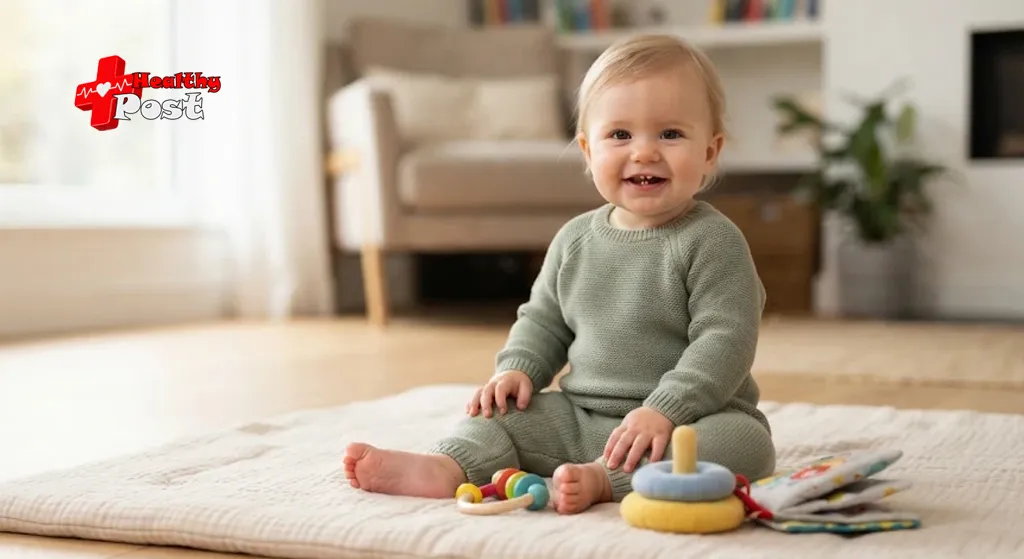
The final stage is when a baby holds their head and back upright without leaning on their hands, reaches for a toy, turns to look at a sound, and recovers their balance after a small wobble. Falls are still part of the process at this point. The CDC shows what this looks like in practice on its 9-month milestone photo and video page.
Signs Your Baby Is Ready to Sit Up
Readiness tends to show in movement before it shows in posture. You may notice steady head control, strong pushing up during tummy time, rolling in one or both directions, and purposeful arm and leg movements. Babies who are close to sitting also lean forward or sideways and try to catch themselves with their hands.
None of these is a medical test. They simply tell you the muscles and coordination are developing. If you’re unsure about muscle strength, posture, or progress, your health visitor or pediatrician can assess your baby in person.
What Factors Affect When Babies Start Sitting?
Several things influence timing, and most of them are completely ordinary.
Sitting needs coordination between the neck, back, abdominal, hip and trunk muscles, so some babies take longer to build the combined control. Temperament matters too: one baby may spend weeks perfecting rolling, while another moves quickly to the next stage.
Prematurity also plays a role. The CDC advises that if a baby was born more than three weeks early, parents should use the baby’s corrected age when checking its milestone lists. A baby born two months early who is now six months old is developmentally closer to four months. If you’re curious about how motor skills start forming before birth, our article on fetal development week by week gives useful background.
Opportunities for movement matter as well. Babies who spend plenty of awake, supervised time on the floor tend to practise the skills sitting depends on. Finally, some medical or developmental conditions can affect muscle tone and coordination, which is why persistent concerns deserve professional attention.
How to Help Your Baby Learn to Sit Up Safely
The aim is to give your baby chances to move, not to speed up a milestone.
Offer short periods of tummy time while your baby is awake and watched, and lengthen them gradually as your baby tolerates it. Tummy time is only for waking play. Babies should always be put down to sleep on their backs.
Place a toy just out of reach so your baby has a reason to reach, twist and shift their weight. Floor play on a clear, safe surface gives them space to roll and experiment. When your baby is awake and you’re right there, you can hold them in a supported sitting position for brief periods and let them look around.
When your baby starts to sit, put a soft landing area around them. Sitting unsupported brings falls, and a cushioned floor makes those falls harmless.
Sitting also isn’t the only signal that a baby is ready for solid foods, and feeding readiness is a separate question. If you’re thinking about how babies communicate at feeding time, our article on baby behavior while breastfeeding covers common feeding behaviors.
Should You Make Your Baby Sit Before They Are Ready?
It’s tempting to prop a baby up with pillows to see how they cope, but that only shows how well the pillows work. Supported sitting, where an adult holds the baby securely, is useful practice. Independent sitting is a different skill that comes only when the baby’s own muscles can manage it.
It’s best to avoid leaving a baby propped up and unattended, to stop if they seem tired or uncomfortable, and not to rely on seats or positioning equipment instead of floor play. If you’re ever unsure whether your baby is ready, ask your pediatrician or health visitor.
Why Is My Baby Not Sitting Up Yet?
Not sitting alone at six or seven months does not mean something is wrong. Babies move at different speeds, and a baby who is working hard at rolling or crawling may simply be investing their energy elsewhere. Common reasons include ordinary variation, early birth, differences in muscle strength, and limited chances to move freely.
Look at the whole picture instead of one skill. A baby who is rolling, reaching, pushing up, and engaging with people is usually developing well even if sitting arrives a little later.
When Should You Worry About Delayed Sitting?
The most useful benchmark is the CDC’s 9-month checklist: if your baby isn’t sitting without support by then, or isn’t meeting other milestones, mention it to your pediatrician. You don’t need to wait until then if you’re worried. It’s reasonable to raise concerns at any visit.
Talk to a healthcare professional if your baby:
- consistently falls toward one side
- seems unusually stiff or floppy
- has trouble controlling their head or upper body
- uses one side of the body much less than the other
- is struggling with other age-appropriate movements
Loss of a skill your baby had already gained should always be reported promptly and not put down to normal variation. Sudden marked weakness, unresponsiveness, or a seizure needs urgent medical care. A doctor can assess muscle tone, strength, reflexes and movement symmetry, so no one should try to work out a cause from a single milestone.
Supported Sitting vs. Independent Sitting
Because these terms get blurred, this table shows how they differ.
| Skill | What it looks like | Typical timing |
|---|---|---|
| Sitting with support | An adult or a suitable support keeps the baby upright | Often from about 4–6 months |
| Tripod sitting | Baby leans forward and uses hands for balance | CDC lists leaning on hands at 6 months |
| Sitting without support | Baby stays upright with free hands | CDC lists by 9 months |
| Getting into a sitting position | Baby moves into sitting without help | CDC lists by 9 months |
These are approximate guides, not deadlines.
Do Boys and Girls Start Sitting at Different Ages?
There’s no reliable basis for separate sitting timelines for boys and girls. The CDC’s milestone checklists don’t differ by sex, and individual temperament, strength and opportunity matter far more. Compare your baby with their own progress, not with a friend’s child.
Frequently Asked Questions
Can a six-month-old sit without support?
Some can, especially for a short time, while others still need a hand or lean on their arms. Both are within the usual range.
Is it normal for babies to fall over when they’re learning to sit?
Yes, some tipping is part of learning balance. Falling repeatedly to the same side is worth mentioning to a pediatrician.
Does tummy time really help?
Yes. It builds the neck, shoulder and back strength that sitting uses, and the NHS recommends it. Always supervise it, and only when your baby is awake.
My baby is nine months old and still can’t sit alone. What now?
Book a visit with your pediatrician. They can look at your baby’s overall development and decide whether any further checks are needed.
Do premature babies sit later?
They often reach milestones later by calendar age, which is why corrected age is used for babies born more than three weeks early.
Conclusion
Asking what age do infants sit up is really asking about a process, since babies move from head control to tummy-time pushing, rolling, supported sitting, and finally steady, independent sitting. Most reach the last stage by about nine months, and many do so earlier. The best support you can give is plenty of safe floor time and patience, and a conversation with your pediatrician if your baby isn’t sitting without support by nine months or you notice any warning signs. For more clear explanations of everyday health questions, browse HealthyPost’s patient education guides.
References
- CDC, “9 Month Online Milestone Checklist” (https://cdc.gov/act-early/digital-online-checklist/9-months.html)
- CDC, “Milestones In Action: By 9 Months” (https://www.cdc.gov/act-early/milestones-in-action/9-months.html)
- NHS, “How to keep your baby or toddler active” (https://www.nhs.uk/baby/babys-development/play-and-learning/keep-baby-or-toddler-active/)