


Medical Disclaimer: The information provided in the article “Endovascular Therapy: What It Is, How It Works, and When It Is Used”, written by Dr. Sana Lodhi, is intended for general educational and informational purposes only and does not constitute medical advice, diagnosis, or treatment. Always consult a qualified physician or healthcare professional with any questions you may have regarding a medical condition, vascular procedure, or treatment options. Never disregard professional medical advice or delay seeking it because of something you have read in this article. If you are experiencing a medical emergency, call your local emergency services or go to the nearest emergency department immediately.

✍️ HealthyPost Author
Dr. Sana Lodhi, MBBS
Medical Doctor & General Health Specialist
Dr. Sana Lodhi, MBBS, is a medical doctor with a background in general clinical medicine and healthcare education. At HealthyPost, she focuses on making complex healthcare topics easier to understand through clear, practical health information. Her contributions cover general health awareness, preventive healthcare, and patient wellness, helping readers develop a better understanding of their health and make informed decisions.
Endovascular therapy treats diseases of the blood vessels, and some tumours, from inside the vessels themselves. Instead of opening the body to reach a problem, a specialist threads a thin tube (a catheter) through an artery, usually from the groin, and guides it to the affected area under X-ray. From there, the specialist can use balloons, stents, coils or special liquid “glues” to keep a vessel open, close off an abnormal one, or seal a weak spot before it bleeds.
The approach is widely used for brain (cerebral) aneurysms and for abnormal tangles of vessels in the brain and spinal cord. This article explains how the procedure works, what recovery usually involves, and which conditions it treats.
Why Doctors Choose Endovascular Therapy
The main appeal is that the procedure uses the body’s own blood vessels as the route to the problem. For brain conditions, that means no large incision in the scalp, no bone removal and no extensive stitching. Compared with open surgery, this generally means less strain on the body, a lower risk of wound infection, and often a shorter hospital stay and recovery.
It is not automatically the better choice for every patient, though. The right treatment depends on the type, size, shape and location of the problem, and on the person’s age and other health conditions. Some patients are better served by open surgery, radiation treatment or careful monitoring alone.
| Endovascular therapy | Open surgery | |
|---|---|---|
| Access | Small puncture in an artery, often the groin | Incision, and for the brain, removal of a section of skull |
| Wound | Usually a puncture site only | Larger wound that needs closing |
| Typical recovery | Often shorter | Often longer |
| Suitability | Depends on the lesion’s shape and location | Preferred in some cases |
The table shows general patterns. Your specialist team will decide which approach suits your situation.
For comparison, open treatment of a brain aneurysm is called clipping. It involves a craniotomy, a procedure that opens the skull to reach the brain, and uses specialised neurosurgical instruments that endovascular techniques avoid.
How Endovascular Therapy Works
Preparation and anaesthesia
For brain procedures, the NHS notes that a general anaesthetic is used, so you are asleep and feel nothing during treatment. Because of that, preparation usually includes blood tests, a consultation with the anaesthetist and, where needed, further imaging.
During the procedure
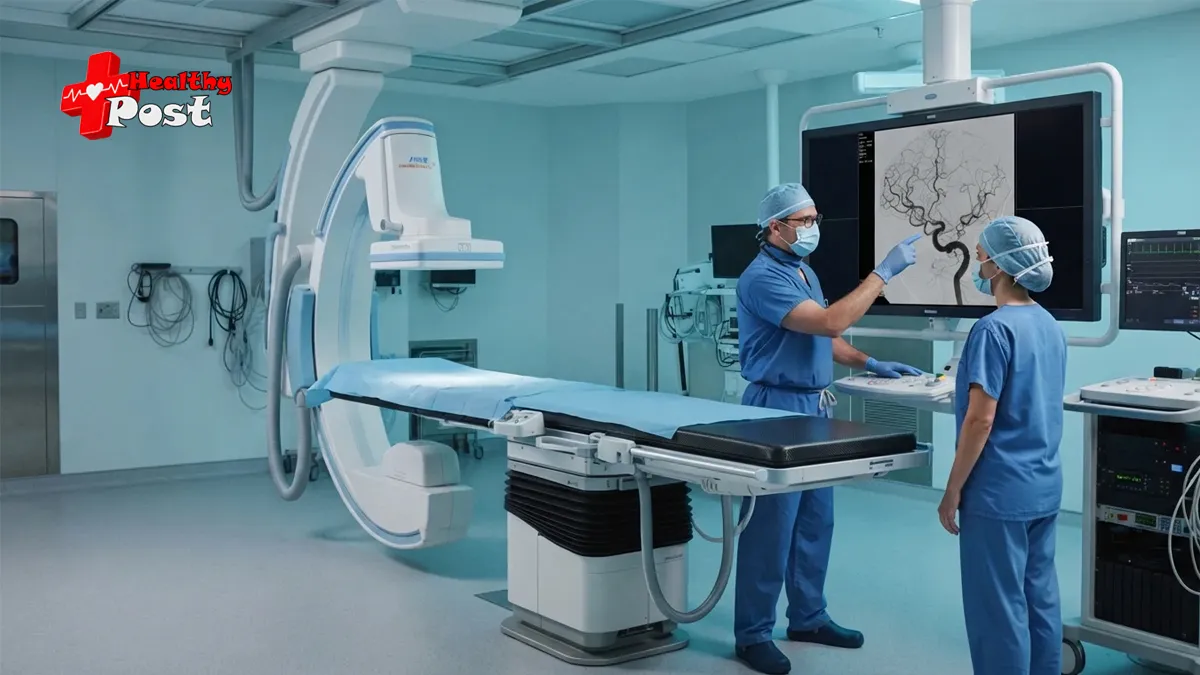
The specialist makes a small puncture in an artery, most often in the groin, and passes a catheter and a fine guidewire along the vessels to the target. The position of these instruments is followed on live X-ray images using angiography, a technique that shows blood vessels by injecting contrast dye. When angiography is first done to make a diagnosis, treatment can sometimes follow in the same session, depending on what it shows.
Contrast dye can affect the kidneys, which is why some hospitals check kidney function with a blood test beforehand. Patients can expect a bruised or tender groin afterwards, but there are no stitched incisions there, only a puncture site. Pressure is applied to the site, and because of the bleeding risk, you will usually need to lie flat in bed for several hours, depending on the size of the catheter used. After that you are gradually helped to get up.
Risks
Any procedure on the blood vessels of the brain carries a risk of stroke, caused either by a blocked vessel or by bleeding. Other possible problems include bleeding or bruising at the puncture site and a reaction to contrast dye. Your team should go through the specific risks for your case before treatment.
Recovery and Follow-Up After Endovascular Therapy
Most people are monitored in hospital for a short time after the procedure. Your team may arrange follow-up scans, such as CT or MRI, before you go home. If the scans look as expected and you feel well, discharge may come within a few days, but the exact length of stay varies with the condition treated and whether it had already bled.
Medication afterwards depends on the procedure. Patients who have had a stent or flow diverter, for example, are commonly given antiplatelet medicines, which reduce the chance of clots forming on the device. Your team will explain which medicines you need, for how long, and why. Do not stop them without asking, because stopping early can be dangerous.
Follow-up imaging is typically planned at intervals, using MRI or catheter angiography, to check that the treated area remains closed. Special rehabilitation is not needed for everyone, but it may be arranged if the underlying condition, particularly a bleed, has affected movement, speech or thinking.
Return to work and sport varies widely. Some people feel ready within a week or two after an uncomplicated procedure, while others need longer, especially after a bleed. Your care team can give you a timeline that fits your situation, along with advice on driving, as some conditions affect whether you may drive.
Conditions Treated With Endovascular Therapy
Brain (cerebral) aneurysms
An aneurysm is a weak, bulging area in the wall of a blood vessel. Most brain aneurysms are small and cause no symptoms, and the NHS explains that they are often found during tests for something else. The risk is that an aneurysm may burst, causing bleeding around the brain, which is a medical emergency. Small aneurysms that aren’t causing symptoms may not need treatment at all, only regular scans.
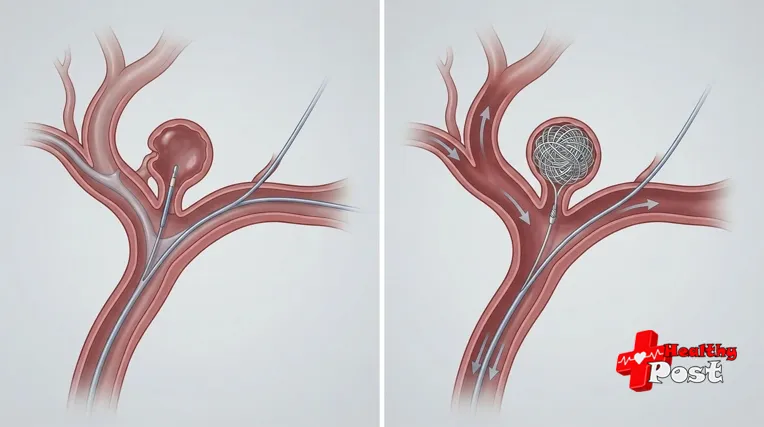
When treatment is needed, endovascular repair is one of the two main options, alongside surgical clipping. The most common technique is coil embolisation. Through the catheter, the specialist places soft platinum coils inside the aneurysm. The coils slow the blood flow so that a clot forms and seals the bulge off from circulation. Some coils carry a special coating intended to improve healing and durability; how much difference these coatings make to long-term results is still debated, so ask your specialist whether they are relevant to you.
For some aneurysms, especially those with wide openings, a stent or a flow-diverting device can be placed in the parent artery. It redirects blood past the aneurysm, which then gradually shrinks away from the circulation. Stents are also widely used in the heart’s arteries, where the risks and aftercare differ; the HealthyPost article on the risks of coronary stent surgery explains those.
Arteriovenous malformations and fistulas
An arteriovenous malformation (AVM) is a tangle of vessels in which blood passes directly from arteries into veins instead of through the fine capillary network between them. The NHS England commissioning policy describes AVMs as generally present from birth and most commonly found in the brain. An arteriovenous fistula is a similar abnormal direct connection, typically a single link between an artery and a vein. A dural arteriovenous fistula is one that involves the membrane (dura) covering the brain or spinal cord.
These abnormal connections carry high-pressure blood into vessels not built for it, which is why they can cause symptoms or bleeding. Embolisation is one of the main treatments. The specialist guides microcatheters to the abnormal connection and blocks it with a liquid embolic agent such as an adhesive glue or Onyx, a liquid material that sets inside the vessels. Treatment may also use coils or other materials.
Embolisation is not always used alone. Hospital information describes three main options: endovascular treatment, surgery and radiosurgery, which are sometimes combined. For example, embolisation may be done first to reduce blood flow before surgery or radiosurgery. The original article’s statement that endovascular therapy is “currently the primary treatment” is too broad, and the choice depends on the lesion.
When to Seek Medical Help
A ruptured brain aneurysm is an emergency. The NHS advises calling 999 for a sudden, extremely painful headache that does not go away, facial weakness, arm weakness or numbness, speech problems, or sudden vision loss. Do not drive yourself to hospital. If you have ongoing or worsening headaches, or pain around the eye, ask for an urgent GP appointment or contact NHS 111.
After any endovascular procedure, contact your care team promptly if the puncture site swells, bleeds or becomes very painful, or if you notice new weakness, speech difficulty or severe headache, which need emergency help.
Frequently Asked Questions
Is endovascular therapy the same as keyhole surgery?
Not exactly. Both are minimally invasive, but keyhole (laparoscopic) surgery uses small cuts and a camera to operate in a body cavity. Endovascular therapy works from within the blood vessels, guided by X-ray imaging.
Will I be awake during the procedure?
For brain procedures, the NHS says a general anaesthetic is used, so you will be asleep. Other vascular procedures elsewhere in the body may use different anaesthesia, so ask your team.
Does endovascular therapy leave a scar?
It involves a puncture rather than a cut, so a visible scar is unlikely, though the puncture site may bruise for a while.
How long will I stay in hospital?
It depends on the condition and your recovery. Many uncomplicated cases need only a short stay, but a patient who has had a bleed needs longer. Your team will give you an estimate.
Can the problem come back after treatment?
Sometimes. A treated aneurysm or malformation may need further treatment, which is why follow-up imaging is planned.
Is endovascular therapy safe?
It is widely used and is considered safe in suitable patients, but it carries real risks, including stroke for brain procedures. Ask your specialist how those risks compare with the risk of leaving the condition untreated.
Final Thoughts
Endovascular therapy lets specialists treat aneurysms, malformations and other vessel problems from the inside, without large wounds. That generally makes recovery gentler than with open surgery, though it is not suitable for every patient and it is not risk-free. If you have been offered this treatment, ask your team why it suits your condition, what the alternatives are, and what follow-up to expect.
References
- NHS. Brain aneurysm. NHS.uk (page last reviewed 9 October 2025).
- University College London Hospitals NHS Foundation Trust. Cerebral arterio venous malformation endovascular treatment. Patient information.