

Clinical Review & Medical Notice
This comprehensive guide on Cancer Patient Diet & Side Effect Management has been rigorously reviewed and medically validated by Dr. Kamlesh Verma, MS, M.Ch, to ensure clinical accuracy regarding oncology nutrition and symptom relief protocols.
Disclaimer
The medical information, nutritional insights, and dietary recommendations provided here are strictly for educational and general informational purposes. This content should not replace professional clinical guidance, official medical diagnosis, or personalized oncology treatment plans. Always consult a qualified oncologist, clinical dietitian, or licensed healthcare specialist before making significant changes to a cancer patient’s diet or treatment routine.

🏥 Medical Review Board Member
Dr. Kamlesh Verma, MS, M.Ch
Director – Surgical Oncology | Max Super Speciality Hospital, Lucknow
Dr. Kamlesh Verma is a highly experienced Surgical Oncologist and Director of Surgical Oncology at Max Super Speciality Hospital, Lucknow. Trained at premier institutions including the Tata Memorial Centre in Mumbai and King George’s Medical University (KGMU), Dr. Verma specializes in advanced minimally invasive, robotic, and complex cancer surgeries. He is deeply committed to evidence-based oncology care, ensuring that every cancer-related publication he reviews meets the highest standards of medical accuracy, safety, and clinical integrity.
Metastatic lung cancer is one of the most difficult types of cancer to deal with. It happens when cancer cells spread from the lungs to other parts of the body. When lung cancer reaches this advanced stage, it’s important to have detailed medical records and precise coding to ensure the best possible care for patients.
The International Classification of Diseases, 10th Edition (ICD-10) offers a standardized system for coding metastatic lung cancer diagnoses. This system allows healthcare providers, insurance companies, and medical researchers to communicate effectively using a common language.
Why accurate coding matters:
- Ensures appropriate treatment protocols
- Facilitates insurance claim processing
- Supports clinical research initiatives
- Enables effective communication between healthcare providers
- Tracks disease progression and treatment outcomes
Medical professionals face complex coding requirements when documenting cases of metastatic lung cancer. Each code represents specific details about the disease, including the location of the primary tumor and the sites where it has spread.
This article explores 10 important aspects of ICD-10 coding for metastatic lung cancer. You’ll discover how to select the right codes, what documentation is typically required, and best practices for accurately coding diagnoses. Whether you’re a healthcare provider, medical coder, or administrator in the healthcare field, understanding these coding intricacies is essential for delivering high-quality care to patients.
1. Understanding Metastatic Lung Cancer
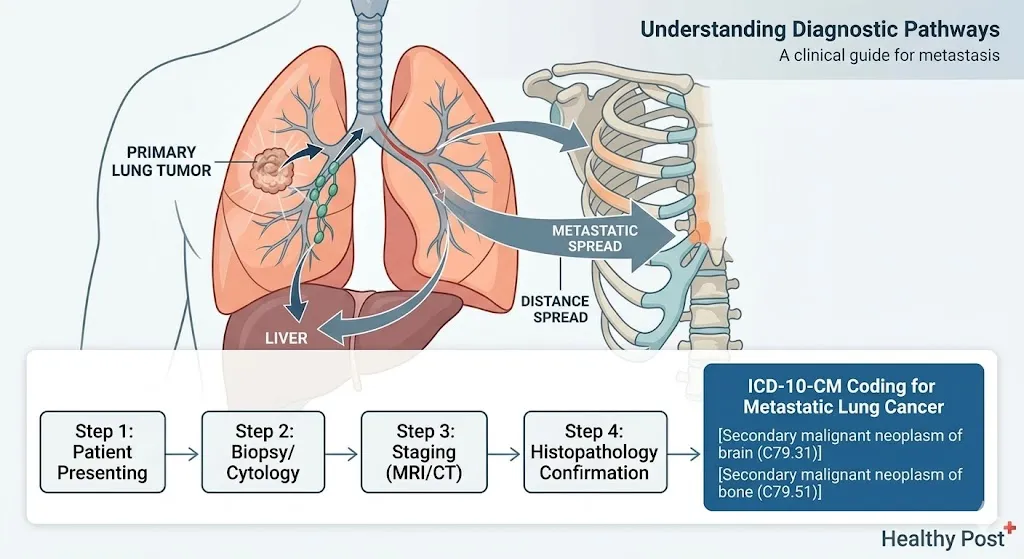
Metastatic lung cancer occurs when cancer cells spread from the primary lung tumor to other parts of the body through the bloodstream or lymphatic system. This advanced stage of lung cancer, also known as Stage IV lung cancer, creates secondary tumors in distant organs.
Common Metastatic Sites:
- Brain metastases affect 20-40% of lung cancer patients
- Bone lesions develop in 30-40% of cases
- Adrenal gland involvement occurs in 20-30% of patients
- Liver metastases present in 15-25% of diagnoses
The spread pattern of lung cancer varies based on the primary tumor’s characteristics. Non-small cell lung cancer tends to spread more slowly, while small cell lung cancer often spreads rapidly to multiple sites.
Clinical Impact:
- Reduced 5-year survival rates (less than 10%)
- Complex treatment requirements involving multiple specialists
- Need for targeted therapies based on metastatic locations
- Increased risk of complications
Treatment approaches shift from curative intent to life-prolonging strategies when metastases are present. Your medical team will develop a personalized treatment plan considering:
- Number and location of metastases
- Cancer cell type and genetic markers
- Your overall health status
- Available clinical trials
- Quality of life factors
2. Overview of ICD-10 Coding for Lung Cancer
The ICD-10 coding system serves as a standardized method to classify and track diseases across healthcare settings. For lung cancer, this system provides specific codes that capture detailed information about the disease’s location and characteristics.
Primary Lung Cancer Code Structure:
- C34: Base code for malignant neoplasms of bronchus and lung
- Fourth character (0-9): Identifies specific location
- Fifth character: Indicates laterality (right/left)
Location-Specific Codes:
- C34.0: Main bronchus
- C34.1: Upper lobe
- C34.2: Middle lobe
- C34.3: Lower lobe
- C34.8: Overlapping lesions
- C34.9: Unspecified parts
The coding system allows healthcare providers to document precise anatomical locations of lung tumors. A complete ICD-10 code includes five characters – for example, C34.12 represents a malignant neoplasm in the upper lobe of the left lung.
These codes play a vital role in:
- Treatment planning
- Insurance claims processing
- Medical research
- Healthcare data analytics
- Disease tracking
- Resource allocation
The specificity of ICD-10 codes helps healthcare providers maintain accurate medical records and ensures appropriate billing for services rendered. This level of detail supports better communication between healthcare providers and improves patient care coordination.
Moreover, the impact of ICD-10 on medical coding practices is significant, as it not only enhances the accuracy of coding but also streamlines various processes such as insurance claims and treatment planning. Additionally, studies have shown that the use of ICD-10 codes can significantly improve healthcare data analytics, providing valuable insights for medical research and resource allocation.
3. Specific ICD-10 Codes for Metastatic Lung Cancer
The ICD-10 coding system provides specific codes to identify metastatic lung cancer locations with precision. Here’s a breakdown of the essential codes:
1. Secondary Malignant Neoplasm Codes (C78 Series)
- C78.00: Secondary malignant neoplasm of unspecified lung
- C78.01: Secondary malignant neoplasm of right lung
- C78.02: Secondary malignant neoplasm of left lung
2. Common Metastatic Site Codes
- Brain metastasis: C79.31
- Bone metastasis: C79.51
- Adrenal gland metastasis: C79.71
- Liver metastasis: C78.7
- Lymph node metastasis: C77.0-C77.9
The laterality-specific codes enable healthcare providers to document the exact location of metastases. These codes must be used in combination with the primary site codes to create a complete diagnostic picture.
3. Example Code Combinations
- Primary right lung cancer with brain metastasis: C34.91 + C79.31
- Primary left lung cancer with bone metastasis: C34.92 + C79.51
- Bilateral lung involvement with adrenal metastasis: C34.90 + C79.71
These specific codes support accurate documentation, proper treatment planning, and appropriate insurance reimbursement. Healthcare providers must document both primary and secondary sites to ensure proper code assignment and patient care coordination.
4. Importance of Detailed Clinical Documentation for Accurate Coding
Precise clinical documentation is crucial for accurate ICD-10 coding in metastatic lung cancer cases. It forms the basis for selecting the correct code from the C34 series, which depends on specific details about the tumor location. Here’s what your documentation needs to include:
- Main bronchus involvement
- Upper lobe presence
- Middle lobe occurrence
- Lower lobe manifestation
- Overlapping lesions
Histology Type Documentation Requirements:
The distinction between non-small cell lung cancer (NSCLC) and small cell lung cancer (SCLC) affects both coding and treatment protocols. Your documentation should clearly specify:
- Adenocarcinoma
- Squamous cell carcinoma
- Large cell carcinoma
- Small cell carcinoma
- Mixed types
Laterality Documentation Specifics:
Accurate identification of affected sides is essential to avoid coding errors and claim denials. Your records must explicitly indicate:
- Right lung involvement
- Left lung involvement
- Bilateral presentation
- Specific lobe affected on each side
- Metastatic site laterality
Incomplete documentation can result in unspecified codes being used, which may impact treatment authorization and reimbursement. To support the chosen ICD-10 codes, healthcare providers should keep thorough progress notes, imaging reports, and pathology findings. This level of detail allows for precise monitoring of disease progression and promotes effective communication among healthcare team members.
5. Transition from ICD-9 to ICD-10 in Lung Cancer Coding
The shift from ICD-9 to ICD-10 brought significant improvements in lung cancer coding accuracy. ICD-10 introduced a comprehensive system with enhanced specificity that revolutionized how medical professionals document and track lung cancer cases.
Key differences between ICD-9 and ICD-10 for lung cancer coding include:
- Expanded Code Length: ICD-9 used 3-5 character codes, while ICD-10 uses 7 characters, allowing for greater detail
- Laterality Options: ICD-10 adds specific codes for right, left, and bilateral lung involvement
- Metastatic Site Precision: Detailed codes for various metastatic locations, compared to ICD-9’s limited options
The new classification system provides enhanced documentation capabilities:
- Anatomical SpecificityMain bronchus involvement
- Upper, middle, and lower lobe distinctions
- Overlapping lesions
- Multiple primary sites
- Metastatic Pattern RecordingPrecise secondary site documentation
- Multiple metastasis tracking
- Temporal progression patterns
These improvements directly impact patient care through:
- Better communication between healthcare providers
- More accurate disease tracking and surveillance
- Enhanced data collection for research purposes
- Improved treatment planning based on specific tumor characteristics
The detailed coding structure supports precise billing documentation and creates standardized data sets for clinical research, leading to more effective treatment protocols and improved patient outcomes.
6. Common Coding Errors and How to Avoid Them
Accurate ICD-10 coding for metastatic lung cancer requires attention to detail. Here are critical errors healthcare providers need to watch for:
Primary vs. Metastatic Cancer Confusion
- Using C34 codes for metastatic sites instead of C78/C79 series
- Failing to code both primary and secondary sites
- Incorrect sequencing of primary and secondary diagnoses
Documentation Pitfalls
- Missing laterality specifications (right vs. left lung)
- Incomplete histological information
- Lack of documented metastatic sites
Unspecified Code Issues
- Defaulting to C34.90 (unspecified lung cancer) when specific location is known
- Using generic metastasis codes when detailed information exists
- Applying C80.0 (metastatic disease) without identifying specific sites
Best Practices for Accurate Coding
- Review complete patient history before code assignment
- Verify tumor location and spread through imaging reports
- Document specific histological type (NSCLC vs. SCLC)
- Include all relevant metastatic sites with appropriate C78/C79 codes
- Maintain detailed progress notes supporting code selection
- Request clarification from physicians when documentation is unclear
Prevention Strategies
- Implement regular coding audits
- Create standardized documentation templates
- Establish physician query protocols
- Schedule periodic coder training sessions
- Use coding validation software
Following these guidelines helps ensure proper reimbursement and maintains data accuracy for patient care coordination.
7. Role of ICD-10 Coding in Multidisciplinary Treatment Planning and Prognosis Assessment
Accurate ICD-10 coding establishes a common language that facilitates smooth communication among various medical specialties involved in the treatment of metastatic lung cancer. This shared understanding has a direct influence on the quality of patient care and the results of treatment.
Treatment Decision Support
- ICD-10 codes provide critical data points for tumor boards when developing personalized treatment plans
- Specific codes help identify suitable clinical trials based on cancer type and stage
- Coded information guides radiation oncologists in targeting precise anatomical locations
Disease Progression Tracking
- Sequential ICD-10 codes create a timeline of disease advancement
- Changes in coded metastatic sites help measure treatment effectiveness
- Documented progression patterns support survival rate predictions
Care Team Coordination
- Radiologists use codes to align imaging protocols with specific cancer types
- Surgeons rely on coded anatomical details for surgical planning
- Oncologists track treatment responses through standardized code documentation
- Palliative care teams utilize coded data to time appropriate interventions
The structured nature of ICD-10 coding enables healthcare providers to:
- Access complete patient histories instantly
- Make data-driven treatment modifications
- Share critical information across institutions
- Monitor treatment effectiveness systematically
This standardized approach to documenting metastatic lung cancer creates a robust framework for coordinated care delivery and outcome assessment across multiple specialists and healthcare settings.
Moreover, the integration of technology into healthcare, such as through digital health platforms, is further enhancing the utility of ICD-10 coding. These platforms enable more efficient data management and sharing, ultimately leading to improved patient outcomes. Additionally, research indicates that the implementation of ICD-10 coding can significantly improve patient care by providing a comprehensive framework for tracking and managing complex health conditions like metastatic lung cancer.
8. Implications for Insurance Claims and Medical Research
Precise ICD-10 coding plays a critical role in insurance claims processing for metastatic lung cancer treatments. Insurance providers require specific documentation to approve coverage for:
- Advanced imaging studies
- Targeted therapies
- Immunotherapy treatments
- Radiation procedures
- Surgical interventions
Accurate coding directly impacts reimbursement rates and claim approvals. When healthcare providers submit claims with incorrect or incomplete ICD-10 codes, insurance companies often deny coverage, leading to:
- Delayed treatments
- Additional administrative work
- Increased healthcare costs
- Patient financial burden
- Extended billing cycles
The impact of ICD-10 coding extends beyond individual patient care into medical research. Research institutions and epidemiologists rely on coded data to:
- Track disease patterns
- Identify treatment effectiveness
- Study population health trends
- Analyze survival rates
- Develop new therapeutic approaches
Large-scale medical studies use ICD-10 coded data to examine:
- Geographic distribution of lung cancer cases
- Treatment response rates
- Metastatic patterns
- Comorbidity associations
- Healthcare resource utilization
These research findings shape clinical guidelines, influence treatment protocols, and guide healthcare policy decisions. The standardized nature of ICD-10 codes enables researchers to analyze data across different healthcare systems and countries, creating a robust foundation for advancing lung cancer treatment strategies.
9. Ongoing Updates to ICD-10 Codes Reflecting Advances in Lung Cancer Classification
The ICD-10 coding system continues to evolve alongside rapid advancements in lung cancer diagnosis and treatment. Recent updates have introduced specific codes that reflect biomarker-based classifications, enabling healthcare providers to document molecular testing results with greater precision.
Key Biomarker-Based Updates:
- EGFR mutation status coding
- ALK gene rearrangement documentation
- PD-L1 expression level classification
- ROS1 and BRAF mutation identification
The integration of immunotherapy treatments has prompted new coding requirements. Healthcare providers now document immune checkpoint inhibitor usage and responses through specialized codes, enhancing treatment tracking and outcomes analysis.
Recent Code Modifications Include:
- Tumor mutation burden (TMB) status
- Microsatellite instability (MSI) testing results
- Treatment response markers
- Adverse event documentation specific to immunotherapy
These updates demand continuous education for medical coders and clinicians. Healthcare facilities implement regular training programs to maintain coding accuracy and compliance with evolving standards. The complexity of metastatic lung cancer ICD-10 coding requires:
- Monthly guideline reviews
- Regular coding audits
- Documentation improvement initiatives
- Cross-departmental communication protocols
The dynamic nature of lung cancer classification drives ongoing ICD-10 code refinements. Medical facilities adapt their coding practices to incorporate emerging diagnostic criteria and treatment modalities, ensuring accurate representation of patient care in medical records.
Conclusion
Accurate ICD-10 coding for metastatic lung cancer is crucial for effective healthcare delivery. Choosing the right codes from the C34 series for primary tumors and C78/C79 series for metastases has a direct impact on:
- Patient Care Quality
- Enables seamless communication between healthcare providers
- Supports accurate treatment planning
- Facilitates proper disease progression monitoring
- Revenue Cycle Management
- Reduces claim denials
- Streamlines reimbursement processes
- Maintains compliance with billing requirements
- Research Advancement
- Creates reliable datasets for clinical studies
- Supports epidemiological research
- Drives evidence-based practice improvements
The success of coding for metastatic lung cancer relies on detailed clinical documentation. Healthcare providers must document specific tumor locations, histological types, laterality, and metastatic sites. This level of detail empowers coding professionals to select the most appropriate ICD-10 codes.
Medical facilities can improve their coding practices by:
- Implementing regular staff training
- Maintaining updated coding resources
- Conducting periodic documentation audits
- Fostering communication between clinicians and coders
Proper ICD-10 coding goes beyond administrative tasks – it is a vital tool in delivering optimal patient care, securing appropriate reimbursement, and advancing medical knowledge in the fight against metastatic lung cancer.
FAQs (Frequently Asked Questions)
What is metastatic lung cancer and why is accurate ICD-10 coding important for its diagnosis?
Metastatic lung cancer refers to lung cancer that has spread from the primary site to other parts of the body, such as the brain, bone, or adrenal glands. Accurate ICD-10 coding is crucial for precise diagnosis, effective management, treatment planning, and ensuring proper documentation for clinical care and insurance purposes.
How does the ICD-10 coding system classify primary and metastatic lung cancers?
The ICD-10 system uses C34 codes to classify primary malignant neoplasms of the bronchus and lung, differentiated by tumor location within the lung (e.g., main bronchus, upper lobe). Metastatic lung cancers are coded under secondary malignant neoplasm codes in the C78 series, with specific codes indicating metastases to lungs (C78.00-C78.02), brain (C79.31), bone (C79.51), and adrenal glands (C79.71).
Why is detailed clinical documentation essential for accurate metastatic lung cancer coding?
Detailed clinical documentation including precise tumor location, histology type (such as non-small cell or small cell lung cancer), and laterality (right vs left) is necessary to select the correct ICD-10 code. This accuracy supports appropriate treatment decisions, prognosis assessment, and reduces errors in medical records and billing.
What are common coding errors in metastatic lung cancer diagnosis and how can they be avoided?
Common errors include confusing primary versus metastatic cancers during coding and overusing unspecified or generic codes without sufficient clinical detail. These mistakes can lead to claim denials and compliance issues. To avoid them, coders should rely on comprehensive clinical documentation and adhere strictly to ICD-10 guidelines for specificity.
How has the transition from ICD-9 to ICD-10 improved lung cancer coding?
ICD-10 offers enhanced specificity compared to ICD-9 by including more detailed classifications related to tumor location within the lung and metastasis sites. This update improves clinical care coordination, data accuracy, reimbursement processes, and facilitates better tracking of disease progression.
What role does accurate ICD-10 coding play in multidisciplinary treatment planning and medical research for metastatic lung cancer?
Accurate ICD-10 coding supports effective treatment decision-making among oncologists, radiologists, surgeons, and other healthcare providers by providing clear information on disease extent. It also aids prognosis assessment, insurance claims processing for reimbursement accuracy, reduces claim denials, and contributes valuable data for large-scale medical research and epidemiological studies.