

Clinical Authorship & Musculoskeletal Notice: This orthopedic guide analyzing why does my knee click but no pain has been written by Dr. Himanshu Gupta (Orthopedics & Robotics, Amicare Hospital ↗) to ensure accurate mechanical and anatomical context.
Disclaimer: The medical research, anatomical breakdowns, and preventative exercises detailed below are intended strictly for educational and general informational purposes. Asymptomatic knee crepitus is highly common and predominantly benign, meaning it rarely serves as a standalone indicator of joint damage or early-onset arthritis. This content cannot replace a formal physical examination, diagnostic imaging, or an individualized orthopedic consultation. Always consult a primary care physician, physical therapist, or orthopedic specialist for persistent joint tracking issues or if clicking is accompanied by physical discomfort.

🏥 Medical Review Board Member
Dr. Himanshu Gupta
Orthopedic Specialist | Amicare Hospital (Ghaziabad, India)
Dr. Himanshu Gupta is a distinguished medical professional with over 20 years of expertise in orthopedics and joint replacement surgery. As the Chief Orthopedic and Director at Amicare Hospital, he specializes in advanced robotic-assisted procedures and sports injury management, dedicated to enhancing mobility and quality of life for his patients. Dr. Gupta is committed to bridging the gap between complex surgical clinical practice and accessible, evidence-based patient education. His rigorous approach to medical oversight ensures that every piece of content he reviews meets the highest standards of clinical accuracy, safety, and reliability.
You are walking up a quiet flight of stairs, bending down to pick up a dropped pen, or descending into a deep squat at the gym when you hear it: a loud, distinct pop, snap, or crunch echoing from your joint. Your immediate reaction is likely a mix of surprise and anxiety. You pause, wait for the ache to set in, but nothing happens. Naturally, you find yourself typing a very specific question into a search engine: why does my knee click but no pain?
If you are reading this, take a deep breath and relax. The primary intent of this article is reassurance. You are not alone, your joints are likely not wearing out, and you are probably not developing early-onset arthritis.
In the medical community, these joint noises—encompassing popping, snapping, grinding, and cracking—are grouped under the umbrella term knee crepitus (derived from the Latin word crepare, meaning “to rattle” or “to crack”). The golden rule of orthopedics regarding joint noise is simple: if there is no pain, there is usually no problem.
In this comprehensive guide, we will explore the fascinating anatomical reasons behind painless knee clicking, identify the rare red flags that actually warrant a doctor’s visit, and provide actionable, physical therapy-backed strategies on how to stop knee clicking by optimizing your joint health.
The Anatomy of the Sound: Why Knees Click Without Pain
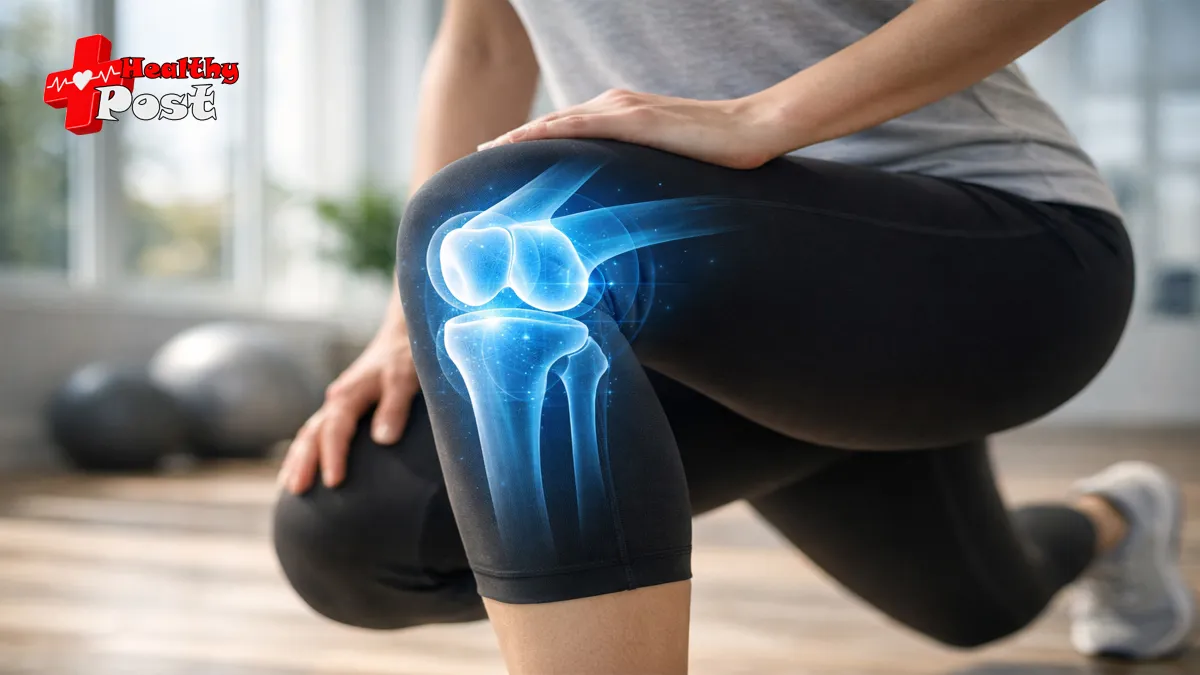
To understand why your knee sounds like a bowl of Rice Krispies, we have to look at the complex biomechanics of the joint. The human knee is a marvel of engineering, acting as a hinge joint where the femur (thigh bone), tibia (shin bone), and patella (kneecap) meet.
When you experience why does my knee click but no pain, it is typically driven by one of two completely harmless physiological mechanisms.
1. Cavitation (The Gas Bubble Release)
The most common cause of a sudden, loud pop in the knee is a process called cavitation. Your knee joint is encapsulated and filled with synovial fluid, a thick, viscous liquid that lubricates the cartilage and provides nutrients to the joint.
Over time, microscopic bubbles of nitrogen gas naturally accumulate within this synovial fluid. When you bend or straighten your knee, the pressure inside the joint capsule changes rapidly. This sudden pressure shift causes the nitrogen gas bubbles to rapidly collapse or burst, creating an audible pop.
This is the exact same mechanism that occurs when you crack your knuckles. You may notice that once your knee pops in this manner, you cannot immediately make it pop again. This is because it takes roughly 20 minutes for the nitrogen gases to dissolve back into the synovial fluid and form new bubbles.
2. Soft Tissue Slipping and Snapping
If your knee clicking is repetitive—meaning you can recreate the sound every time you bend and straighten your leg—it is likely caused by soft tissue slipping.
Your knee is surrounded by a dense network of tendons and ligaments that act like tight rubber bands. As the joint moves through its range of motion, these thick bands of tissue glide over bony prominences, such as the femoral condyles (the rounded ends of the thigh bone). Occasionally, a tendon may shift slightly out of its normal track. When the knee straightens, the tendon snaps cleanly back into its proper place, creating a sharp, painless clicking sound.
Structural Variations: When “No Pain” Still Warrants Attention
Even when completely free of discomfort, knee popping no pain can sometimes be linked to benign anatomical variations. While these do not require surgery or panic, understanding them can help you better manage your joint health.
3. Synovial Plica Syndrome (Benign Friction)
During fetal development, the knee joint is divided into three separate compartments by thin membranes. As we grow, these membranes typically dissolve, leaving a single, unified joint capsule. However, in about 50% of the population, remnants of these membranes remain. These folds of tissue are called plicae.
If you have a naturally thicker synovial plica, it can repeatedly catch, flick, or rub across the femur during deep knee bends. This creates a distinct, repetitive clicking sensation. As long as the plica does not become inflamed (which would cause pain), this is a harmless anatomical quirk.
4. Asymmetrical Patellar Tracking
The patella (kneecap) is designed to glide smoothly up and down within a specific groove on the femur called the trochlear groove. However, if you have minor muscular imbalances—specifically between the inner and outer quadriceps muscles—the kneecap may be pulled slightly off-center.
This is known as asymmetrical patellar tracking (note: “tracking” here refers to orthopedic biomechanics, not GPS or digital tracking). When the kneecap rubs against the edge of the femoral groove, it causes mechanical clicking. While this is a common cause of painless knee clicking, it is worth addressing through exercise to prevent future wear and tear on the cartilage.
5. Normal Aging and Mild Cartilage Changes
As we age, the thick, smooth articular cartilage that covers the ends of our bones naturally loses some of its water content and becomes slightly fibrillated (frayed). This is a normal part of human aging, much like getting wrinkles on your skin. These microscopic rough patches can cause a soft, grinding form of knee crepitus when they rub together. Without pain, this is simply the sound of a joint that has lived a full, active life.
The Psychological Trap: Fear-Avoidance and Joint Noise
Before we discuss red flags and treatments, we must address a massive blind spot in joint health: the psychological impact of knee crepitus.
Many people who ask, “why does my knee click but no pain?” fall victim to the “fear-avoidance model.” They assume that noise equals damage. Believing their joints are fragile or crumbling, they stop squatting, stop running, and avoid taking the stairs.
This is the worst thing you can do.
Cartilage does not have its own blood supply; it relies on movement to absorb nutrients from the synovial fluid, much like a sponge soaking up water. Furthermore, resting too much causes the muscles surrounding the knee (the quadriceps, hamstrings, and glutes) to atrophy and weaken. When these muscles weaken, the knee loses its structural support, patellar tracking worsens, and the clicking actually becomes louder and more frequent.
Movement is medicine. Unless accompanied by pain, joint noise should never be a reason to stop exercising.
4 Red Flags: When to Pivot from Reassurance to Medical Evaluation
While we have established that knee popping no pain is generally harmless, the knee is a complex mechanical structure. A transition from normal, benign joint mechanics to a structural pathology is marked by accompanying physical signs rather than the volume or frequency of the sound.
Immediate medical evaluation by an orthopedic specialist or a physical therapist is required if your clicking is accompanied by any of the following four red flags:
1. Localized Swelling or Stiffness
If your knee clicks and subsequently swells, it indicates joint effusion (fluid buildup) or active inflammation. Swelling is the body’s natural response to internal trauma, suggesting that the clicking may be irritating the joint lining or that there is underlying cartilage damage, such as early osteoarthritis.
2. Catching or True Locking
There is a distinct difference between a knee that clicks and a knee that physically jams. If your knee catches, locks, or feels like there is a mechanical block preventing you from fully straightening your leg, this is a major red flag. This often signals a structural blockage, such as a displaced meniscus tear (a tear in the shock-absorbing cartilage) or a “loose body” (a small fragment of bone or cartilage floating in the joint space).
3. Instability or “Giving Way”
If the pop or click is followed by a sensation that the knee is buckling, collapsing, or “giving way” beneath you, this points to ligamentous laxity or severe muscle inhibition. This is common in injuries to the Anterior Cruciate Ligament (ACL) or severe patellar instability.
4. Traumatic Onset
Context matters. If you have had clicking knees for ten years, it is likely benign. However, if you experience a loud pop that initiates immediately following an acute impact, a sudden twisting motion on the soccer pitch, or a fall, you must seek medical attention. Traumatic pops are highly correlated with acute ligament tears or fractures.
Proactive Joint Management: How to Stop Knee Clicking
If you have ruled out the red flags and are simply annoyed by the sound, you might be wondering how to stop knee clicking. While benign crepitus does not require clinical treatment or surgery, you can actively minimize the mechanical friction causing the noise by optimizing your joint mechanics.
Here are three highly effective, physical therapy-backed strategies:
1. Targeted VMO (Vastus Medialis Obliquus) Strengthening
The quadriceps consist of four distinct muscles. The Vastus Medialis Obliquus (VMO) is the teardrop-shaped muscle located on the inner thigh, just above the kneecap. Its primary job is to pull the kneecap inward, counteracting the strong outward pull of the outer thigh muscles.
If your VMO is weak, the kneecap tracks too far to the outside, causing clicking.
- Actionable Exercise: Terminal Knee Extensions (TKEs) using a resistance band, or slow, controlled step-downs focusing on keeping the knee aligned over the second toe.
2. Kinetic Chain Stabilization (Hips and Ankles)
The knee is a “dumb joint”—it only does what the hip and ankle tell it to do. If you have weak hip abductors (specifically the gluteus medius) or poor ankle mobility, your knee will naturally collapse inward (a movement called valgus stress) during functional movements like walking, running, or squatting. This inward collapse drastically alters tendon alignment, leading to snapping and popping.
- Actionable Exercise: Clamshells, lateral band walks, and single-leg Romanian deadlifts (RDLs) to build robust gluteal strength.
3. Soft Tissue Mobilization
If your muscles are chronically tight, they pull the tendons taut across the bones, increasing the likelihood of that “snapping rubber band” effect. The Iliotibial (IT) band, a thick fascia running down the outside of the thigh, is a notorious culprit for lateral knee clicking.
- Actionable Exercise: Use a foam roller or massage gun on the lateral quadriceps, hamstrings, and calves. (Note: Avoid rolling directly over the IT band itself, as it is highly fibrous; instead, roll the muscles surrounding it to relieve tension).
The Future of Diagnosis: Dynamic Diagnostic Ultrasound
If you visit a doctor asking, “why does my knee click but no pain?” they will likely order a static X-ray or an MRI. While these are excellent tools for ruling out fractures or tumors, they have a major blind spot: they are static. You are lying perfectly still inside a tube.
Because clicking only happens during movement, static imaging often shows absolutely nothing wrong.
To bridge this gap, modern physical therapists and sports medicine physicians are increasingly utilizing Dynamic Diagnostic Ultrasound. This technology allows the clinician to place an ultrasound probe on your knee while you actively squat, bend, and move. It allows them to visualize the exact tendon snapping over the bone or the precise moment a gas bubble cavitates in real-time. This dynamic approach provides unparalleled clarity, proving to the patient exactly what is causing the noise and reinforcing that the joint is structurally sound.
📝 FAQ Section Content
Q1: Is it normal for my knee to click if there is no pain?
A: Yes, painless knee clicking (known clinically as knee crepitus) is incredibly common and usually entirely harmless. In most cases, the sound is simply caused by benign mechanical processes, such as gas bubbles bursting in your joint fluid or a tendon gently shifting and snapping over a bony ridge during movement.
Q2: Can knee clicking when bending without pain lead to arthritis?
A: No, there is no clinical evidence showing that asymptomatic or painless knee clicking is a predictor of future joint degeneration or osteoarthritis. Joint noise only becomes a concern if it is accompanied by structural symptoms like pain, swelling, or heat, which indicate active tissue damage or inflammation.
Q3: How can I stop my knees from clicking?
A: While harmless crepitus doesn’t require medical treatment, you can minimize the sound by optimizing your joint tracking. Focus on exercises for clicking knees that strengthen the quadriceps (specifically the inner VMO muscle) and glutes. Keeping your joints lubricated through low-impact movement and foam rolling tight surrounding muscles will also reduce tendon friction.
Q4: When should I see a doctor for knee clicking?
A: You should transition from reassurance to medical evaluation if the clicking begins immediately after a sudden injury or traumatic impact. Other critical red flags that require an orthopedic evaluation include visible localized swelling, joint stiffness, a feeling of instability where the knee gives way, or physical catching and locking.
Conclusion
The human body is a noisy machine. Just as a house settles and creaks with temperature changes, our joints pop, snap, and grind as we move through life.
If you find yourself constantly wondering, “why does my knee click but no pain?”, let the absence of pain be your ultimate comfort. Whether it is the rapid release of nitrogen gas bubbles (cavitation), a tendon snapping back into place, or a slightly thick synovial plica, these sounds are overwhelmingly benign.
Do not let the fear of joint noise keep you on the couch. By staying active, strengthening your VMO and glutes, and maintaining good soft tissue mobility, you can improve your patellar tracking and potentially quiet the clicking. Remember: a noisy knee is usually a healthy knee, provided it moves freely and painlessly. Keep moving, keep strengthening, and leave the anxiety behind.
5 Comments
Pingback: Radial Tunnel Syndrome: Symptoms, Diagnosis, and 2026 Treatment Guidelines -
Pingback: Knee Support Meniscus Injury: Best Braces and Recovery Guide
Pingback: Top 5 Mistakes After Knee Replacement: Critical Errors to Avoid
Pingback: Safe Knee Exercises for Arthritis: Relief, Stretches & Movement
Pingback: Knee Buckling: Causes, Symptoms, Treatment & When to See a Doctor