


Widowmaker Heart Attack: Symptoms, Causes, and Emergency Survival Guide
Written and Vetted by: Dr. Sarita Rao, FACC, FESC (Senior Interventional Cardiologist, Apollo Hospitals, Indore, India) | Published: August 2026
Medical Disclaimer: This article is for informational, educational, and awareness purposes only and does not constitute professional medical advice, emergency triage, diagnosis, or treatment. A widowmaker heart attack (caused by a critical left anterior descending artery blockage) is a life-threatening medical emergency. To learn more about our clinical verification standards, visit our Author Profile.
🚨 Emergency Warning: If you or someone nearby experiences sudden crushing chest pressure, shortness of breath, pain radiating to the jaw or left arm, cold sweats, or dizziness, do not wait or drive yourself. Call emergency services (911 or your local emergency number) immediately. Time is muscle—immediate professional intervention is required.

🏥 Medical Review Board Member
Dr. Sarita Rao, FACC, FESC
Senior Interventional Cardiologist | Apollo Hospitals (Indore, India)
Dr. Sarita Rao, FACC, FESC, is a renowned Senior Interventional Cardiologist with over 25 years of distinguished clinical experience in advanced cardiac sciences. Widely recognized as the first female Interventional Cardiologist in Central India, her commitment to evidence-based medicine ensures the highest standards of heart health tracking, diagnostic accuracy, and patient safety.
A widowmaker heart attack is one of the most dangerous cardiac emergencies a person can experience. It happens when blood flow through a major artery on the front of the heart is suddenly blocked. The result can be swift, severe, and sometimes fatal without immediate treatment. In our medical editorial work, we repeatedly see one truth confirmed: fast recognition saves heart muscle, and often saves lives.
The term sounds dramatic. Medically, it usually refers to a severe LAD heart attack (Left Anterior Descending artery), often presenting as an Anterior STEMI. That means the artery feeding a large portion of the heart’s main pumping chamber has become critically obstructed. If you have ever asked, what is a widow maker heart attack, the short answer is this: it is a major heart attack caused by a sudden, often complete blockage coronary artery event in the LAD, cutting off oxygen to a large area of heart muscle.
This guide explains the warning signs, how the blockage happens, why timing matters so much, and what to do in the first minutes of an emergency.
1. What is a widow maker heart attack?
A widowmaker is not a separate disease. It is a nickname for a very serious type of heart attack involving the LAD artery.
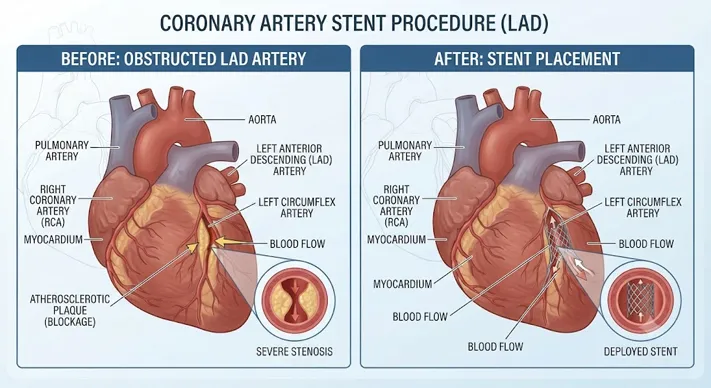
The Left Anterior Descending artery runs down the front of the heart and supplies a large part of the left ventricle, the chamber that pumps oxygen-rich blood to the body. Because this artery feeds such an important area, a blockage here can quickly damage heart muscle and trigger life-threatening rhythm problems.
In clinical practice, when we review angiograms from patients with large anterior heart attacks, the pattern is often striking. A single obstruction in the LAD can explain why someone went from mild discomfort to collapse in a short period.
A widowmaker event is often associated with:
- Sudden closure of the LAD
- Large area of heart muscle at risk
- High sudden cardiac arrest risk
- Urgent need for emergency cardiac catheterization
- Rapid treatment with percutaneous coronary intervention (PCI) and possible coronary stent placement
It can affect men and women. It can happen in older adults, but also in younger people with smoking history, uncontrolled cholesterol, diabetes, or a strong family history of early heart disease.
2. Why the LAD artery matters so much
The LAD is often described as the heart’s main highway. That is not an exaggeration.
Here is why this artery is so critical:
- It supplies a major portion of the front wall of the heart
- It helps nourish the left ventricle, the heart’s main pump
- It supports circulation to the septum, the wall dividing the heart’s chambers
- A total blockage can impair the heart’s ability to pump blood effectively
This is why a widowmaker heart attack can be so devastating. When the LAD is blocked, the heart muscle may begin to die within minutes. The longer the artery remains closed, the larger the injury.
Some readers confuse this with left main coronary artery disease. They are not identical. Left main disease involves a different major artery higher up in the coronary tree and can also be extremely dangerous. But a widowmaker usually refers specifically to a severe LAD blockage, especially a proximal one near the start of the vessel.
3. What causes a complete blockage coronary artery event?
In most cases, the underlying cause is atherosclerotic plaque buildup.
This usually develops over years. Fat, cholesterol, inflammatory cells, and calcium collect inside the artery wall. Over time, this plaque may narrow the vessel. Then one day, the surface of the plaque can rupture.
When that happens, the body treats it like an injury. Platelets rush in. A clot forms rapidly. If the clot seals the artery completely, blood flow stops. That is the classic mechanism behind a myocardial infarction treatment emergency.
The process often looks like this:
- Plaque slowly builds in the artery wall
- The plaque becomes unstable
- It ruptures or erodes
- A blood clot forms suddenly
- The artery becomes 100% blocked
- Heart muscle is starved of oxygen
Common risk factors include:
- High LDL cholesterol
- High blood pressure
- Smoking
- Diabetes
- Obesity
- Sedentary lifestyle
- Chronic kidney disease
- Family history of early coronary disease
- Long-term inflammatory conditions
Stress alone does not usually create plaque overnight. But intense physical or emotional stress may contribute to plaque rupture in someone already at risk.
4. Symptoms of a widowmaker heart attack
The Symptoms of a widowmaker heart attack are often similar to those of other major heart attacks. You cannot reliably tell which artery is blocked based on symptoms alone. But the warning signs should never be ignored.
Common symptoms include:
- Heavy chest pressure, squeezing, or fullness
- Pain in the center or left side of the chest
- Pain spreading to the arm, both arms, back, neck, shoulder, or jaw
- Sudden shortness of breath
- Cold sweat
- Nausea or vomiting
- Dizziness or faintness
- Unusual fatigue, especially in women
- A sense that “something is very wrong”
Some people do not describe “pain.” They describe crushing pressure, burning, or tightness. Others, especially women, older adults, and people with diabetes, may present with less typical symptoms such as nausea, breathlessness, or profound exhaustion.
⚡ Quick Symptom Guide
If symptoms last more than a few minutes, or come and go, call emergency services right away.

5. What to do in the first minutes: an emergency survival guide
If you suspect a widowmaker heart attack, do not wait to see if it passes.
Take these steps:
- Call 911 or your local emergency number immediately.
Do not drive yourself if symptoms are severe. - Stop activity and sit or lie down.
Rest reduces strain on the heart. - Chew aspirin if advised and if not allergic.
In many emergency protocols, chewing a standard aspirin may help reduce clotting while help is on the way. If you have been told not to take aspirin, follow your clinician’s advice. - Unlock the door and prepare for responders.
Keep your phone nearby. - If the person collapses and is not breathing normally, start CPR.
Use an AED if available.
In hospital settings, the next steps often include an ECG, blood tests, oxygen assessment, heart rhythm monitoring, and urgent transfer for emergency cardiac catheterization. If a blocked LAD is found, doctors usually move quickly to reopen it using percutaneous coronary intervention (PCI), often with coronary stent placement.
This is why emergency transport matters. Ambulance teams can begin care early and alert the hospital before arrival.
For readers trying to understand treatment after recovery, related site resources such as How Do You Know If a Heart Stent Is Blocked Again and Risks of Coronary Stent Surgery can help frame the questions many patients ask after discharge.
6. How hospitals treat a widowmaker
Once a patient arrives, speed becomes everything. Most studies agree that faster reopening of the artery improves survival and reduces long-term damage.
Typical hospital treatment may include:
- ECG to detect STEMI patterns
- Blood tests for cardiac enzymes
- Antiplatelet drugs
- Anticoagulants
- Nitroglycerin in selected cases
- Pain control
- Oxygen if levels are low
- Urgent cardiac cath lab transfer
The gold-standard treatment for most eligible patients is percutaneous coronary intervention (PCI). A cardiologist threads a catheter through an artery, reaches the blockage, opens it with a balloon, and often places a stent to keep the vessel open.
If PCI is not immediately available, clot-busting medicines may be considered in some settings. But primary PCI is generally preferred when it can be performed quickly.
This is modern myocardial infarction treatment at its most time-sensitive. The phrase clinicians often use is simple: time is muscle.
7. Widowmaker heart attack survival rate: what the numbers really mean
Many people search for the Widowmaker heart attack survival rate because they want a clear answer. The reality is more nuanced.
Survival depends on:
- How quickly emergency care begins
- Whether cardiac arrest occurs before hospital arrival
- The exact location of the blockage
- How much heart muscle is affected
- Age and existing health conditions
- Access to a PCI-capable hospital
Out of hospital, the risk is high, especially if the first event is sudden cardiac arrest. But survival improves dramatically when people call emergency services quickly and receive prompt intervention.
In broad terms:
- Survival is far lower when a complete LAD blockage causes collapse before medical help arrives
- Survival is much better when the artery is opened quickly in hospital
- Long-term outcomes can be very good with medication, rehabilitation, and risk-factor control
In our review of patient recovery patterns, those who enter cardiac rehabilitation, stop smoking, take antiplatelet therapy and statins as prescribed, and manage blood pressure and diabetes often do far better than they initially expect.
That is an important message. A widowmaker heart attack is terrifying. It is not always fatal. Many survivors return to meaningful, active lives.
8. Recovery after the crisis
Recovery does not end with a stent. It begins there.
After discharge, the care plan often includes:
- Dual antiplatelet therapy
- Statin medication
- Beta blockers or ACE inhibitors, depending on clinical needs
- Cardiac rehabilitation
- Gradual return to activity
- Dietary changes
- Stress management
- Smoking cessation
- Follow-up imaging or testing when appropriate
Patients often ask how to tell whether they are healing normally or developing new trouble. That is where education matters. Topics such as warning signs after angioplasty, cardiac rehab after heart attack, cholesterol lowering after PCI, and managing chest pain after stent placement are common follow-up needs and worth discussing with your care team.
9. Can a widowmaker be prevented?
Not every event is preventable. But many can be made less likely.
Prevention focuses on reducing plaque formation and making plaques less likely to rupture.
Key steps include:
- Do not smoke
- Know your blood pressure
- Control LDL cholesterol
- Manage diabetes carefully
- Exercise regularly
- Eat a heart-healthy diet
- Maintain a healthy weight
- Sleep well
- Take prescribed medicines consistently
- Do not ignore new chest symptoms
For some people, especially those with strong family history or multiple risk factors, clinicians may recommend deeper evaluation. That may include stress testing, coronary calcium scoring, or specialist review.
If you already have coronary artery disease, prevention becomes even more specific. Follow-up questions about How Do You Know If a Heart Stent Is Blocked Again should be discussed early, not only after symptoms return.
FAQs
1. What is a widow maker heart attack in simple terms?
It is a severe heart attack caused by a major blockage in the LAD artery, which supplies a large part of the heart’s main pumping chamber.
2. Are the symptoms of a widowmaker heart attack always dramatic?
No. Some people have crushing chest pain, but others have shortness of breath, nausea, jaw pain, or sudden fatigue. Women and older adults may present less typically.
3. Is a widowmaker always fatal?
No. It is extremely dangerous, but fast treatment can be lifesaving. Survival improves greatly with rapid ambulance response and urgent PCI.
4. What should I do first if I suspect one?
Call emergency services immediately. Do not drive yourself if symptoms are severe. If the person becomes unresponsive and is not breathing normally, begin CPR.
5. How is a LAD heart attack treated?
A LAD heart attack (Left Anterior Descending artery) is usually treated with urgent catheter-based reopening of the artery, most often through percutaneous coronary intervention (PCI) and stent placement.
6. Can a stent fix the problem completely?
A stent can reopen the blocked artery, but long-term protection also depends on medicines, cardiac rehab, and controlling risk factors. That is why articles like Risks of Coronary Stent Surgery and How Do You Know If a Heart Stent Is Blocked Again are useful follow-up reads.
Conclusion
A widowmaker heart attack is a medical emergency built on one dangerous fact: a major artery supplying the heart becomes suddenly blocked, starving a large area of muscle of oxygen. The symptoms may include chest pressure, radiating pain, breathlessness, sweating, nausea, or sudden collapse. The cause is often atherosclerotic plaque buildup followed by clot formation and a complete blockage coronary artery event.
The most important takeaway is simple. Act fast. Call emergency services. Early diagnosis, emergency cardiac catheterization, and coronary stent placement can dramatically improve outcomes. If you have risk factors for coronary disease, now is the time to review them with a clinician, not after a crisis.
For readers building a fuller picture of recovery and long-term heart health, related topics such as cardiac rehab after heart attack, warning signs after angioplasty, How Do You Know If a Heart Stent Is Blocked Again, and Risks of Coronary Stent Surgery can help guide the next conversation with your medical team.
References
- American Heart Association heart attack warning signs
- NHS heart attack
- MedlinePlus coronary angioplasty and stent placement