


🏥 Medical Review Board Member
Dr. Michelle Uzor, MD
Board-Certified Obstetrician-Gynecologist | Southern Crescent Women’s HealthCare
Dr. Michelle Uzor, MD, is a board-certified Obstetrician-Gynecologist with extensive clinical experience dedicated to comprehensive women’s healthcare, obstetrics, and reproductive medicine. Practicing with Southern Crescent Women’s HealthCare, she is committed to providing evidence-based patient guidance and clinical oversight. Dr. Uzor ensures that every piece of women’s health content she reviews meets the highest standards of medical accuracy, safety, and clinical integrity.
Ask a group of mothers whether a C-section or a vaginal birth hurts more and you will hear confident answers in both directions. The question is hard to settle because the answer changes depending on when you measure. In the C-section vs vaginal delivery pain debate, an unmedicated vaginal birth usually hurts more during delivery, while the days and weeks afterward are usually harder after a C-section. When both births are uncomplicated, the research points to a faster and easier physical recovery after vaginal delivery. A difficult vaginal birth, though, can leave someone sorer than a smooth planned C-section.
This guide separates the stages, explains what recovery tends to look like, and covers what helps. It is general information, not a substitute for advice from your own midwife or obstetrician.
Two Different Kinds of Pain: During Birth and Afterward
It helps to treat childbirth pain and postpartum pain as separate experiences. Someone can have an intense labor and a gentle recovery, or a painless surgery and a difficult recovery.
Pain during a vaginal delivery
Labor pain comes mainly from the uterus contracting, from pressure as the baby descends, and from stretching of the vagina and perineum (the tissue between the vaginal opening and the anus). Contractions build in strength and frequency, and intensity varies a great deal between people. Some experience pain well before labor begins. Sharp, fleeting pelvic twinges in late pregnancy, often called lightning crotch, are one example, and they are usually unrelated to how labor will go.
Pain relief changes the picture considerably. Options range from breathing techniques, position changes and water immersion to nitrous oxide (where offered), injectable opioids and epidural anesthesia, which numbs the lower body through a small catheter in the back.
Pain during a C-section
Most C-sections are done with a spinal or epidural block, so you are awake but numb from the chest down. You will not feel a sharp incision. You may feel pressure, tugging or movement as the baby is delivered. Less often, general anesthesia is needed, usually in emergencies, and some hospital leaflets note that pain can be more severe afterward when it is used.
The harder part begins once the anesthetic wears off. A C-section involves incisions through the abdominal wall and the uterus, and ACOG, the American College of Obstetricians and Gynecologists, describes it plainly as major surgery that typically takes several weeks to recover from. Standing up, coughing, laughing, getting out of bed and lifting a baby can all pull on a tender incision.
Is a C-Section More Painful Than Vaginal Birth?
Pain is personal, so no single answer fits everyone. If you mean overall postpartum recovery rather than the moment of birth, the evidence leans toward vaginal delivery as the easier route, provided it is uncomplicated.
A 2025 systematic review in AJOG Global Reports looked at which delivery-related factors affect postpartum recovery. Its authors concluded that recovery took longer and was more painful after cesarean delivery than after vaginal delivery. The picture inside the review was more mixed than that headline. Among the studies directly comparing the two modes, the largest group reported poorer outcomes after cesarean, a few found no significant difference, and a couple reported worse outcomes after vaginal birth. The review also found that assisted vaginal births, such as those using forceps or a vacuum, were commonly linked to poorer recovery too.
So the question “is a C-section more painful than vaginal birth?” has a layered answer. During delivery, a medicated C-section hurts less. In the following weeks, a C-section generally hurts more. Across the whole experience, an uncomplicated vaginal birth tends to come out ahead on recovery, while a vaginal birth with significant tearing or instrumental assistance may not.
Recovery Time: C-Section vs. Natural Birth
The gap in recovery time between a C-section and a natural birth is one of the most practical differences between the two. Hospital stays show it first, although the figures vary by country and hospital. ACOG cites a typical stay of 2 to 4 days after cesarean birth, while the NHS says most women can leave hospital 1 or 2 days after a caesarean section. After an uncomplicated vaginal birth, many women go home within a day or so, though policies differ.
After a vaginal birth
Many women walk within hours and return to light daily activity fairly quickly. That does not mean the body has finished healing. The uterus keeps contracting as it shrinks, which can cause cramping known as afterpains. These are often stronger with breastfeeding and in second or later births. Vaginal bleeding (lochia) continues for several weeks, and the perineum can be tender, swollen or stitched. Sitting, urinating and bowel movements are the usual sore spots.
How the perineum fared is the biggest factor. Tears are graded from first to fourth degree. Many are minor and heal without much trouble, whereas third- and fourth-degree tears reach the anal sphincter and need careful repair and longer healing.
After a C-section
Recovery means healing an abdominal wound and a uterine one, and the pace is gradual. The NHS notes that most women have some discomfort for the first few days, that for some the pain lasts several weeks, and that you may not be able to drive for a few weeks. Many guides describe roughly six weeks as the usual period for the main physical recovery, with full strength sometimes taking longer.
A rough picture of the timeline:
- First days: Incision pain is most noticeable. A urinary catheter stays in for at least 12 hours, and you are encouraged to start moving early because it lowers the risk of blood clots.
- Weeks 1 to 2: Pain usually eases, though movement, coughing and lifting remain uncomfortable. Fatigue is common, and many people are advised not to lift anything heavier than the baby.
- Weeks 3 to 6: Daily tasks get easier, bleeding tapers off and the scar settles. Numbness, itching or a pulling sensation around the scar is common.
- Beyond six weeks: Most people resume exercise gradually after a postnatal check, though a minority have scar-area pain that lingers for months.
Leaving hospital does not mean the surgical recovery is finished. It is easy to feel pressure to bounce back early when you are home with a newborn, which is why practical help matters so much.
When a Vaginal Birth Is Harder Than Expected
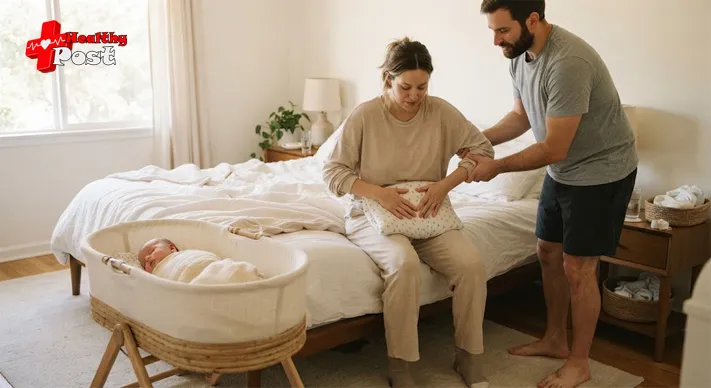
It would be misleading to treat vaginal delivery as the gentle option every time. Recovery can be much more difficult after:
- a large perineal tear or an episiotomy (a surgical cut to widen the vaginal opening)
- a forceps or vacuum-assisted delivery
- a long labor with prolonged pushing
- significant swelling or painful hemorrhoids
Perineal pain after childbirth in these situations can affect sitting, walking and toileting for weeks, and stitches can feel sore, tight or itchy as they heal. Some women also have urinary leakage or pelvic floor weakness that needs its own follow-up and physiotherapy. If perineal pain is severe, worsening, or comes with fever or a foul-smelling discharge, it needs medical review rather than patience.
When a C-Section Is Harder Than Expected
Circumstances shape the recovery as much as the delivery method does. A planned C-section lets you arrive rested, with a prepared plan for pain relief and help at home. An emergency C-section often follows hours of labor, so the body is recovering from contractions, exhaustion and surgery at once. Emotions can add to this. Many people feel shaken or disappointed after an unplanned surgical birth, and that is a normal reaction rather than a failure on anyone’s part.
Other factors can slow healing, including anemia, infection, diabetes, smoking and, after an emergency, the stress of a rapid delivery. A separate recovery issue deserves a mention too: after pregnancy, some women notice a ridge or bulge along the midline of the belly, a sign of diastasis recti, where the abdominal muscles separate. It occurs after both vaginal and cesarean births and is worth raising with a clinician if it persists or hurts.
Vaginal Delivery vs. C-Section: Pros and Cons
No method is “best” in the abstract. The safest option is the one that fits the pregnancy, and sometimes a C-section is clearly the safer route for mother or baby. Here is how the two compare:
| Factor | Vaginal delivery | C-section |
|---|---|---|
| Pain during birth | Can be intense without effective pain relief | Little sharp pain with spinal or epidural anesthesia |
| Pain afterward | Cramping and perineal soreness, often shorter-lived | Incision pain, usually lasting longer |
| Recovery | Generally quicker if uncomplicated | Generally slower, as it is major surgery |
| Hospital stay | Usually shorter | Usually longer |
| Perineal injury | Possible | Usually avoided |
| Surgical risks | Not applicable | Infection, blood loss, blood clots, organ injury |
| Future pregnancies | No new uterine scar | Uterine scar can affect later pregnancies |
| Predictability | Timing of labor can’t be planned | Planned surgery offers a set date |
| Emergencies | Not always safe in certain complications | Can be lifesaving when vaginal birth is unsafe |
ACOG notes that cesarean birth also raises certain risks in future pregnancies, though it remains the right choice in many situations.
Postpartum Pain Management After Delivery
Effective postpartum pain management after delivery should be tailored to what you actually had done, not just labeled “vaginal” or “cesarean.” Most approaches combine several layers, which is sometimes called multimodal pain relief.
Medication. Paracetamol (acetaminophen) and ibuprofen are the usual starting points after either type of birth, with stronger medicines added when needed, particularly after a C-section. Hospital leaflets commonly advise taking pain relief regularly in the first days rather than waiting for pain to build, because gaps can make it harder to control. Anti-inflammatory drugs are not suitable for everyone, and kidney problems, asthma, bleeding risks and blood pressure conditions can change what is appropriate. If you are breastfeeding, mention it, since some stronger painkillers, including codeine and tramadol, are generally avoided. Ask your midwife or pharmacist for the right plan, including doses.
Practical measures. These help in both situations:
- Rest when you can and accept offers of help with lifting and household tasks.
- After a C-section, hold a small pillow against the incision when coughing, laughing or standing, and keep the wound clean and dry as advised.
- After a vaginal birth, cold packs and clean, gentle washing can ease perineal soreness, and a warm bath may help if your care team approves.
- Keep moving gently. Short walks support circulation and bowel function, and the NHS encourages getting up as soon as you are able after a C-section.
- Prevent constipation with fluids, fiber and a stool softener if advised, since straining hurts after both types of birth and some painkillers make it worse.
Feeding can complicate things when you are sore. Side-lying and “football hold” positions keep weight off a C-section incision, and if worries about supply add to the stress, this guide on low milk supply and breastfeeding covers common concerns.
Warning Signs That Need Prompt Attention
Soreness is expected, but some symptoms are not. The NHS advises contacting a midwife or GP straight away after a caesarean if you have severe pain, pain when passing urine, or swelling or pain in the lower leg. More broadly, call your care team promptly for:
- fever, or a wound that is red, swollen, leaking or smelling unpleasant
- heavy bleeding, or passing large clots
- chest pain or shortness of breath
- pain that is getting worse instead of gradually easing
- severe perineal pain after a vaginal birth
Seek emergency help for chest pain, breathing difficulty, or heavy bleeding that soaks through pads quickly.
Using This Information Before Your Birth
Pain should not be the only factor in choosing how to give birth, and in many cases the choice isn’t entirely yours to make. A few conversations can help:
- Ask your obstetrician or midwife what the realistic plan is for your pregnancy and what could change it.
- Discuss pain relief options in labor, including what happens if you need an emergency C-section.
- Line up practical help for the first two weeks at home, especially if you are having a planned C-section.
- Learn which symptoms should prompt a call, so you are not guessing at 2 a.m.
Frequently Asked Questions
Does C-section pain last longer than vaginal birth pain?
Usually, yes. A C-section creates a surgical wound, so incision pain and activity limits commonly last for weeks. Vaginal birth pain tends to resolve sooner unless there was significant tearing or an assisted delivery.
Can you feel anything during a C-section?
You should not feel sharp pain. With a spinal or epidural you may feel pressure, tugging or movement. If you feel pain during surgery, tell the anesthetist straight away so it can be treated.
Is an epidural or a C-section better for pain?
They are different tools. An epidural reduces labor pain but still leads to a vaginal birth, with its own recovery. A C-section is a surgical delivery with a longer recovery. Neither is better for everyone, and an epidural can be topped up and converted to a surgical block if you need a C-section.
Does an emergency C-section hurt more than a planned one?
Surgical pain afterward is similar, but recovery can feel harder after an emergency because you may have gone through labor first and had little time to prepare. Emotional recovery may also take longer.
When can I drive or exercise after a C-section?
NHS guidance says driving is not possible for a few weeks. Timing depends on your pain level, ability to move freely and your insurer’s terms. Ask your clinician before resuming driving or exercise.
Conclusion
The comparison of C-section vs vaginal delivery pain comes down to timing. Vaginal delivery tends to hurt more during birth and recover faster, while a C-section spares you most pain during delivery but asks more of your body afterward, because it is major abdominal surgery. Tears, assisted deliveries, emergency surgery and personal health can reverse the usual pattern, which is why individual experiences vary so much.
The most useful next step is a conversation with your own care team about the plan for your pregnancy, your pain relief options and the support you will need at home. For more reading on pregnancy and recovery, browse the pregnancy and women’s health guides.
This article is for general education and is not medical advice. Always follow guidance from your own healthcare professional.
References
- American College of Obstetricians and Gynecologists (ACOG). “What to Know About Unplanned Cesarean Births.” https://www.acog.org/womens-health/experts-and-stories/the-latest/what-to-know-about-unplanned-cesarean-births
- NHS. “Recovery – Caesarean section.” https://www.nhs.uk/conditions/caesarean-section/recovery/
- “What delivery-related factors affect postpartum recovery? A systematic review.” AJOG Global Reports, 2025; PubMed. https://pubmed.ncbi.nlm.nih.gov/40458539/