

This article has been written by Dr. Himanshu Gupta (Orthopedics & Robotics, Amicare Hospital ↗), specializing in orthopedic surgery, robotic-assisted joint and spine care, musculoskeletal health, and structural alignment evaluations.
Medical Disclaimer: The information provided regarding the stand-against-the-wall posture check, spine alignment assessments, musculoskeletal self-evaluations, and postural correction strategies is for educational and informational purposes only. At-home screening tests are not a substitute for professional clinical diagnosis. Always consult a licensed orthopedic surgeon, physical therapist, or qualified healthcare provider before initiating new exercise routines or if you experience chronic back pain and spinal discomfort.

🏥 Medical Review Board Member
Dr. Himanshu Gupta
Orthopedic Specialist | Amicare Hospital (Ghaziabad, India)
Dr. Himanshu Gupta is a distinguished medical professional with over 20 years of expertise in orthopedics and joint replacement surgery. As the Chief Orthopedic and Director at Amicare Hospital, he specializes in advanced robotic-assisted procedures and sports injury management, dedicated to enhancing mobility and quality of life for his patients. Dr. Gupta is committed to bridging the gap between complex surgical clinical practice and accessible, evidence-based patient education. His rigorous approach to medical oversight ensures that every piece of content he reviews meets the highest standards of clinical accuracy, safety, and reliability.
If you want a simple way to look at your standing posture, a stand against wall posture check can give you a useful starting point. It requires no special equipment—just a flat wall, a few minutes and, ideally, a mirror or another person who can observe you.
The purpose isn’t to prove that your spine is perfectly straight. Healthy posture still includes the spine’s natural curves, and bodies naturally vary from person to person. Instead, the test helps you notice how your head, shoulders, pelvis and lower back relate to one another when you stand.
A wall check can be especially useful if you frequently notice slouching, rounded shoulders, a forward head position or an exaggerated lower-back arch. But it is a posture-awareness and screening exercise, not a medical diagnosis. An unusual position does not automatically mean your spine is damaged or misaligned.
What Is the Stand Against Wall Posture Check?
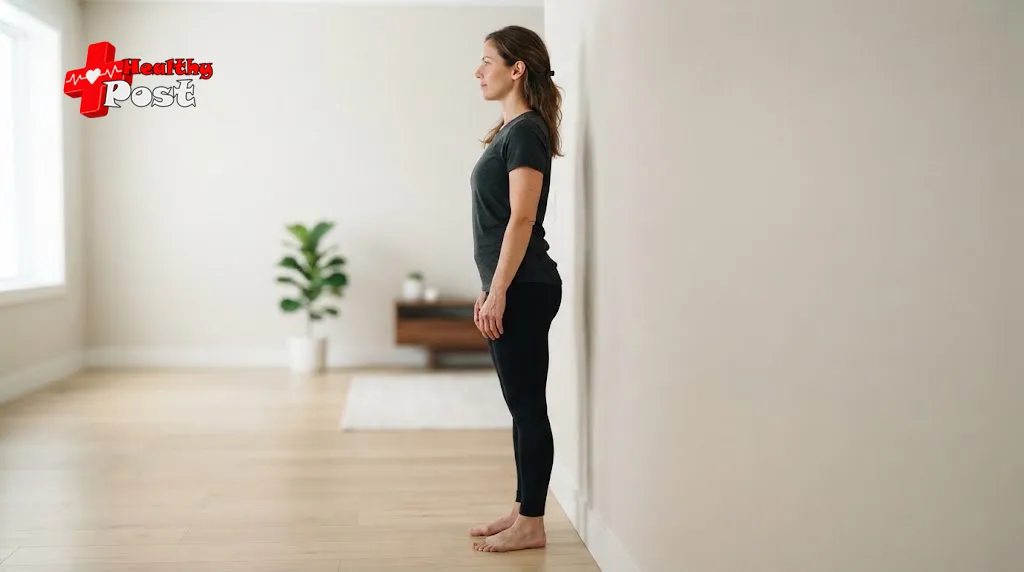
A wall posture check involves standing with your back toward a wall and observing which parts of your body naturally approach or touch it.
A commonly described version looks at the:
- Back of the head
- Shoulder blades or upper back
- Buttocks
- Lower-back curve
- Hips and legs
- Feet and heels
Mayo Clinic’s wall test places the back of the head, shoulder blades and buttocks against the wall, with the heels positioned a few inches forward. It also recommends checking the natural space behind the lower back rather than trying to flatten the spine completely.
Cleveland Clinic similarly describes using a wall to develop awareness of head, shoulder, hip and leg positioning.
What can this test reveal?
A wall check may help you notice patterns such as:
- Your head sitting noticeably forward
- Rounded or forward-positioned shoulders
- An unusually pronounced lower-back arch
- A relatively flat lumbar curve
- Uneven shoulders or hips
- A tendency to shift your weight onto one leg
- Difficulty finding a comfortable upright position
These observations are clues about your posture—not proof of a spinal disorder.
The Wall Posture Test at Home: Step-by-Step
You can perform the test in only a few minutes. The key is to observe your natural standing position, rather than deliberately forcing yourself into what you think “perfect posture” should look like.
1. Choose a suitable wall
Find a flat wall with enough space for you to stand comfortably.
For a clearer assessment:
- Remove bulky shoes if practical.
- Avoid very thick carpeting.
- Use good lighting.
- Wear clothing that allows your general body position to be seen.
- Use a mirror or ask someone to observe you if possible.
Stand normally for a moment before beginning. If you immediately pull your shoulders back, tuck your pelvis and push your head against the wall, you’re testing a corrected posture rather than your usual one.
2. Position your feet
Stand with your back toward the wall and your feet approximately hip-width apart.
Let your weight distribute naturally between both feet. Your heels do not necessarily have to touch the wall.
In the Mayo Clinic version of the test, the heels are roughly 2–4 inches away from the wall while the upper body approaches it.
There is no need to obsess over the exact measurement. The important point is to avoid changing your whole stance simply to make your body fit the wall.
3. Allow your body to contact the wall naturally
Without forcing anything, allow your:
- Buttocks
- Upper back or shoulder blades
- Back of your head
to approach or touch the wall.
Don’t aggressively squeeze your shoulder blades together or push your lower back backward.
Notice what happens naturally.
For example, perhaps your buttocks and upper back touch easily, but your head remains several centimeters away. Or perhaps your head touches but you have to arch your lower back significantly to achieve it.
Those differences are more informative than simply asking whether every body part touches the wall.
4. Check your head and neck
Look straight ahead and ask:
Can the back of my head reach the wall without lifting my chin, tilting my head backward or straining my neck?
If you have to make a substantial adjustment to reach the wall, you may have a forward-head posture pattern.
Forward head posture occurs when the head sits farther in front of the shoulders than is typical for a neutral position. Prolonged screen use, desk work and other sustained positions can contribute to this pattern, although posture is influenced by many factors.
Cleveland Clinic recommends a gentle head-retraction movement while keeping the eyes level rather than simply throwing the head backward.
Do not force your head against the wall. If reaching the wall requires significant discomfort or a dramatic change in your neck position, simply record what you observe.
5. Look at your shoulders
Next, pay attention to your shoulders and upper back.
Ask yourself:
- Are both shoulders approximately level?
- Do they naturally roll forward?
- Is one shoulder noticeably higher?
- Does one shoulder blade appear different from the other?
- Do you have to squeeze your shoulder blades together to touch the wall?
Some asymmetry is normal. Human bodies aren’t perfectly symmetrical, and small differences don’t necessarily indicate a problem.
More obvious or persistent asymmetry deserves more attention, particularly if it occurs alongside pain, weakness, reduced movement or other symptoms.
How to Check Spine Alignment With the Lower-Back Gap
The space between your lower back and the wall is one of the most commonly misunderstood parts of a wall posture test.
Your lumbar spine—the lower section of the spine—has a natural inward curve called lumbar lordosis. Because of this curve, your lower back normally does not need to be completely flat against the wall.
Place one hand sideways into the space between your lower back and the wall.
If there is a small natural gap
A modest gap is expected because of the lumbar curve.
Mayo Clinic describes being able to slide a flat hand behind the lower back as a useful reference for the wall test.
This does not mean every healthy person will have exactly the same amount of space. Pelvic shape, spinal anatomy and body proportions vary.
If the gap is noticeably large
A larger gap may accompany an increased inward lumbar curve. One possible pattern is an anterior pelvic tilt, in which the pelvis rotates forward and the lower back may appear more arched.
However, a wall test cannot tell you why the gap is large.
Possible influences include:
- Individual anatomy
- Pelvic position
- Muscle strength and endurance
- Hip mobility
- Habitual standing position
- Pregnancy
- Body composition
So don’t assume that a large gap automatically means you need to “correct” your pelvis.
If there is almost no gap
Some people naturally have a relatively flatter lumbar curve.
If the position is comfortable and you can move normally, this finding by itself does not establish that anything is wrong.
The objective isn’t to manufacture a particular gap.
A healthy spine is not supposed to be completely flat.
What Should Proper Standing Alignment Look Like?
There is no single rigid posture that every person should reproduce.
A more useful concept is neutral spine position: a comfortable alignment in which the spine maintains its natural curves without excessive slouching or exaggerated arching.
Think of the body as reasonably stacked:
Head → shoulders → pelvis → knees → ankles
NHS physiotherapy material uses a similar “stacked” concept when describing standing posture.
From the side, avoid deliberately pushing your chest forward, pulling your head backward or exaggerating the lower-back curve.
From the front and back, look for broad symmetry rather than perfect mathematical alignment.
Healthy standing posture should also be dynamic. You aren’t expected to freeze in one position all day. Changing positions, walking and moving regularly are part of normal physical function.
Common Posture Deviations and Fixes
The wall test can help you recognize several common patterns, but the appropriate response depends on the individual.
Forward head posture
What you may notice: Your head appears noticeably in front of your shoulders when viewed from the side.
Possible contributors: Extended periods looking downward, desk work, screen use and reduced endurance of the muscles supporting the head and upper back can contribute.
What may help: Practice gentle head retraction while keeping your gaze level. Cleveland Clinic describes this as moving the head backward without tipping the chin upward or downward.
Also consider changing your workstation and taking regular movement breaks rather than trying to hold your head rigidly in one position.
Rounded shoulders
What you may notice: Your shoulders naturally fall forward and your upper back appears more rounded.
This can occur with prolonged sitting, repeated forward-reaching activities or reduced upper-body strength and mobility.
Rather than constantly pulling your shoulders backward, work on movement and strength. Wall angels are one exercise Cleveland Clinic describes for working on shoulder and upper-body posture.
Excessive lower-back arch
What you may notice: There is a pronounced space between your lower back and the wall.
This can occur alongside increased lumbar lordosis or an anterior pelvic tilt, but the wall test cannot identify the underlying cause.
Avoid trying to flatten your back aggressively. A better approach is to learn what a comfortable neutral position feels like and, if needed, work with a physiotherapist on strength, mobility and movement habits.
Flattened lower back
A very small gap may indicate a flatter lumbar curve, but it isn’t automatically a problem.
Some people naturally have different spinal shapes. If there is no pain or functional limitation, there may be no reason to try to create a larger curve simply to satisfy the wall test.
Uneven shoulders or hips
Standing in front of a mirror—or having someone photograph you from behind—can make asymmetries easier to see.
Look for:
- One shoulder noticeably higher
- One hip appearing higher
- A consistent weight shift
- A visible sideways trunk shift
- One shoulder blade appearing substantially different
Small differences are common. A pronounced or persistent asymmetry, particularly with pain or weakness, warrants professional assessment.
Signs of Poor Standing Posture to Watch For
A posture assessment at home may raise questions if you frequently notice:
- Your head sitting far forward
- Rounded shoulders
- Persistent slouching
- An exaggerated or very flattened lower-back curve
- Regularly standing with most weight on one leg
- Difficulty maintaining an upright position comfortably
- Noticeably uneven shoulders or hips
- Neck, shoulder or back discomfort during prolonged standing
- Fatigue associated with maintaining a standing position
These are observations, not diagnostic criteria.
Pain deserves particular caution. Back or neck pain can have many possible causes involving muscles, joints, discs, nerves and other structures. It is therefore too simplistic to assume that poor posture is responsible for every ache.
Use Three Views for a Better Posture Assessment
A wall test gives you useful information, but photographs can make certain patterns easier to recognize.
Side view
Take a full-body photograph while standing naturally.
Look at:
- Head position
- Shoulder position
- Upper-back shape
- Pelvic position
- Knees
- Ankles
The side view is especially useful for spotting forward head positioning and obvious changes in the natural curves of the spine.
Front view
Check for broad symmetry:
- Are the shoulders approximately level?
- Are the hips approximately level?
- Does your weight appear reasonably balanced?
- Does your torso appear shifted to one side?
Back view
Look at:
- Shoulder height
- Shoulder blades
- Hip height
- General trunk symmetry
- Any obvious sideways curvature
Don’t diagnose scoliosis from a photograph. A visible curve or asymmetry needs proper clinical assessment if it is persistent or concerning.
Don’t Try to “Pass” the Wall Test
One of the most common mistakes is forcing every body part against the wall.
You might:
- Pull your chin aggressively backward
- Squeeze your shoulder blades
- Flatten your lower back
- Push your chest upward
- Tuck your pelvis too far underneath you
That can create a posture that looks different from the way you normally stand.
The purpose of the stand against wall posture check is awareness, not achieving a perfect score.
Think of the wall as a reference point rather than a mold your body has to fit into.
Good standing alignment should feel reasonably comfortable and sustainable. You should still be able to breathe, relax and move without constantly monitoring every body part.
Can the Wall Test Diagnose a Spinal Problem?
No.
A home spinal alignment test can reveal an obvious posture pattern, but it cannot diagnose scoliosis, spinal deformities, disc disorders, nerve problems or other medical conditions.
For example, scoliosis is not diagnosed simply because one shoulder appears higher in a photograph. A clinician may need to assess the person’s history, physical findings and, when appropriate, imaging.
Similarly, a large lower-back gap does not tell you whether you have a specific pelvic or spinal disorder.
Seek medical evaluation if you have symptoms such as:
- Persistent or worsening back pain
- Significant or increasing spinal asymmetry
- Numbness or tingling
- Weakness
- Difficulty walking or maintaining balance
- Pain after a significant injury
- New bowel or bladder control problems
- Severe or unexplained pain
Mayo Clinic advises urgent evaluation for back pain associated with major trauma, new bowel or bladder problems or certain other warning symptoms.
If you’re already dealing with persistent back pain or recovering from an injury, don’t begin an exercise program based solely on a home posture test. Mayo Clinic recommends discussing appropriate activities with a healthcare professional in those circumstances.
What to Do After the Test
The most useful outcome isn’t discovering that you have “bad posture.” It’s identifying one or two habits you can improve.
For example, if you spend much of the day sitting, consider changing position regularly rather than trying to maintain one ideal posture for hours.
You can also work on general strength and mobility. Depending on your individual needs, this may include exercises for the upper back, core, hips and legs.
If you are interested in gentle back-mobility and strengthening ideas, our guide to back exercises for flexibility and strength provides additional examples.
For people who have pain around the shoulder blade or neck, a more specific evaluation may be appropriate rather than assuming the discomfort is simply a posture problem. Our article discussing scapular pain and cervical spine problems covers that topic in greater detail.
The goal is gradual improvement in comfortable movement and physical capacity, not maintaining a rigid posture all day.
How Often Should You Do a Wall Posture Check?
You don’t need to test yourself several times a day.
For general posture awareness, doing the check occasionally—such as every few weeks—can be enough to notice whether your habits are changing.
What matters more is what you do between tests.
Try to:
- Change position regularly.
- Avoid remaining in one posture for prolonged periods.
- Adjust your workstation to a comfortable setup.
- Keep physically active.
- Work on strength and mobility appropriate to your abilities.
- Pay attention to persistent symptoms rather than trying to “correct” them yourself.
Mayo Clinic also emphasizes strengthening and stretching muscles that support the back, while recommending professional guidance when someone is beginning exercise because of ongoing pain or a previous injury.
Frequently Asked Questions
Is standing against a wall a good posture test?
Yes. It is a simple way to become more aware of how your head, upper back, pelvis and lower back relate to the wall. It is useful for screening and self-awareness, but it isn’t a diagnostic test.
How much space should be between my lower back and the wall?
There should normally be some space because the lumbar spine has a natural inward curve. Mayo Clinic uses the ability to slide a flat hand behind the lower back as a practical reference.
The exact amount varies between people, so don’t treat a particular gap as a universal measurement of good or bad posture.
Should my heels touch the wall?
Not necessarily. In Mayo Clinic’s commonly described wall test, the heels are positioned approximately 2–4 inches away from the wall.
Should my head touch the wall?
The back of your head should ideally be able to approach the wall without significant strain or an exaggerated change in your neck position. If you have to force it backward, don’t do so simply to make the test look successful.
Can a wall test tell me if my spine is crooked?
It can make obvious asymmetries easier to notice, but it cannot diagnose a spinal curvature such as scoliosis. Persistent or significant asymmetry should be assessed by a qualified healthcare professional.
Can poor posture cause back or neck pain?
Posture can influence how your muscles and joints are loaded, but pain has many possible causes. It is therefore not appropriate to assume that posture is the sole explanation for persistent neck or back pain.
Bottom Line
The stand against wall posture check is a convenient way to observe your standing alignment without special equipment. Stand naturally with your upper body near the wall, observe your head and shoulders, and check the space behind your lower back without trying to flatten your natural spinal curve.
Use the test as a snapshot rather than a pass-or-fail examination.
A comfortable, balanced posture allows your spine to retain its natural curves while your head, shoulders, pelvis, knees and ankles remain reasonably organized over one another. Your body does not need to be perfectly symmetrical or rigid to be healthy.
If the wall check reveals a significant asymmetry, or if you have persistent pain, numbness, weakness, balance problems or symptoms following an injury, a clinician or physiotherapist can provide a much more meaningful assessment.
Key Takeaways
- The wall posture test at home is mainly a posture-awareness tool.
- Your lower back normally has a natural inward curve.
- A small gap between the lumbar spine and wall is expected.
- Look for broad alignment rather than perfect symmetry.
- Forward head posture, rounded shoulders and altered lumbar curvature are common patterns worth observing.
- Don’t force your head, shoulders or lower back against the wall.
- A wall test cannot diagnose scoliosis or another spinal disorder.
- Persistent pain, weakness, numbness or significant asymmetry should be professionally assessed.
References
- Mayo Clinic News Network — “Mayo Clinic Q and A: Proper posture and body alignment.” The source describes the wall test, including head, shoulder-blade and buttock contact, heel positioning and the lower-back hand test.
- Cleveland Clinic — “8 Posture Exercises to Sit and Stand Straighter.” This source discusses using a wall for posture awareness, forward-head positioning and exercises such as wall angels.
- University Hospitals Coventry and Warwickshire NHS Trust — “Shoulder Class: Week 2.” The physiotherapy guidance explains the concept of stacking the head, shoulders, pelvis, knees and ankles during standing.
1 Comment
Pingback: 8 Back Spasm Symptoms That Could Be Warning Signs