

🩺 Medical Review & Disclaimer
This article has been authored and clinically reviewed by Dr. Priyanka Agarwal, Dermatologist at Dakai Skin Clinic. The information provided in this guide is strictly for educational and informational purposes and does not constitute formal medical advice, diagnosis, or treatment.
Always consult a board-certified dermatologist or qualified healthcare provider before attempting any at-home removal kits to accurately evaluate skin lesions and rule out underlying malignant conditions.

Dr. Priyanka Agarwal
Dermatologist | Dakai Skin Clinic
Dr. Priyanka Agarwal is an experienced Dermatologist dedicated to providing advanced medical and aesthetic skin care solutions. Practicing at Dakai Skin Clinic, Dr. Agarwal combines evidence-based dermatological care with a patient-centered approach, ensuring optimal skin health, advanced clinical treatments, and the highest standards of safety and diagnostic precision.
If you have ever looked at a small flap of skin on your neck or underarm and wondered, are skin tag removal kits safe, you are not alone. In our medical editorial practice, we regularly see patients who feel embarrassed by skin tags, irritated by rubbing, or simply curious about whether an over-the-counter fix is worth trying. The appeal is obvious: a quick, private solution at home. But convenience and safety are not always the same thing.
Skin tags are common. They are usually harmless, benign skin growths that show up where skin rubs against skin or clothing. Think neck folds, armpits, groin, under the breasts, and sometimes the eyelids. Most do not need treatment. Still, many people want them removed for comfort or cosmetic reasons.
That is where the typical skin tag removal kit enters the picture. Pharmacies and online shops now sell freezing devices, ligation tools, and topical formulas marketed for at home removal kits. Some products, including dr scholl’s skin tag remover, promise results within days or weeks. Yet in clinical discussions, the question is less about marketing and more about diagnosis, skin damage, and the risk of infection and scarring.
In this guide, we will walk through what dermatologists want patients to know, where kits may help, where they can go wrong, and when it is smarter to consult a board-certified dermatologist. We will also point you toward related skin health topics such as Facts About Wart Removal, What is melasma and how to treat melasma, and How to improve poor skin metabolism if you are trying to better understand changes in your skin overall.
1. What skin tags are, and why people try to remove them
Skin tags, also called acrochordons, are soft, flesh-colored or slightly darker growths attached by a thin stalk. They are not contagious. They are not skin cancer. And most of the time, they stay small and stable.
People usually seek removal for a few simple reasons:
- The tag catches on jewelry or clothing
- It becomes irritated from shaving
- It sits in a visible area, such as the neck
- It creates discomfort during exercise or friction
- They dislike how it looks
That motivation is understandable. But a key medical point often gets missed: not every bump is a skin tag.
In clinic, one of the most important steps is confirming what the lesion actually is. Warts, moles, seborrheic keratoses, and even some suspicious skin lesions can resemble skin tags at first glance. That is one major reason why a DIY approach can become risky. If you treat the wrong lesion, the problem is no longer cosmetic. It becomes a diagnostic and safety issue.
2. What are skin tag removal kits?
A skin tag removal kit is usually sold as an at-home alternative to in-office treatment. These products generally fall into three categories.
Cryotherapy kits
These use a freezing method meant to mimic professional liquid nitrogen freezing. A well-known example is dr scholl’s skin tag remover. The goal is to freeze the tissue so the tag dries up and falls off over time.
Ligation band kits
These use small bands to cut off blood flow at the base of the tag. Without blood supply, the tissue eventually dies and detaches.
Topical solutions
These may contain acids or plant-based compounds marketed to dry out the tag. Some consumers confuse these with salicylic acid treatments used for warts, but that is a mistake. Skin tags and warts are different conditions, and wart chemicals are not always appropriate for skin tags.
Most kits are designed for small growths in less sensitive areas. That does not mean they are universally safe.
3. Are skin tag removal kits safe? The short answer
For carefully selected, clearly identified, small skin tags on low-risk body areas, some at home removal kits may be used without serious complications. But that is the narrow answer.
The fuller answer is this: are skin tag removal kits safe depends on the diagnosis, the location, the method, and the person using them. Most studies agree that professional removal is more reliable and safer, especially for delicate areas or uncertain lesions.
In our review of patient histories, the biggest problems tend to fall into four groups:
- Misidentifying the lesion
- Damaging healthy surrounding skin
- Incomplete removal
- Delayed treatment after complications start
Those risks rise when people use an over the counter skin tag remover on the eyelid, groin, face, or on larger growths.
4. The real risks of at-home skin tag treatment
Cryotherapy can miss the target
Products such as dr scholl’s skin tag remover are marketed as convenient freezing tools. But clinic-grade cryotherapy uses precisely applied liquid nitrogen freezing at much colder and more controlled temperatures than most consumer products can achieve.
That difference matters. Home freezing may:
- Fail to destroy the full tag
- Require repeat applications
- Irritate the surrounding skin
- Cause blistering or temporary pigmentation changes
On darker skin tones, even mild freezing injuries can leave longer-lasting discoloration. That may be more distressing than the original tag.
Topical products can burn normal skin
Many people assume that if a bottle is sold online, it must be gentle. That is not always true. Chemical formulas may spread beyond the tag and injure healthy surrounding skin. We have seen patients mistake irritation for “proof it’s working,” when in fact they are developing chemical skin burns.
This is especially concerning when people use strong acids, wart liquids, or homemade remedies. Salicylic acid treatments, for example, are commonly used for warts, not routine skin tag care. Used incorrectly, they can erode normal tissue and increase the risk of infection and scarring.
Ligation bands carry a deeper medical risk
Skin tag removal bands work by cutting off blood supply. That process causes tissue death, known medically as necrosis. The tag may darken, turn black, dry out, and eventually fall off.
That can sound straightforward. It is not always benign.
If someone places a band on a mole, wart, or another lesion by mistake, they may create deep necrotic tissue damage rather than simple removal. Once tissue dies, bacteria can enter more easily. Severe infection, pain, foul drainage, and delayed wound healing can follow. In people with diabetes, poor circulation, or reduced immune function, that risk is higher.
This is one of the clearest reasons dermatologists urge caution with skin tag removal bands. The danger is not just discomfort. It is treating the wrong lesion in the wrong way.
5. Why diagnosis is the biggest safety issue
When patients ask us, are skin tag removal kits safe, our first question is often: “Are you sure it is a skin tag?”
That is not a technicality. It is the heart of the matter.
Several skin conditions can mimic a tag:
- Common warts
- Raised moles
- Seborrheic keratoses
- Neurofibromas
- Early skin cancers in unusual presentations
A suspicious lesion may bleed easily, change color, grow quickly, develop crusting, or look irregular. Those are not details to ignore. A home product can remove surface tissue and delay the proper diagnosis of something more serious.
That concern is reflected in guidance from trusted health sources. The FDA has warned consumers about unapproved skin lesion products sold online. The NHS also notes that skin tags are usually harmless but may need assessment if there is uncertainty. For evidence summaries and clinical literature, PubMed remains a useful reference point for dermatology research.
6. When professional removal is strongly recommended
Some cases should not be treated at home. Full stop.
You should seek medical care if the growth is:
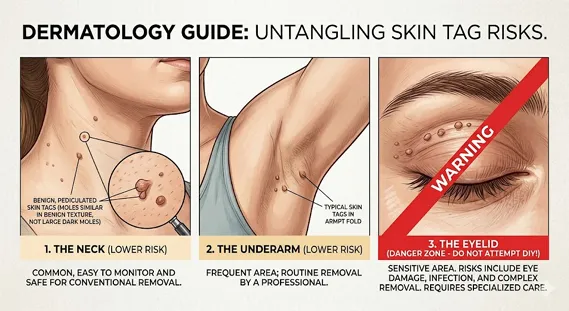
- On or near the eyelid
- Near the genitals or anus
- Large, broad-based, or present in clusters
- Bleeding, painful, inflamed, or changing
- Difficult to see clearly yourself
- Present in someone with diabetes, poor wound healing, or immunosuppression
The eyelid warning patients need to hear
Home cryotherapy or chemical kits should never be used anywhere near the eyes. This is one of the most important safety messages in this article. Runoff from a topical solution or accidental contact from a freezing applicator can cause permanent corneal damage, chemical burns to the ocular tissue, or other serious eye injury.
Even a tiny eyelid lesion deserves extra caution because the surrounding anatomy is delicate and unforgiving. In those cases, cosmetic procedure removal by a trained clinician is far safer than experimentation at home.
Professional options may include:
- Snip excision with sterile scissors
- Electrocautery
- Clinic-based cryotherapy
- Careful removal after confirming diagnosis
This is also a good point to mention related care pathways. Patients asking about benign skin growths often have broader skincare concerns too, from pigmentation to healing. Topics like Excimer Laser Therapy or What is melasma and how to treat melasma may become relevant depending on the full skin history.
7. Pros and cons of skin tag removal kits
Here is a practical comparison for patients weighing their options.
| Factor | Potential Benefits | Main Risks |
|---|---|---|
| Cost | Usually cheaper than a clinic visit | Complications may lead to higher medical costs later |
| Convenience | Easy access at pharmacies or online | No direct medical oversight |
| Cryotherapy | May work for small tags on low-risk areas | Incomplete freezing, blistering, irritation |
| Ligation | Avoids cutting the skin directly | Necrosis, pain, infection if misused |
| Topicals | Simple to apply in theory | Chemical skin burns, damage to normal skin |
| Diagnosis | Feels quick and private | May treat a mole, wart, or suspicious lesion by mistake |
For some adults with a tiny, classic-looking tag on the trunk or underarm, a reputable over the counter skin tag remover may seem reasonable after reading the instructions carefully. But it should never replace proper assessment when the lesion looks unusual.
8. What we notice in real-world patient behavior
In our editorial review of patient-care patterns, one issue comes up again and again: people wait too long after a home treatment starts to go wrong. They hope redness will settle and assume black tissue is normal. They cover drainage with a bandage and carry on.
Sometimes it resolves. Sometimes it does not.
A typical example is the patient who uses a freezing product twice because the first attempt “didn’t take.” The area then blisters, rubs against clothing, opens, and becomes infected. Another common story is the person who uses a ligation band on what they thought was a tag, only to realize later it was a mole that became painful and necrotic.
This is where practical judgment matters more than optimism. If a treated area becomes increasingly red, swollen, very painful, foul-smelling, or starts draining pus, stop the product and seek medical evaluation promptly.
If you are comparing lesions, it may also help to learn the difference between a tag and a wart. That is where Facts About Wart Removal becomes useful. For healing support and skin resilience, How to improve poor skin metabolism is another related topic many readers find helpful.
9. Frequently asked questions
1. Are skin tag removal kits safe for everyone?
No. Safety varies by skin type, medical history, body location, and whether the growth is truly a skin tag. Children, older adults with fragile skin, and people with diabetes should be especially cautious.
2. Is dr scholl’s skin tag remover effective?
dr scholl’s skin tag remover may help some people with small, uncomplicated tags in appropriate locations. Results are mixed, and clinic cryotherapy is generally more precise.
3. Can I use wart remover on a skin tag?
That is not recommended. Wart products, including some salicylic acid treatments, may injure healthy surrounding skin and increase the risk of infection and scarring.
4. What does it mean if a ligation-treated tag turns black?
That may reflect necrosis, meaning the tissue is dying after blood supply is cut off. While expected in correct use, it can be dangerous if the wrong lesion was treated or if infection develops.
5. When should I see a dermatologist instead of trying at home removal kits?
See a clinician if the lesion is near the eye, genital area, bleeding, painful, growing, changing color, or hard to identify. When in doubt, consult a board-certified dermatologist.
6. Can a skin tag be a sign of something else?
Sometimes. Skin tags themselves are benign skin growths, but multiple tags may be associated with friction, weight changes, or metabolic factors. If you are noticing broader pigment or texture changes, What is melasma and how to treat melasma or Excimer Laser Therapy may be relevant entry points for broader skin evaluation.
10. Bottom line: safety depends on judgment, not just the product
So, are skin tag removal kits safe? Sometimes, in limited situations. But they are not risk-free, and they are not a substitute for diagnosis.
For a very small, clearly identified skin tag on a low-risk area, a carefully used skin tag removal kit may offer convenience. Even then, users should follow instructions closely, avoid repeated aggressive treatment, and stop if the skin becomes very irritated.
The risks rise fast when the lesion is uncertain, the area is sensitive, or the user has health conditions that affect healing. That is why dermatologists remain cautious about at home removal kits, including products like dr scholl’s skin tag remover. The product itself is only part of the equation. The bigger issue is whether the growth has been identified correctly and whether the chosen method matches the body site.
If you are unsure, the safest next step is simple: consult a board-certified dermatologist. A brief visit can prevent chemical skin burns, infection, scarring, and delayed diagnosis of suspicious skin lesions. That is a far better trade than gambling with your skin.
For readers exploring related concerns, Facts About Wart Removal, How to improve poor skin metabolism, and What is melasma and how to treat melasma are useful next reads that can help you understand what your skin may be telling you.
References
Are skin tag removal kits safe for everyone?
No. Safety varies by skin type, medical history, body location, and whether the growth is truly a skin tag. Children, older adults with fragile skin, and people with diabetes should be especially cautious.
Is dr scholl’s skin tag remover effective?
dr scholl’s skin tag remover may help some people with small, uncomplicated tags in appropriate locations. Results are mixed, and clinic cryotherapy is generally more precise.
2 Comments
Pingback: Benefits of Tretinoin for Acne Treatment: Dr. Jacob Cote’s Guide
Pingback: How Long Does It Take for Eyelashes to Grow Back? Complete Growth Guide