

Medical Accuracy Verified
This article has been written and clinically verified by Dr. Kamlesh Verma, MS, M.Ch, a specialist in Surgical Oncology.
Medical Disclaimer: The content on Healthy Post is for educational and informational purposes only and does not substitute for professional medical advice, diagnosis, or treatment. Differentiating between benign mouth ulcers and malignant oral lesions requires thorough clinical evaluation, as persistent, non-healing sores can be an early indicator of oral cancer. Always consult a qualified surgical oncologist, otolaryngologist, or primary healthcare provider for regular clinical exams, timely biopsies, and personalized diagnostic assessments.

🏥 Medical Review Board Member
Dr. Kamlesh Verma, MS, M.Ch
Director – Surgical Oncology | Max Super Speciality Hospital, Lucknow
Dr. Kamlesh Verma is a highly experienced Surgical Oncologist and Director of Surgical Oncology at Max Super Speciality Hospital, Lucknow. Trained at premier institutions including the Tata Memorial Centre in Mumbai and King George’s Medical University (KGMU), Dr. Verma specializes in advanced minimally invasive, robotic, and complex cancer surgeries. He is deeply committed to evidence-based oncology care, ensuring that every cancer-related publication he reviews meets the highest standards of medical accuracy, safety, and clinical integrity.
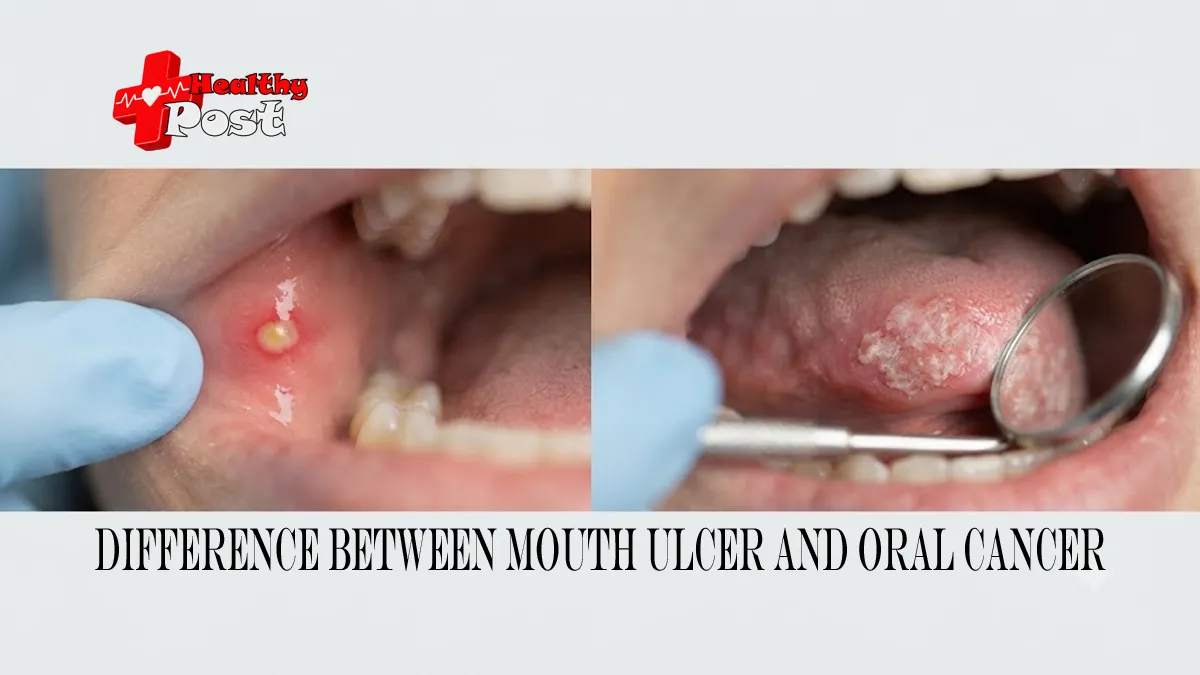
If you are worried about the difference between mouth ulcer and oral cancer, you are not alone. In our medical editorial practice, we often hear the same question from patients: “It looks like a sore, but how do I know if it’s something serious?” That concern is understandable. Many mouth ulcers are harmless and heal on their own. Oral cancer, however, can begin quietly and may look deceptively similar in the early stage. The key is knowing what to watch for, when to wait, and when to get examined.
A simple rule helps. Most mouth ulcers heal within 1 to 2 weeks. Oral cancer lesions often persist beyond 3 weeks, may feel firm, and can appear as irregular ulcers, red or white patches, or painless growths. This article breaks down mouth ulcer vs oral cancer symptoms, explains how to tell if a mouth ulcer is cancerous, and highlights the most important precautions.
If you are also exploring related oral health topics, our guides on 3 types of “ulcers” in the mouth and early symptoms and causes of oral cancer can help add context.
1. What is a mouth ulcer?
A mouth ulcer, often called an aphthous ulcer or canker sore, is a small break in the lining of the mouth. It usually forms on the inside of the cheeks, lips, gums, tongue, or soft palate.
These sores are common. They are usually benign, meaning non-cancerous. In many patients we review, the sore begins with stinging or tenderness, then becomes painful quickly.
Typical features of a mouth ulcer
- Round or oval shape
- White, yellow, or gray center
- Red inflamed border
- Painful from the start
- Heals in about 7 to 14 days
- Usually does not leave a scar
Common triggers
- Stress
- Cheek-biting or friction from braces/dentures
- Acidic or spicy foods
- Vitamin B12, folate, or iron deficiency
- Hormonal changes
- Fatigue
- Recurrent aphthous stomatitis
A painful tongue ulcer after accidentally biting the tongue is far more likely to be a traumatic or aphthous sore than cancer. Still, healing time matters.
2. What is oral cancer?
Oral cancer is a malignant growth in the mouth. The most common type is oral squamous cell carcinoma, which develops in the thin, flat cells lining the mouth and lips.
Unlike a simple ulcer, oral cancer may not hurt early on. That is one reason it can be missed.
Where oral cancer can appear
- Tongue
- Floor of the mouth
- Gums
- Inner cheeks
- Roof of the mouth
- Lips
- Tonsillar area
Common oral cancer warning signs
- A sore that does not heal after 3 weeks
- Red, white, or mixed red-white patches
- A thickened or hardened area
- A lump in the mouth or neck
- Difficulty chewing or swallowing
- Unexplained bleeding
- Numbness in the lips or tongue
- Dentures fitting differently
A non healing sore on tongue or gums deserves prompt professional assessment, especially in adults over 40 or anyone with tobacco, alcohol, or HPV-related risk factors.
3. The main difference: healing time tells a bigger story
When comparing a benign mouth ulcer vs malignant lesion, healing time remains the most practical and reliable clue.
A routine mouth ulcer usually improves within days and resolves within 2 weeks. A cancer-related lesion often persists, enlarges, or changes character.
In clinic-facing reviews, we pay close attention to this timeline:
- Less than 2 weeks: often consistent with a simple ulcer, especially if painful and triggered by trauma
- 2 to 3 weeks: monitor carefully, especially if there is no clear cause
- More than 3 weeks: this becomes a persistent mouth sore red flag
That does not mean every long-lasting ulcer is cancer. Some are linked to chronic irritation, autoimmune conditions, infections, or nutritional deficiency. But a persistent lesion should not be ignored.
4. Mouth ulcer vs oral cancer symptoms: side-by-side comparison
Here is a practical comparison table to make the distinction clearer.
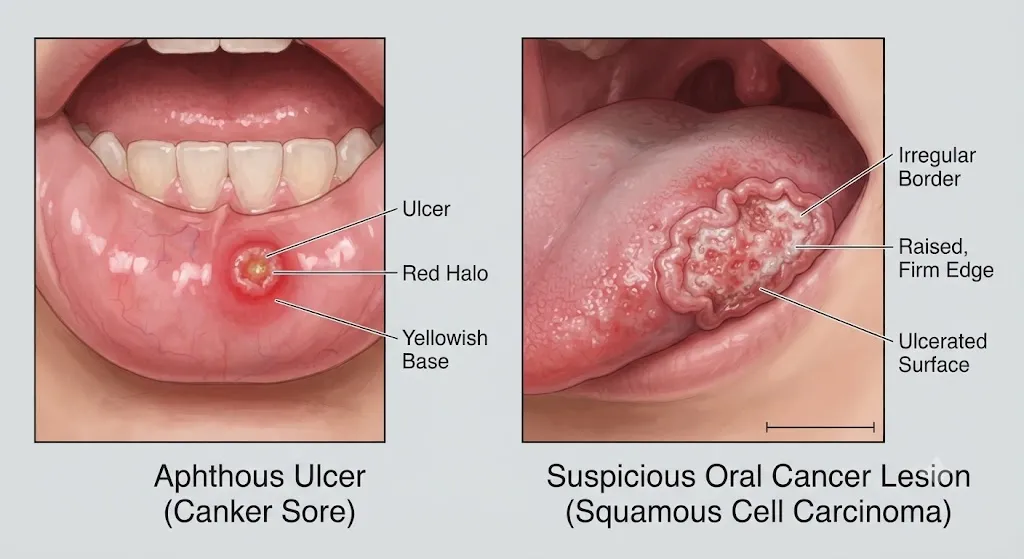
This table captures the heart of the difference between mouth ulcer and oral cancer. Shape, firmness, and duration matter more than appearance alone.
5. How to tell if a mouth ulcer is cancerous
Patients often ask about the warning signs they can spot at home. While a biopsy is the only definitive test, some features raise concern more than others.
Signs that deserve urgent dental or medical review
- The ulcer lasts more than 3 weeks
- It has irregular, raised, or rolled edges
- There is a hard lump under or around the sore
- It bleeds without obvious injury
- You notice numbness or reduced tongue movement
- A neck gland becomes enlarged
- Eating, swallowing, or speaking becomes difficult
- The patch is red, white, or mixed and does not fade
These are classic non healing mouth ulcer warning signs. They are not proof of cancer, but they are strong reasons to get checked.
For trusted symptom guidance, the NHS mouth cancer page outlines key symptoms and when to seek help.
6. Risk factors that shift the concern
A sore in the mouth is more concerning when it appears in someone with known risk factors.
Major risk factors for oral cancer
- Smoking cigarettes, cigars, or bidis
- Chewing tobacco or betel quid
- Heavy alcohol use
- HPV-16 infection
- Poor oral hygiene
- Chronic denture irritation
- Long-term sun exposure on the lips
- Older age, especially over 40
Updated public health trends matter too. Oral cancer rates are rising in parts of South Asia, where betel nut and smokeless tobacco use remain common. In global cancer surveillance and regional studies indexed on PubMed, this pattern is consistently reported.
The CDC HPV and cancer resource also supports the role of HPV in several cancers, including cancers of the oropharyngeal region.
If a person with these risk factors develops a non healing sore on tongue or gums, clinicians typically recommend early examination rather than watchful waiting.
7. Why visual comparison helps—but only to a point
Searches for canker sore vs mouth cancer pictures are common. Images can be useful for general awareness. They can show the typical round, shallow look of a canker sore and the more irregular appearance of suspicious lesions.
But pictures have limits.
Lighting varies. So do skin tones, lesion locations, and infection patterns. Even experienced clinicians do not diagnose oral cancer from images alone. They combine history, physical examination, and when needed, tissue testing.
So if you are looking up canker sore vs mouth cancer pictures, use them as an educational tool, not a diagnosis.
The gold standard: biopsy
If a lesion looks suspicious or does not heal, a clinician may recommend a biopsy for mouth ulcer evaluation. This means taking a small tissue sample to examine under a microscope.
That is the only way to confirm whether the lesion is benign, precancerous, or malignant.
8. Real-world examples from clinical review
In our editorial review of patient cases, patterns repeat.
Example 1: likely simple ulcer
A 26-year-old notices a sore inside her cheek after a stressful week and several nights of poor sleep. It hurts when she eats citrus fruit. The ulcer is round, white-centered, and gone in 10 days. This pattern strongly fits a common mouth ulcer.
Example 2: needs urgent workup
A 52-year-old smoker has a painless ulcer on the side of his tongue. He assumes it is from hot tea. Three weeks later, it remains. The edge looks uneven. He also feels a small lump in his neck. This is a classic scenario where when to see an oncologist for mouth sore becomes a serious question. At minimum, urgent dental or ENT assessment is warranted.
These examples are not meant to frighten. They are meant to show how timing and risk factors change the picture.
9. When to seek medical help
You should arrange professional evaluation if:
- A mouth sore lasts more than 2 to 3 weeks
- It keeps returning in the same spot
- It becomes larger or firmer
- You have trouble swallowing, chewing, or moving the tongue
- There is unexplained bleeding
- You notice a neck lump
- You have risk factors such as smoking, alcohol misuse, or HPV exposure
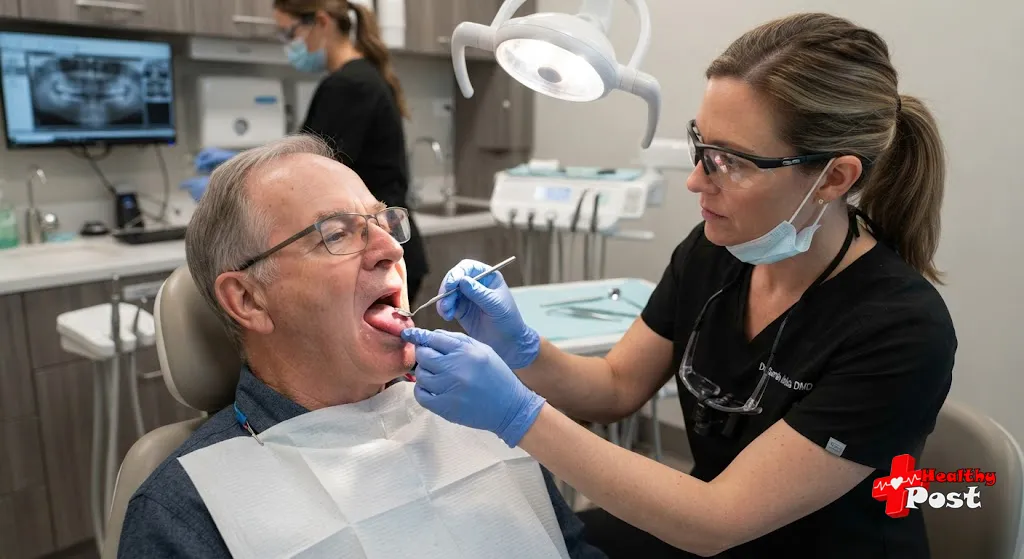
A dentist, oral surgeon, ENT specialist, or primary care physician may all be involved. If cancer is suspected, referral pathways may include head and neck oncology.
If you are already managing cancer treatment or supporting recovery, nutrition matters too. Our related guide on Cancer Patient Diet covers supportive eating strategies often discussed after oral procedures or treatment.
10. Precautions that may help reduce risk
No prevention plan removes all risk, but several steps are widely supported by health authorities.
Practical precautions
- Stop smoking and avoid smokeless tobacco
- Limit alcohol intake
- Keep up with regular dental check-ups
- Brush and floss consistently
- Eat a diet rich in fruits and vegetables
- Correct poorly fitting dentures
- Use lip protection in strong sun
- Discuss HPV vaccination with a qualified clinician when appropriate
- Seek prompt review for any non-healing lesion
Most studies agree that earlier detection leads to better outcomes. Lesions found early can have significantly higher 5-year survival rates than advanced-stage disease.
For broad evidence-based cancer prevention guidance, the NICE suspected cancer recognition and referral recommendations are also useful for understanding when persistent symptoms should trigger referral.
11. FAQs
1. Can a mouth ulcer turn into cancer?
Most common mouth ulcers do not turn into cancer. However, a lesion that is actually cancer may first be mistaken for a simple ulcer. That is why duration and examination matter.
2. What are the biggest oral cancer warning signs?
The biggest oral cancer warning signs include a sore lasting more than 3 weeks, irregular edges, firmness, unexplained bleeding, a neck lump, and difficulty swallowing.
3. Is pain a reliable way to judge risk?
Not fully. Simple ulcers are often painful. Early oral cancer may be painless. A painless sore can be more concerning if it persists.
4. When is a biopsy needed?
A biopsy for mouth ulcer assessment may be recommended when the lesion does not heal, looks irregular, feels hard, or appears alongside risk factors like tobacco use.
5. Should I compare my sore with online photos?
Looking at canker sore vs mouth cancer pictures may help with awareness, but photos cannot confirm a diagnosis. A clinician’s exam, and sometimes biopsy, is needed.
6. What related topics should I read next?
If you want a broader understanding, explore early symptoms and causes of oral cancer and 3 types of “ulcers” in the mouth for deeper comparisons.
12. Final takeaway
The difference between mouth ulcer and oral cancer often comes down to three things: healing time, appearance, and associated symptoms. A typical mouth ulcer is painful, round, and heals in 1 to 2 weeks. Oral cancer may be painless early, look irregular, feel firm, and persist beyond 3 weeks.
If you are wondering about mouth ulcer vs oral cancer symptoms, the safest approach is simple: do not ignore a sore that stays. If you are trying to understand how to tell if a mouth ulcer is cancerous, remember that a persistent lesion, especially with bleeding, firmness, or numbness, needs professional evaluation. These non healing mouth ulcer warning signs matter.
Awareness is not alarm. It is protection. If something in your mouth is not healing, get it checked. That small step can make a major difference.
References
- NHS. mouth cancer
- CDC. HPV and cancer
1 Comment
Pingback: Best Vitamin B12 Supplement: 10 Best Choices for Amazing Energy