


This article has been written by Dr. Michelle Uzor (OB-GYN, Southern Crescent ↗), specializing in obstetrics, gynecology, assisted reproductive technologies, and clinical fertility patient education.
Medical Disclaimer: This article is for general educational purposes and does not replace individualized medical advice, diagnosis, or treatment from a qualified fertility specialist or other healthcare professional. Assisted reproductive procedures, hormonal preparation protocols, and individual pregnancy risks vary significantly depending on patient history and clinical evaluations. Always consult a licensed reproductive endocrinologist or OB-GYN before making any decisions regarding fertility treatments.

🏥 Medical Review Board Member
Dr. Michelle Uzor, MD
Board-Certified Obstetrician-Gynecologist | Southern Crescent Women’s HealthCare
Dr. Michelle Uzor, MD, is a board-certified Obstetrician-Gynecologist with extensive clinical experience dedicated to comprehensive women’s healthcare, obstetrics, and reproductive medicine. Practicing with Southern Crescent Women’s HealthCare, she is committed to providing evidence-based patient guidance and clinical oversight. Dr. Uzor ensures that every piece of women’s health content she reviews meets the highest standards of medical accuracy, safety, and clinical integrity.
If you are searching for what is a frozen embryo transfer, you are probably trying to understand what happens after embryos have already been created through IVF or ICSI. A frozen embryo transfer (FET) is a fertility treatment in which a previously frozen embryo is thawed and transferred into the uterus during a later cycle. Unlike a fresh transfer, the embryo is not transferred during the same cycle as egg collection.
FET has become a major part of modern fertility treatment. In the UK, frozen embryo transfers accounted for 48% of all IVF cycles in 2024, according to the Human Fertilisation and Embryology Authority (HFEA).
The treatment can use a natural cycle, timed around the patient’s own ovulation, or a medicated cycle, in which hormones prepare the uterine lining. The right approach depends on factors such as ovulation, menstrual-cycle regularity, previous treatment and the fertility clinic’s protocol.
What Is a Frozen Embryo Transfer?
A frozen embryo transfer, commonly called FET, uses an embryo that was created during an earlier IVF or ICSI cycle and preserved through cryopreservation.
During IVF, eggs are collected and fertilised in a laboratory. Embryos develop for several days, and an embryo may be transferred during that treatment cycle or frozen for future use. Modern vitrification, a rapid freezing technique, has made embryo storage and later warming much more reliable than older freezing methods.
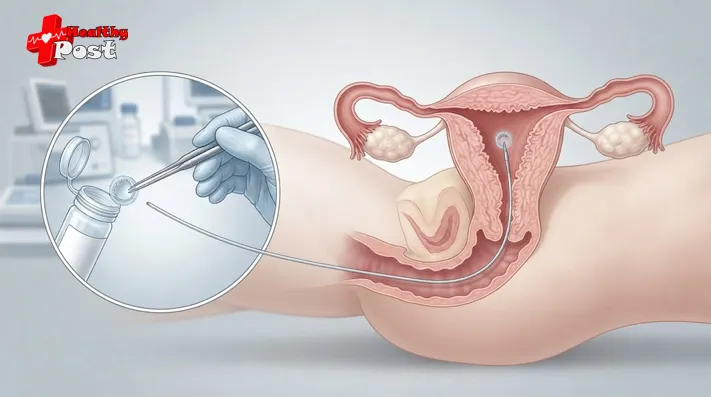
During FET, the fertility team prepares the endometrium—the inner lining of the uterus—so that its development is appropriately synchronized with the embryo. The selected embryo is then warmed in the laboratory and transferred through the cervix using a thin catheter.
One practical difference is that FET does not normally require another round of ovarian stimulation or egg collection. Those steps happened when the embryos were originally created. NHS fertility information similarly describes frozen transfer as a way to use stored embryos without another egg-collection procedure.
How Does a Frozen Embryo Transfer Work?
The basic frozen embryo transfer process involves preparing the uterine lining, monitoring the cycle, warming the selected embryo and transferring it into the uterus.
Although individual protocols differ, the main stages are fairly consistent.
1. Preparing the uterine lining
The endometrium needs to be appropriately developed and synchronized with the embryo.
There are two common approaches:
- Natural FET: The clinic monitors the patient’s natural cycle and identifies ovulation.
- Medicated FET: Hormonal medication is used to prepare the uterine lining and establish the timing of transfer.
A person who ovulates regularly may be suitable for a natural frozen embryo transfer. A medicated cycle may be used when ovulation is irregular or absent, or when the fertility specialist considers hormonal preparation more appropriate.
2. Monitoring the cycle
Monitoring may include ultrasound examinations and, depending on the protocol, blood or urine hormone testing.
In a natural cycle, monitoring helps identify follicular development and ovulation. In a medicated cycle, ultrasound can be used to assess the thickness and appearance of the endometrium before the transfer is scheduled.
For people trying to understand their menstrual cycle more generally, HealthyPost also has a related guide on cycle-tracking apps and clinical accuracy, although fertility-clinic monitoring should not be replaced by an app.
3. Embryo thawing
The embryology laboratory warms the selected frozen embryo before transfer.
Not every embryo survives the freezing and warming process, although most do. HFEA explains that embryos that survive may occasionally lose a cell or two and can subsequently recover; the laboratory assesses whether the embryo remains suitable for transfer.
4. Embryo assessment
After warming, embryologists examine the embryo according to the laboratory’s protocol.
Embryos can be frozen at different developmental stages. Many modern IVF programs commonly use blastocyst-stage embryos, which have developed for around five or six days after fertilisation.
The embryo’s appearance after warming is one part of the clinical assessment. It does not, by itself, guarantee implantation or pregnancy.
5. Embryo transfer
The actual frozen embryo transfer procedure is generally brief.
The clinician guides a thin, flexible catheter through the cervix and into the uterus. The embryo is then released into the uterine cavity. Ultrasound guidance may be used to help position the catheter.
The procedure does not normally involve surgery or general anesthesia.
6. Medication and follow-up
Depending on the protocol, the patient may receive progesterone or other hormonal support before and/or after transfer.
Medication schedules differ, so patients should follow the exact instructions provided by their fertility clinic rather than copying a schedule used by someone else.
Frozen Embryo Transfer Timeline
The frozen embryo transfer timeline varies considerably. A natural cycle is organized around ovulation, while a medicated cycle is scheduled according to hormonal treatment and the development of the uterine lining.
| Stage | What usually happens |
|---|---|
| Cycle preparation | The clinic establishes whether a natural or medicated protocol will be used |
| Lining preparation | Natural ovulation is monitored or hormones are used to prepare the endometrium |
| Monitoring | Ultrasound and, when appropriate, hormone testing assess cycle development |
| Transfer timing | The uterine lining is synchronized with the embryo’s developmental stage |
| Embryo warming | The selected frozen embryo is warmed in the laboratory |
| Embryo assessment | The embryology team checks whether the embryo has survived warming and is suitable for transfer |
| Transfer | A thin catheter places the embryo into the uterus |
| Follow-up | Prescribed medication continues and the clinic provides a pregnancy-test date |
There is therefore no universal “day 5” or “day 10” FET schedule that applies to everyone. The exact timing is determined by the embryo stage, ovulation or hormonal preparation and the clinic’s protocol.
Natural vs Medicated Frozen Embryo Transfer
Natural FET cycle
A natural FET uses the patient’s own ovulatory cycle to determine when transfer should occur.
The clinic may monitor follicle development, ovulation and hormonal changes. Once the timing is established, the embryo transfer is coordinated with the endometrial changes that normally occur after ovulation.
This approach may be appropriate for someone who ovulates regularly.
Medicated FET cycle
A medicated, or programmed, FET uses hormones to prepare the endometrium and control the timing of transfer.
Depending on the protocol, estrogen may be used to develop the uterine lining, followed by progesterone to create the hormonal environment needed for embryo transfer. Some protocols also suppress natural ovarian activity.
Neither approach is universally appropriate. The choice should be based on the patient’s reproductive history and the fertility team’s assessment.
Frozen vs Fresh Embryo Transfer
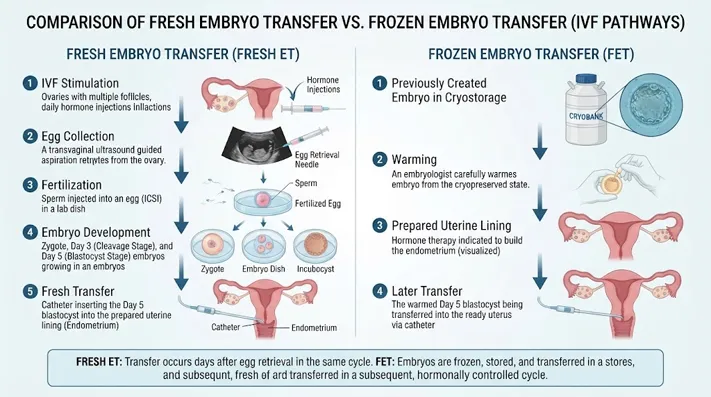
The main difference between frozen vs fresh embryo transfer is when the embryo is transferred.
| Feature | Frozen embryo transfer | Fresh embryo transfer |
|---|---|---|
| Embryo | Previously frozen and later warmed | Transferred without prior freezing |
| Egg collection immediately before transfer | No | Usually part of the IVF cycle |
| Embryo warming | Required | Not required |
| Ovarian stimulation immediately before transfer | Not normally required | Usually used to obtain eggs |
| Uterine preparation | Natural or medication-based | Occurs within the IVF treatment cycle |
| Timing | Later than egg collection | Usually shortly after embryo development |
FET can therefore allow an embryo from an earlier IVF cycle to be used without repeating ovarian stimulation and egg collection.
However, frozen does not automatically mean better than fresh. The people undergoing each type of transfer can differ substantially. HFEA specifically cautions that birth rates from fresh and frozen transfers are not directly comparable because, among other factors, embryos selected for freezing may already have demonstrated sufficient quality for storage.
How Long Does a Frozen Embryo Transfer Take?
The embryo transfer itself is usually much shorter than the preparation leading up to it.
On transfer day, the selected embryo is warmed according to laboratory procedures and assessed. The clinician then places it into the uterus using a catheter.
Because the embryo was created previously, the FET cycle does not normally require another egg collection.
The overall preparation can take days or several weeks depending on whether the cycle is natural or medicated, how quickly the endometrium develops and how the clinic schedules monitoring.
What Happens After a Frozen Embryo Transfer?
After the transfer, the embryo must implant and continue developing for pregnancy to occur.
Some people notice mild cramping, pelvic sensations or light spotting, while others notice nothing. These experiences do not reliably tell you whether implantation has occurred.
Similarly, symptoms such as breast tenderness, bloating or fatigue may be caused by hormonal medication and should not be interpreted as proof of pregnancy.
Continue prescribed medication exactly as directed. Do not stop progesterone or other fertility medicines simply because symptoms change or disappear.
Extended bed rest is generally not required after embryo transfer. NHS fertility information notes that patients can normally empty their bladder after transfer without dislodging the embryo.
If significant pain, heavy bleeding, fainting, severe weakness or other concerning symptoms develop, contact the fertility clinic or seek appropriate medical care.
When Can You Take a Pregnancy Test After FET?
There is no single pregnancy-test day that applies to every FET cycle.
The timing depends on the clinic’s protocol, the embryo stage and the date of transfer. Your fertility clinic should give you a specific testing date.
Testing substantially earlier can create unnecessary uncertainty. A negative result may be too early to interpret, while some medications and treatment circumstances can complicate the timing of results.
Following the clinic’s testing instructions is therefore more useful than relying on a generic FET calendar found online.
Frozen Embryo Transfer Success Rate
The frozen embryo transfer success rate varies considerably among individuals and clinics.
Important factors include:
- Age when the eggs were collected
- Embryo quality and developmental stage
- Whether the embryos were created using the patient’s own or donor eggs
- Reproductive and uterine factors
- Previous fertility treatment
- Laboratory practices
- Whether the statistic measures pregnancy, clinical pregnancy or live birth
What do UK statistics show?
HFEA’s latest published 2024 report states that the average IVF birth rate was 30% per embryo transferred for the reported combined fresh and frozen IVF population using patient eggs. The rate was 38% among patients aged 18–34 and 8% among patients aged 43–44. These are population-level figures rather than individual predictions.
For frozen transfers specifically, HFEA’s 2023 report reported an average pregnancy rate of 39% per frozen embryo transferred and a preliminary birth rate of 33% per frozen embryo transferred. HFEA also explains that frozen-transfer outcomes are substantially related to the patient’s age at egg collection rather than simply age at the later embryo-transfer date.
These statistics should not be interpreted as a personal probability. An individual’s chance may be considerably different depending on embryo characteristics, age at egg collection, reproductive history and other clinical factors.
Is FET More Successful Than Fresh Transfer?
It is easy to assume that FET must be more successful because some reported frozen-transfer statistics are higher than corresponding fresh-transfer figures.
That conclusion is too simple.
The two groups are not necessarily comparable. Patients who undergo frozen transfer may have embryos that were good enough to be frozen, and the circumstances leading to freezing can differ from those leading to fresh transfer.
HFEA explicitly warns that fresh and frozen transfer populations should not be directly compared as though they were identical groups.
Similarly, HFEA states that evidence does not establish that an elective “freeze-all” strategy should universally replace conventional IVF or ICSI to increase the chance of having a baby.
The relevant question is therefore not simply “Which has the higher percentage?” It is which treatment strategy is appropriate for the individual’s circumstances.
What Happens If the Embryo Does Not Survive Thawing?
Most embryos survive modern warming procedures, but survival is not guaranteed.
If an embryo does not survive adequately for transfer, the embryology team will inform the patient and explain the available options. If additional suitable embryos are stored, the clinic may discuss whether another embryo can be warmed, depending on the treatment plan and consent arrangements.
HFEA notes that occasionally no embryos survive the freezing and thawing process.
This is one of the practical questions worth discussing with the clinic before the FET cycle begins.
Possible Risks and Side Effects of FET
FET is an established fertility treatment, but pregnancy following fertility treatment can involve certain risks.
Multiple pregnancy
Transferring more than one embryo increases the chance of twins or higher-order multiple pregnancy. Multiple pregnancy carries greater risks for both the pregnant patient and babies, including complications associated with prematurity.
For this reason, fertility services often consider single embryo transfer when clinically appropriate.
Ectopic pregnancy
An ectopic pregnancy occurs when an embryo implants outside the uterus, most commonly in a fallopian tube.
The risk following fertility treatment is relatively low, but it is an important complication to recognize. Severe or one-sided pelvic pain, significant bleeding, dizziness or fainting during early pregnancy warrants urgent medical assessment.
High blood pressure and preeclampsia
HFEA reports a slightly increased risk of pre-eclampsia and hypertension following fertility treatment compared with natural conception. Some research also suggests that programmed or medicated FET cycles may carry a higher risk of hypertensive disorders during pregnancy than natural-cycle FET.
This is an area where research is still developing, and an association does not mean that an individual patient will develop hypertension.
Large-for-gestational-age birth
HFEA notes that some research has found a higher likelihood of large-for-gestational-age babies following frozen embryo transfer compared with some fresh-transfer groups. The reasons are not completely understood, and this evidence should not be interpreted as meaning that FET is unsafe overall.
Miscarriage
Miscarriage can occur after FET, just as it can after other forms of conception. Risk depends on multiple factors, including age, embryo characteristics and underlying reproductive factors.
Embryo loss during warming
A small proportion of embryos may not survive the freeze-thaw process sufficiently for transfer.
Does FET Cause Ovarian Hyperstimulation Syndrome?
A FET cycle itself does not normally involve the ovarian stimulation and egg collection used to produce multiple eggs during an IVF cycle.
As a result, someone undergoing only an FET does not generally face the same immediate ovarian-hyperstimulation exposure associated with the egg-collection phase of IVF.
This is one practical difference between FET and beginning another complete IVF cycle.
Is Frozen Embryo Transfer Painful?
Most embryo transfers do not require surgery or general anesthesia.
A thin catheter passes through the cervix into the uterus, and the embryo is released into the uterine cavity. Some patients experience mild cramping or discomfort, while others find the procedure relatively comfortable.
The experience varies from person to person.
Significant or persistent pain after transfer should be discussed with the fertility clinic because pain severity alone cannot establish whether implantation has occurred or whether treatment has failed.
Does FET Require IVF Injections?
Not necessarily.
FET does not normally require the ovarian-stimulation injections used to produce multiple eggs because the embryo already exists.
However, a medicated FET can involve estrogen, progesterone or other hormonal medicines. A natural-cycle FET may involve considerably less medication when regular ovulation occurs.
The medication plan should always come from the treating fertility team.
Who May Have a Frozen Embryo Transfer?
FET may be an option for someone who has suitable stored embryos from:
- A previous IVF or ICSI cycle
- A cycle in which all suitable embryos were frozen for later transfer
- Fertility preservation
- Treatment involving donor eggs or embryos, where appropriate
- A previous treatment cycle in which additional embryos were preserved
The exact legal, consent and storage arrangements vary between countries and clinics.
Frequently Asked Questions
1. Is a frozen embryo transfer the same as IVF?
FET is a form of assisted reproductive treatment, but it is not the same as completing a full IVF cycle. The egg collection and fertilisation have already occurred when the embryo was originally created.
2. How does a frozen embryo transfer work?
The uterine lining is prepared through a natural ovulatory cycle or medication. The selected embryo is then warmed in the laboratory and transferred into the uterus through a thin catheter.
3. Can you have a natural frozen embryo transfer?
Yes. A natural FET can be performed when ovulation occurs regularly. The clinic monitors the cycle and schedules transfer according to ovulation and the embryo’s developmental stage.
4. Does FET require egg collection?
Usually no. The embryo has already been created and stored, so another egg-collection procedure is not normally needed for the FET cycle.
5. Can you feel implantation after FET?
Some people experience cramping or other sensations, while others have no symptoms. Symptoms cannot reliably confirm implantation or pregnancy.
6. When should you take a pregnancy test after FET?
Use the date provided by your fertility clinic. Testing too early may make the result difficult to interpret, and protocols vary between clinics.
Key Takeaway
A frozen embryo transfer (FET) allows an embryo created during an earlier IVF or ICSI cycle to be warmed and transferred into the uterus at a later time. The process generally involves preparing the uterine lining, monitoring the cycle, warming and assessing the embryo, performing the transfer and following the clinic’s pregnancy-testing plan.
FET can be performed using a natural or medicated cycle and normally avoids another round of ovarian stimulation and egg collection.
FET has become increasingly common. HFEA reports that frozen embryo transfers represented 48% of IVF cycles in the UK in 2024. Its 2023 data reported a 39% average pregnancy rate and 33% preliminary birth rate per frozen embryo transferred, while its newer 2024 report reports a 30% average birth rate per embryo transferred for the specified combined fresh-and-frozen IVF population. These figures describe treatment populations rather than an individual’s personal chance of success.
If you are considering FET, useful questions for your fertility specialist include which type of cycle is appropriate, how the uterine lining will be monitored, which embryo will be selected, what medication is required, when the pregnancy test should be taken and which risks are particularly relevant to you.
Medical information online can help you understand the process, but your fertility clinic remains the appropriate source for an individualized treatment plan.
References
- Human Fertilisation and Embryology Authority (HFEA) — Fertility treatment 2024: trends and figures
- Human Fertilisation and Embryology Authority (HFEA) — Fertility treatment 2023: trends and figures
- HFEA — Embryo freezing and Risks of fertility treatment