


Clinical Authorship & Verification
This article has been written and verified by Dra. Ana Escobar (Pediatrician, FMUSP / Official ↗), specializing in pediatric health, early diagnostics, and clinical manifestations in children.
Medical Disclaimer: The information provided on Healthy Post is for educational and informational purposes only and does not constitute formal medical advice, diagnosis, or treatment. Pediatric nail changes and dermatological conditions can sometimes reflect underlying systemic health issues. Always consult a qualified pediatrician or pediatric specialist for professional evaluation, diagnosis, and personalized medical care for your child.

🏥 Medical Review Board Member
Dra. Ana Escobar, MD
Pediatrician | Professor, Faculty of Medicine FMUSP
Dra. Ana Escobar is a prominent pediatrician, medical doctor, and professor in the Department of Pediatrics at the Faculty of Medicine of the University of São Paulo (FMUSP). With an extensive background in clinical practice and mainstream health communication, she is dedicated to translating evidence-based pediatric medicine and family wellness into clear, accessible guidance. Dra. Escobar ensures that health content meets the highest standards of medical accuracy, clinical integrity, and patient safety.
Nail disease in children may be an early sign of some congenital, hereditary or systemic diseases. Timely identification and correct treatment are crucial. If parents find abnormalities in their children’s nails, do not underestimate these early manifestations. When the diagnosis is unclear, it is necessary to perform genetic testing or nail biopsy to rule out potential serious diseases.
The treatments for nail diseases caused by different reasons are completely different, and the prognosis varies. Our department now has a nail disease clinic every Tuesday afternoon, where dermoscopy, nail biopsy, nail tissue pathology, genetic testing and other related inspections and tests are carried out. We hope that through early diagnosis and early treatment, we can avoid the further development of some systemic diseases and improve the prognosis of the disease.
When it comes to nail diseases, do many parents only know about “onychomycosis (onychomycosis)”?
In fact, nail diseases in children may be caused by a variety of causes, including congenital, genetic factors, infections, tumors and manifestations of systemic diseases.
1. Congenital/hereditary nail disease
Hidrotic ectodermal dysplasia: It is a group of complex congenital diseases characterized by changes in ectodermal structures (hair, nails, teeth and sweat glands). The changes in nails are non-specific and include no nails, micro-nail, thinning, thickening, etc.

2. Congenital pachyonychia:
The free edge of the nail is thickened, and the degree of thickening is obvious.
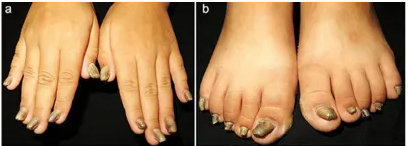
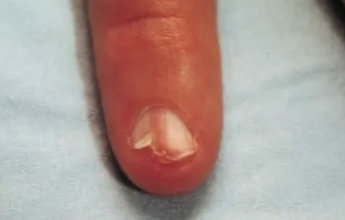
3. Follicular keratosis pilaris (Darier disease):
This disease is characterized by excessive keratosis under the nail, brittle nails, white or red longitudinal lines, and triangular defects on the free edge of the nail.
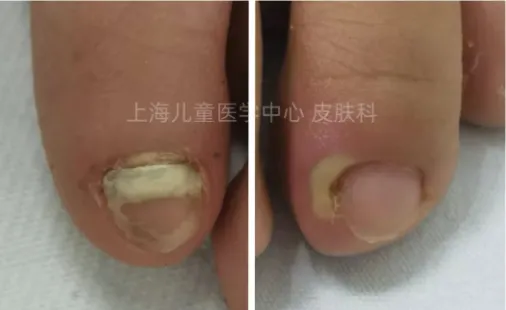
2. Infectious
1. Onychomycosis: a common nail disease caused by fungal infection.
2. Viral infections: including common warts, herpetic whitlow, and nail changes during the recovery period of hand, foot and mouth disease.
3. Bacterial infection: such as paronychia and vesicular distal dactylitis.
3. Nail Tumor
1. Benign tumors: including fibroma, bone warts, glomus tumor, mucocele, nail matrix nevus, etc.
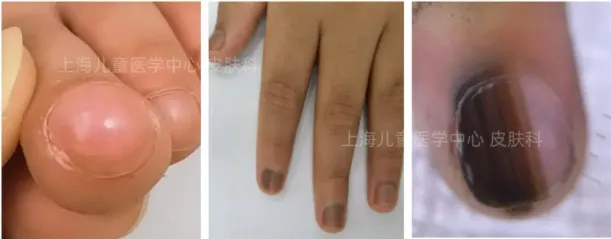
2. Malignant tumors: such as squamous cell carcinoma and malignant melanoma.
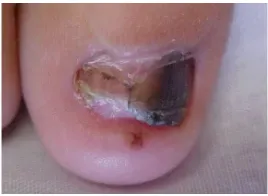
4. Inflammatory
1. Linear lichen nail lesions: usually affect multiple nail plates, simple nail lesions are rare, but the damage is reversible. It manifests as thinning of the nail plate, longitudinal ridges, splitting and excessive keratinization.
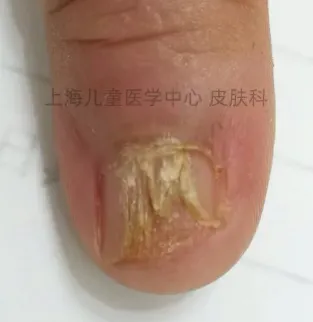
2. Lichen planus nail lesions: can occur alone on the nail, manifested as longitudinal ridges, grooves, thinning, brittle nails, and excessive subungual keratinization, and are characterized by nail atrophy, shedding, and pterygium (the nail matrix is destroyed and the nail plate disappears, the nail cuticle of the proximal nail fold overgrows and adheres to the nail bed, which is an irreversible damage).
3. Psoriatic nail damage: Common manifestations include irregular punctate depressions, oil droplet-like spots, and nail detachment with erythematous borders.
4. Alopecia areata nail damage: the nail plate becomes rough and thickened, and its glossiness decreases.
5. Atopic dermatitis, rough nail disease, ingrown nails, and pincer nails: These also fall into the category of inflammatory nail diseases.
5. Systemic diseases
Systemic diseases such as anemia, diabetes, connective tissue disease, porphyria, shell nail syndrome and peripheral vascular disease may also cause nail involvement, which may manifest as nail separation, onychomycosis, reverse onychomycosis, absent onychomycosis, spoon-shaped onychomycosis, thimble nail, and longitudinal ridges of the nail.
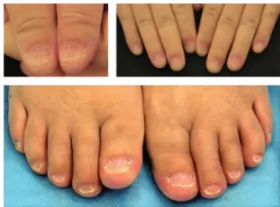
(Systemic amyloidosis causes lichen planus-like nail changes: atrophy, thinning and longitudinal striations of the nail plate)
6. Traumatic nail disease
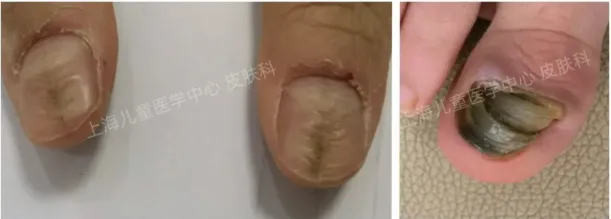
1. Onychophagia and onychotillomania: It manifests as midline nail dystrophy (a form of onychotillomania), with an inverted fir-tree pattern in the middle of the nail or wavy horizontal grooves on the surface, usually related to damage to the nail matrix caused by repeated pressure and friction.
2. Dotted white nails and inverse nails: caused by different traumas or pressures.
Frequently Asked Questions
What are the early signs of nail disease in children?
Early manifestations of nail conditions in children can include changes in nail color, texture, shape, or growth patterns. Parents may notice pitting, white spots, splitting, thickening, or lifting of the nail plate (onycholysis), which can sometimes point to underlying dermatological or systemic issues.
Are pediatric nail changes always a sign of a serious medical condition?
Not necessarily. Many nail anomalies in children are benign and temporary, often resulting from minor finger trauma, nail-biting, or harmless developmental variations. However, persistent changes should be evaluated to rule out fungal infections, eczema, psoriasis, or systemic conditions.
Can nutritional deficiencies affect a child’s nails?
Yes, certain vitamin and mineral deficiencies (such as iron deficiency or zinc imbalances) can alter nail growth and structure, occasionally causing brittle nails or characteristic spoon-shaped depressions (koilonychia).
How are pediatric nail disorders diagnosed?
Diagnosis typically begins with a thorough physical examination of the child’s nails, hands, and feet by a qualified pediatrician or pediatric dermatologist. Depending on the visual findings, they may inquire about family history, recent illnesses, or recommend specialized tests like a fungal culture if an infection is suspected.
When should I consult a pediatrician about my child’s nails?
You should schedule an appointment with a healthcare professional if your child experiences persistent pain, swelling, redness around the nail fold (paronychia), severe deformity, or if the nail changes are accompanied by other systemic symptoms like chronic fatigue or skin rashes.
1 Comment
Pingback: Onychomycosis ICD 10: Symptoms, Causes, Diagnosis, treatment