


Medical Accuracy Verified
This article has been written and clinically verified by Dr. Sana Lodhi, MBBS.
Medical Disclaimer: The content on Healthy Post is for educational and informational purposes only. Understanding what is cytology helps patients appreciate the critical role of microscopic single-cell examinations, such as Pap smears, fine-needle aspirations (FNA), and fluid scrapings, in detecting precancerous changes, infectious agents, and inflammatory diseases. However, cytology screenings look at isolated cellular characteristics rather than whole tissue architecture, meaning they occasionally require confirmation through a core tissue biopsy (histopathology). Always consult a qualified physician, pathologist, or oncologist to interpret diagnostic laboratory reports or establish appropriate clinical follow-ups.
If you have ever wondered what is cytology, you are not alone. Many people first hear the term after a Pap smear, a needle test for a lump, or lab results from a doctor. The word can sound technical, but the idea is simple. Cytology is the study of cells under a microscope to look for signs of disease.
In modern medicine, cytology helps doctors detect cancer, infections, and inflammatory conditions early. It is often faster and less invasive than a surgical biopsy. It also plays a major role in public health, especially in cervical cancer screening.
This guide explains what is cytology test, how it works, when doctors use it, and how new advances like HPV testing and AI are changing the field.
1. What Is Cytology?
At its core, cytology is the microscopic study of individual cells or small groups of cells. These cells may come from body fluids, scraped surfaces, or a lump sampled with a fine needle.
Doctors use cytology to answer important questions, such as:
- Are these cells normal or abnormal?
- Is there evidence of infection?
- Could this be inflammation?
- Are there signs of precancer or cancer?
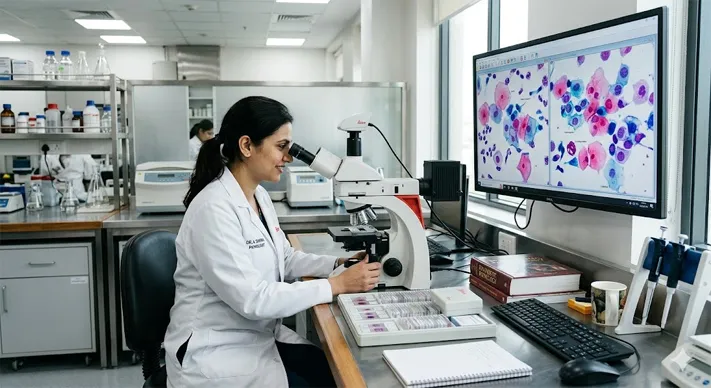
A pathologist or cytologist studies the sample after special stains are applied. The appearance of the cells can reveal a great deal about what is happening in the body.
A simple way to think about it is this: histology looks at the “neighborhood,” while cytology looks closely at the “individual houses.” Both matter, but they provide different kinds of detail.
2. Cytology vs. Histology: What’s the Difference?
People often confuse cytology with histology. They are related, but they are not the same.
Cytology focuses on single cells or tiny clusters. Histology examines larger tissue samples and shows how cells are arranged within tissue architecture.
Here is a quick comparison:
| Feature | Cytology Test | Biopsy/Histology |
|---|---|---|
| Sample size | Few cells or small clusters | Larger tissue piece |
| Invasiveness | Usually less invasive | More invasive |
| What it shows | Cellular changes | Tissue structure and cellular detail |
| Turnaround time | Often 1–7 days | Often 1–2 weeks |
| Risk level | Minimal in most cases | Higher risk of bleeding or infection |
| Common use | Screening, quick evaluation | Confirming diagnosis, staging |
Cytology is often the first step. If results are unclear, a biopsy may follow.
3. What Is a Cytology Test?
So, what is cytology test in practical terms? It is a medical test that collects cells from the body and examines them for abnormal changes.
The sample can come from several methods:
Exfoliative cytology
This uses cells that naturally shed into body fluids.
Examples include:
- Urine
- Sputum
- Pleural fluid
- Peritoneal fluid
- Cerebrospinal fluid
Abrasive cytology
This involves scraping, brushing, or washing cells from a surface.
Examples include:
- Pap smear from the cervix
- Bronchial brushing during bronchoscopy
- Endoscopic brushing from the digestive tract
Fine-needle aspiration cytology
This uses a thin needle to remove cells from a lump, nodule, or fluid collection.
Common sites include:
- Thyroid nodules
- Breast lumps
- Lymph nodes
- Salivary glands
In daily care, this matters because a less invasive test can often provide fast answers. For someone with a neck lump or an abnormal screening test, that speed can reduce stress and guide the next step.
4. How a Cytology Test Works
Understanding the process makes the test feel less intimidating.
Step 1: Sample collection
A healthcare professional collects cells using fluid sampling, scraping, brushing, or a fine needle.
Step 2: Slide preparation
The sample is placed on a slide or in a liquid preservative. It is then stained with dyes that make cell details easier to see.
Step 3: Microscopic review
A cytologist or pathologist studies the sample. They look at the cell size, shape, arrangement, and nuclear features.
Step 4: Reporting the findings
The final report may describe the sample as:
- Normal
- Benign
- Inflammatory
- Infectious
- Atypical
- Precancerous
- Suspicious for malignancy
- Malignant
Results often return within a few days, though timing depends on the lab and test type.
5. Why Cytology Matters in Medicine
When people ask what is cytology, they usually want to know why it matters. The answer is simple: it helps detect disease early, often before symptoms become severe.
Cancer detection
Cytology is widely used to look for cancers such as:
- Cervical cancer
- Bladder cancer
- Lung cancer
- Thyroid cancer
- Breast cancer
- Lymph node cancers
A Pap smear is one of the best-known examples. It identifies abnormal cervical cells before they turn into cancer.
Infection diagnosis
Cytology can reveal signs of infection from:
- Bacteria
- Viruses
- Fungi
- Parasites
For example, cells in sputum may suggest a lung infection. Fluid from around the lungs may also show inflammation or infection.
Inflammatory diseases
Some inflammatory conditions leave distinct cellular patterns. Cytology can support the diagnosis of disorders such as sarcoidosis or chronic inflammatory changes.
Prenatal and specialized testing
In some settings, cell-based analysis is used in prenatal screening and other highly specialized diagnostic work.
This broad use is why cytology remains a cornerstone of medicine, even as newer technologies emerge.
6. Common Examples of Cytology Tests
Some cytology tests are part of routine screening. Others are ordered when symptoms or imaging raise concern.
Pap smear
This checks cervical cells for abnormal changes. It is one of the most important screening tools in women’s health.
Urine cytology
This looks for abnormal cells in urine, often when there is blood in the urine or concern for bladder cancer.
Sputum cytology
This examines mucus coughed up from the lungs. It may help investigate lung cancer or certain infections.
Fine-needle aspiration
This is commonly used for thyroid nodules, breast lumps, and enlarged lymph nodes.
Body fluid cytology
Doctors may examine fluid from the chest or abdomen to check for infection, inflammation, or cancer spread.
For evidence-based screening guidance, the WHO cervical cancer resources provide current public health recommendations.
7. Advantages of Cytology Tests
Cytology is widely used because it offers several practical benefits.
Less invasive
Many tests require only a swab, a fluid sample, or a thin needle.
Faster results
Results often come back within 1 to 7 days.
Lower cost
Cytology is generally more affordable than surgical biopsy.
Lower complication risk
Most procedures have minimal recovery time and few side effects.
Useful as a first step
It can help doctors decide whether more testing is needed.
For patients, that often means less discomfort and less waiting. In medicine, those two things matter more than most people realize.
8. Limitations and Risks to Know
No medical test is perfect. Cytology has important limitations.
Limited sample size
Because only a small number of cells are collected, abnormal cells can sometimes be missed.
Less architectural detail
Cytology shows cellular changes, but not the full tissue pattern. That means it cannot always replace histology.
False negatives and false positives
A test may miss disease or suggest a problem that later proves harmless.
Minor procedure risks
Fine-needle aspiration can rarely cause:
- Minor bleeding
- Mild pain
- Local infection
This is why doctors interpret cytology results alongside symptoms, imaging, and clinical history.
9. New Trends: HPV Testing, AI, and Digital Cytology
The answer to what is cytology is evolving. Cytology is still essential, but it now works alongside newer tools.
HPV testing and cervical cancer prevention
Global screening is shifting toward HPV-based testing. Cytology is increasingly used as a follow-up tool rather than the only screening method.
Recent WHO guidance supports dual-stain cytology after positive HPV tests in cervical cancer prevention programs. This approach helps identify people who need closer evaluation.
AI-powered diagnostics
Artificial intelligence is being developed to assist with slide review. These systems can help flag suspicious cells and improve consistency.
AI does not replace pathologists. It supports them, especially in busy labs.
Digital cytology and telecytology
More labs now use digital slide imaging. This allows remote review, faster consultation, and improved access where specialists are limited.
New non-invasive options
Researchers are studying urine-based DNA methylation tests for bladder cancer and computer vision tools for fluid cytology. These innovations may expand early detection with less discomfort.
For broader cancer screening and diagnostic context, the National Cancer Institute offers reliable medical information.
10. When Your Doctor May Recommend Cytology
A doctor may order cytology if you have:
- An abnormal screening result
- A lump or swollen lymph node
- Blood in the urine
- Persistent cough with concerning symptoms
- Fluid buildup around the lungs or abdomen
- A suspicious thyroid nodule
For example, a person with a new thyroid lump may have an ultrasound first. If the nodule looks suspicious, fine-needle aspiration cytology can help determine whether it appears benign or concerning.
FAQs About Cytology
Is cytology the same as a biopsy?
No. Cytology studies individual cells. A biopsy examines a larger tissue sample.
Is a cytology test painful?
Most cytology tests cause little discomfort. A fine-needle aspiration may feel like a brief pinch.
1. Is cytology the same as a biopsy?
No. Cytology studies individual cells. A biopsy examines a larger tissue sample.
2. Is a cytology test painful?
Most cytology tests cause little discomfort. A fine-needle aspiration may feel like a brief pinch.
3. How long do cytology results take?
Many results come back within 1 to 7 days, depending on the test and lab.
4. Can cytology detect cancer?
Yes. Cytology can detect cancerous and precancerous cell changes, but some cases need biopsy confirmation.
5. What happens if cytology is abnormal?
Your doctor may recommend repeat testing, imaging, HPV testing, colposcopy, or biopsy.
6. Is cytology still important if HPV testing is available?
Yes. Cytology remains an important companion tool, especially in cervical cancer screening and triage.
Internal Linking Suggestions
You could naturally link this article to related content using anchor phrases like:
- signs and symptoms of cervical cancer
- fine needle aspiration procedure
- difference between biopsy and pathology report
Conclusion
By now, the question what is cytology should feel much clearer. Cytology is the study of cells to detect disease, often in a fast and minimally invasive way. It helps doctors screen for cancer, investigate infections, and assess inflammation. It is especially valuable when quick answers matter.
Today, the role of cytology is expanding. It now works alongside HPV testing, digital imaging, and AI-assisted analysis. That makes it both a long-standing tool and a modern one.
If your doctor recommends a cytology test, ask what kind of sample is being collected, what the results may show, and whether follow-up testing might be needed. Understanding the process can make the experience feel more manageable and far less overwhelming.
References
- World Health Organization. Cervical cancer screening and prevention guidance.
- MedlinePlus. Pap test and cytology-related lab information.
- National Cancer Institute. Cancer diagnosis and pathology basics.