


This article has been written by Dr. Mohammad Kamruzzaman (Plastic & Reconstructive Surgery, Dhaka Medical / Ibn Sina), specializing in body contouring procedures, liposuction techniques, and post-operative aesthetic patient care.
Medical Disclaimer: The information provided regarding Lipo 360 procedures, recovery timelines, costs, and before-and-after expectations is for educational and informational purposes only. Surgical body contouring carries inherent medical risks, and individual results, healing speeds, and candidacy vary based on unique physiological factors. Always consult a board-certified plastic surgeon or qualified healthcare professional before deciding to undergo any cosmetic surgical procedure.

🏥 Medical Review Board Member
Dr. Mohammad Kamruzzaman, MBBS, FCPS
Plastic & Reconstructive Surgeon | Associate Professor, Dhaka Medical College & Hospital
Dr. Mohammad Kamruzzaman is a prominent plastic, reconstructive, and burn surgeon serving as an Associate Professor in the Department of Burn & Plastic Surgery at Dhaka Medical College & Hospital. With extensive clinical expertise and advanced surgical credentials, he is dedicated to providing evidence-based medical oversight and translating specialized clinical care into clear, reliable guidance. Dr. Kamruzzaman ensures that health and surgical content on Healthy Post meets the highest standards of medical accuracy, clinical integrity, and patient safety.
If you have stubborn fat around your stomach, waist, flanks and back, Lipo 360 may sound like a way to reshape the entire midsection at once. The name refers to circumferential liposuction, in which a surgeon contours multiple areas around the torso rather than concentrating on one isolated pocket of fat. It is a body-contouring procedure, not a substitute for weight-loss treatment, and the exact areas included can vary between surgeons.
Before considering surgery, it helps to understand what the procedure actually involves, what results are realistic, how long recovery may take, and what you should expect to pay. Just as importantly, the surgeon, anesthesia plan, facility and postoperative care deserve as much attention as the advertised price.
What Is Lipo 360?
Lipo 360, also called 360-degree liposuction or circumferential liposuction, is an approach to liposuction that treats several connected areas around the midsection.
Depending on the surgeon’s treatment plan, these may include:
- Upper and lower abdomen
- Waist
- Flanks or love handles
- Obliques
- Lower back
- Parts of the mid-back
There is no universally standardized definition of exactly what a “360” package must include. One clinic may include the abdomen, flanks and lower back, while another may define the package differently. Ask for the exact treatment areas before comparing prices.
The goal is generally balanced body contouring. Rather than making the abdomen noticeably smaller while leaving adjacent areas untreated, the surgeon considers the front, sides and back together to create smoother transitions.
Liposuction itself uses suction to remove localized fat beneath the skin. It is not intended to treat obesity or replace healthy weight management.
How is it different from traditional liposuction?
Traditional liposuction can focus on one or several specific areas, such as the abdomen, thighs or love handles. Lipo 360 describes a broader treatment plan around the torso.
The underlying liposuction principle is not necessarily a completely different technology. The main distinction is the scope of treatment and the circumferential approach.
How Does the Lipo 360 Procedure Work?
The procedure begins with a consultation and physical assessment. Your surgeon may evaluate your fat distribution, skin elasticity, medical history, previous operations and expectations.
Before surgery, the treatment areas are typically marked while you are standing so the surgeon can plan the contour from different angles.
During liposuction, the surgeon makes small access incisions and inserts a thin tube called a cannula into the fat layer. Depending on the technique, fluid may be introduced into the area before fat is removed. The cannula is then used to suction targeted fat while the surgeon works toward an even contour.
Anesthesia varies according to the extent of treatment and the surgical setting. Some procedures use local or regional anesthesia with medication for relaxation, while others require general anesthesia.
After the procedure, the surgical team monitors you during the immediate recovery period. Compression garments are commonly recommended, although the precise instructions and duration depend on the surgeon and the individual procedure.
The objective is not to remove the maximum possible amount of fat. Excessive or uneven removal can contribute to contour irregularities, so experienced surgical planning matters.
Who Is a Good Candidate?
Liposuction is generally better suited to people who are already relatively close to a stable, healthy weight but have localized fat deposits that remain despite diet and exercise.
A potential candidate may have:
- Relatively stable body weight
- Localized fat around the abdomen, waist or back
- Adequate skin elasticity
- Good general health for elective surgery
- Realistic expectations
- A willingness to follow postoperative instructions
Skin quality is particularly important. Liposuction removes fat, but it does not remove large amounts of loose skin.
For example, someone who has lost substantial weight may have both residual fat and significant redundant skin. In that situation, liposuction alone may not create the expected result.
If loose abdominal skin is a major concern, it may be useful to understand the difference between excess fat and an overhanging fold of skin and tissue. Our guide to [apron belly] can provide additional context on why loose skin does not always disappear with further weight loss.
What Areas Does Lipo 360 Treat?
The most common treatment plan centers on the torso.
Abdomen: Fat may be removed from the upper and lower abdominal areas.
Flanks: Treating love handles can make the waist appear narrower.
Waist and obliques: Contouring these areas can improve the transition between the abdomen and hips.
Back: Depending on the plan, the surgeon may address the lower or mid-back to create a more continuous contour.
Some clinics include additional areas, such as bra-roll fat, while others charge separately. This is one reason two apparently similar Lipo 360 quotes can differ considerably.
Lipo 360 Before and After: What Results Can You Expect?
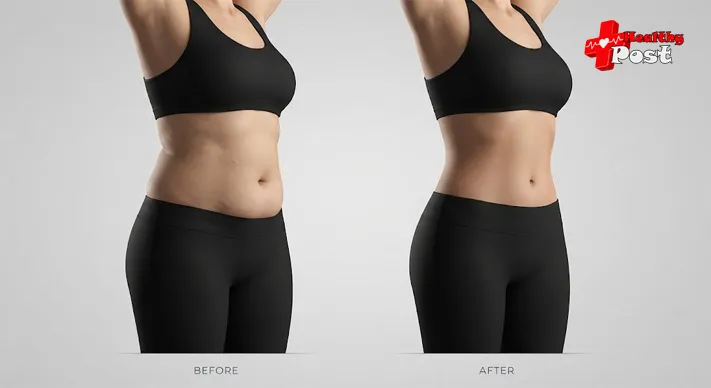
Searching for lipo 360 before and after photographs can help you understand the type of contouring a surgeon performs, but photographs should not be treated as promises.
Potential changes include:
- A smaller-looking waist
- Less prominent love handles
- A flatter-looking abdomen
- Reduced fullness around the back
- Smoother transitions between treated areas
- More balanced proportions from different angles
The final appearance depends on factors such as starting anatomy, fat distribution, skin elasticity, the amount of fat removed and individual healing.
When comparing before-and-after photographs, look for consistent conditions. Ideally, the photographs should have similar lighting, posture, camera distance, clothing and angles. Also check how long after surgery the “after” photograph was taken.
An image taken a few weeks after surgery may still show swelling, while a later image can provide a better indication of the established contour.
When Will You See Lipo 360 Results?
The result immediately after surgery is not the final result.
Swelling, bruising, fluid retention and temporary firmness can make the treated areas look different during the early recovery period. As swelling gradually subsides, the underlying contour becomes easier to see.
A general recovery pattern may look like this:
| Recovery stage | What you may notice |
|---|---|
| First several days | Swelling, bruising, soreness and tightness |
| Weeks 1–2 | Early swelling begins to settle; activity gradually increases |
| Weeks 3–6 | Contours become more noticeable as healing progresses |
| Months 2–3 | Further refinement as residual swelling decreases |
| Several months | More reliable assessment of the established contour |
These are broad expectations rather than a personal recovery schedule. Healing varies, particularly when several areas are treated during the same operation.
Lipo 360 Recovery: What to Expect
Lipo 360 recovery can be more demanding than recovery from a small, single-area liposuction procedure because a larger portion of the torso may be treated.
Common temporary effects include:
- Swelling
- Bruising
- Soreness
- Tightness
- Temporary numbness or altered sensation
- Fatigue
- Fluid drainage from small incision sites
Your surgeon may recommend walking soon after surgery to reduce prolonged inactivity, while strenuous exercise and heavy lifting are restricted until you are medically cleared.
Compression garments may be part of the postoperative plan. Medication, wound care, bathing, driving and return-to-work instructions should come directly from your surgical team rather than from a generic online timeline.
Call your medical team promptly if you develop symptoms that are concerning or substantially different from what you were told to expect. Severe breathing difficulty, chest pain, fainting or other signs of a serious complication require urgent medical attention.
How Much Does Lipo 360 Cost?
The Lipo 360 cost varies substantially according to location, surgeon, treatment scope, anesthesia, facility and technique.
For the United States, a 2025 CareCredit estimate reported an average Lipo 360 price of about $8,051, with a range of approximately $6,380 to $14,660. This should be regarded as a planning figure rather than a guaranteed price because individual surgical quotes can differ.
The American Society of Plastic Surgeons separately reports an average liposuction surgeon fee of $4,711, but emphasizes that the surgeon’s fee is only one component of the total cost.
What affects the price?
Several factors can change the final bill:
- Surgeon experience and credentials
- Geographic location
- Number and size of areas treated
- Amount of fat being removed
- Liposuction technique
- Anesthesia
- Operating-room or facility fees
- Preoperative tests
- Compression garments
- Medications
- Follow-up appointments
A very low advertised price deserves careful scrutiny if it excludes anesthesia, facility charges or postoperative care.
Lipo 360 cost in Pakistan
Current advertised pricing from one Islamabad clinic places Lipo 360 at approximately PKR 180,000–450,000. The clinic describes these as estimated prices that vary according to the treatment plan.
This should not be presented as a national Pakistan average. Surgical fees can differ substantially between Islamabad, Lahore, Karachi and other locations, as well as between surgeons and facilities.
If you are comparing Pakistani clinics, request an itemized quotation rather than relying on a promotional starting price.
What Should Be Included in the Quote?
Before paying a deposit, ask whether the quotation includes:
- Surgeon’s fee
- Anesthesia
- Surgical facility
- Preoperative testing
- Medical clearance
- Compression garment
- Prescription medications
- Follow-up visits
- Management of postoperative complications
- Any overnight or observation charges
The cheapest headline figure is not necessarily the lowest total cost.
Is Lipo 360 Safe?
Liposuction is surgery, so it carries potential risks even when performed for cosmetic purposes.
Possible complications include:
- Bleeding
- Infection
- Fluid accumulation or seroma
- Changes in skin sensation
- Irregular contours or asymmetry
- Poor wound healing
- Skin irregularities
- Anesthesia-related complications
- Blood clots and cardiopulmonary complications
- Injury to deeper structures
- The possibility of revision surgery
Risk depends partly on the patient’s health, the extent of treatment, anesthesia, the amount of fat removed and the surgical environment.
This is why choosing a qualified surgeon and appropriate accredited facility is more important than selecting a procedure based solely on price.
How to Choose a Lipo 360 Surgeon
A consultation should be more than a discussion about cost.
Ask:
- What qualifications and specialist certification do you hold?
- How frequently do you perform circumferential liposuction?
- Which exact areas will be treated?
- What anesthesia will be used?
- Where will the surgery take place?
- Is the facility appropriately accredited or licensed?
- What complications should I understand before consenting?
- Who provides follow-up care?
- What happens if I develop a complication after going home?
- Can I see before-and-after photographs of patients with similar anatomy?
In the United States, patients can verify whether a surgeon is board-certified by the American Board of Plastic Surgery. Patients elsewhere should use the relevant national medical or surgical regulatory body.
Lipo 360 vs. Traditional Liposuction
| Feature | Lipo 360 | Traditional liposuction |
|---|---|---|
| Treatment scope | Multiple areas around the torso | One or several selected areas |
| Abdomen | Commonly included | May be included |
| Flanks | Commonly included | May be included |
| Back | Commonly considered | Optional depending on plan |
| Main goal | Circumferential body contouring | Targeted fat removal |
| Overall treatment extent | Often broader | Depends on selected areas |
| Weight-loss procedure | No | No |
The key difference is the extent and planning of treatment, not necessarily a completely different form of liposuction.
Lipo 360 vs. Tummy Tuck
Lipo 360 and a tummy tuck address different problems.
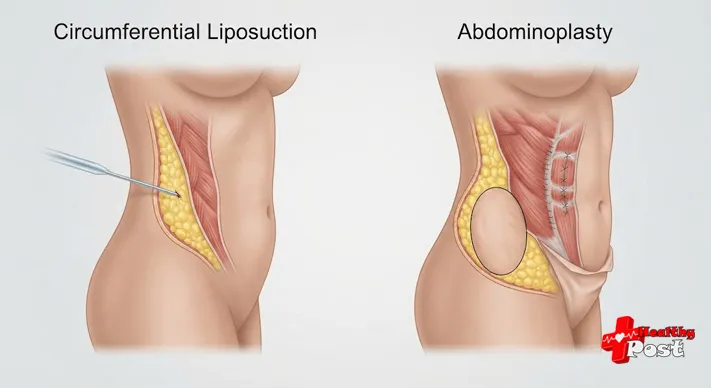
Liposuction primarily removes localized fat. A tummy tuck, medically called abdominoplasty, can remove excess abdominal skin and fat and may tighten the underlying abdominal tissues when appropriate.
That distinction matters for people who have loose skin after pregnancy or substantial weight loss. Removing fat from loose skin does not automatically make the skin tight.
Someone with good skin elasticity and localized fat may be considered for liposuction. Someone with significant redundant skin may need to discuss abdominoplasty or another body-contouring procedure with a qualified surgeon.
Is Lipo 360 a Weight-Loss Procedure?
No. The primary purpose is body contouring, not major weight reduction.
Someone may weigh less after fat removal, but liposuction is designed to change the shape and proportions of selected areas. People who need substantial weight loss generally require a different approach involving nutrition, physical activity and, when medically appropriate, evidence-based obesity treatment.
Expecting Lipo 360 to produce major weight-loss results can lead to unrealistic expectations.
How Long Do Lipo 360 Results Last?
Fat cells removed by liposuction are permanently removed from the treated areas. However, this does not prevent future weight gain.
The remaining fat cells can enlarge if body weight increases substantially, and body composition naturally changes with aging.
For that reason, maintaining a relatively stable weight is important if you want to preserve the contour achieved through surgery.
The procedure should therefore be viewed as a long-term body-contouring intervention, not permanent protection against future changes in body weight.
Frequently Asked Questions
What is Lipo 360?
Lipo 360 is a form of circumferential liposuction that treats multiple areas around the midsection, commonly including the abdomen, waist, flanks and back. The exact treatment areas vary between surgeons.
How much does Lipo 360 cost?
In the United States, a 2025 CareCredit estimate reported an average of about $8,051, with a range of roughly $6,380–$14,660. Prices in other countries can be substantially different, and the final quote depends on the surgeon, facility, anesthesia and treatment plan.
How long does Lipo 360 recovery take?
Early recovery commonly involves swelling, bruising and soreness for days to weeks. Most visible contour improvement develops progressively as swelling resolves, while the final result can take several months to assess.
Is Lipo 360 the same as regular liposuction?
It uses the same basic fat-removal principle, but Lipo 360 generally refers to treating multiple areas around the torso rather than concentrating on one isolated area.
Is Lipo 360 a weight-loss procedure?
No. Liposuction is primarily a body-contouring procedure. It is intended to remove localized fat and improve proportions rather than provide major overall weight loss.
Are Lipo 360 results permanent?
The fat cells removed from treated areas are permanently removed, but future weight gain can enlarge remaining fat cells and change your overall body shape. Maintaining a stable weight helps preserve the result.
Final Takeaway
Lipo 360 can be an effective option for selected people who want to improve the contour of their abdomen, waist, flanks and back, but the procedure is more nuanced than the name may suggest. “360” does not guarantee that every clinic treats exactly the same areas, and the best candidates are generally people seeking localized body contouring rather than major weight loss.
When researching lipo 360 before and after results, look beyond dramatic photographs. Consider the surgeon’s credentials, the patient’s starting anatomy, the timing of the after photograph and whether the treatment areas are comparable.
Likewise, compare the complete Lipo 360 cost, not just the advertised surgical fee. Anesthesia, facility charges, postoperative garments, medications and follow-up care can materially change the final amount.
Most importantly, have an individualized consultation with a properly qualified surgeon before deciding whether circumferential liposuction is appropriate for you. A good treatment plan should explain not only what can be improved, but also what liposuction cannot realistically change.
References
- American Society of Plastic Surgeons — Liposuction: What Is Liposuction?
- Mayo Clinic — Liposuction and Tummy Tuck
- CareCredit — Lipo 360 Cost, Benefits and Procedure Guide
1 Comment
Pingback: What Does Tanning Oil Do? Benefits, How It Works & Sun Safety