

Close Menu

    Subscribe to Updates

    Get the latest creative news from FooBar about art, design and business.

    What's Hot

    How Do You Know If a Heart Stent Is Blocked Again? Warning Signs

    June 25, 2026

    What Is a Newborn Sucking Blister? Clinical Causes and Treatment

    June 24, 2026

    Are Skin Tag Removal Kits Safe? Dermatologist Guidance, Risks vs. Benefits

    June 23, 2026
    Facebook X (Twitter) Instagram
    • About Us
    • Contact Us
    • Our Medical Review Board & Expert Contributors
    • Cancer
    • Cardiology
    • Dental
    • General Disease
    • Gyne
    • Healthy food
    • Medicine
    • Orthopedics
    • Skin
    Button
    Home » Difficulty with neurological examination? Learn to master them easily in 6 steps.
    Patient Education

    Difficulty with neurological examination? Learn to master them easily in 6 steps.

    AdminBy AdminNovember 11, 2025Updated:May 18, 20261 Comment4 Mins Read
    Share Facebook Twitter Pinterest LinkedIn Tumblr Reddit Telegram Email
    neurological examination
    Difficulty with neurological examination? Learn to master them easily in 6 steps.
    Share
    Facebook Twitter LinkedIn Pinterest Email

    Neurological examination is one of the most important basic skills for neurologists. Reliable neurological signs provide crucial evidence for clinical diagnosis, but novice neurologists are often overwhelmed by the complexity and tediousness of neurological examinations . This article summarizes the experiences and insights of Professor Chen Shengyun, Director of the Emergency Department and Chief Physician of the Department of Cerebrovascular Medicine at Sanbo Brain Hospital, Capital Medical University, during his clinical teaching.

    Step 1: Examination of level of consciousness, speech, and mental state

    The state of consciousness refers to the central nervous system’s ability to respond to stimuli from the internal and external environment, including the level and content of consciousness. Its examination can locate a wide range of the cerebral cortex and the ascending reticular activating system in the brainstem.

    The level of consciousness is assessed as: drowsy, confused, stuporous, and comatose (mild, moderate, and severe). The specific state can be determined by referring to the Glasgow Coma Scale.
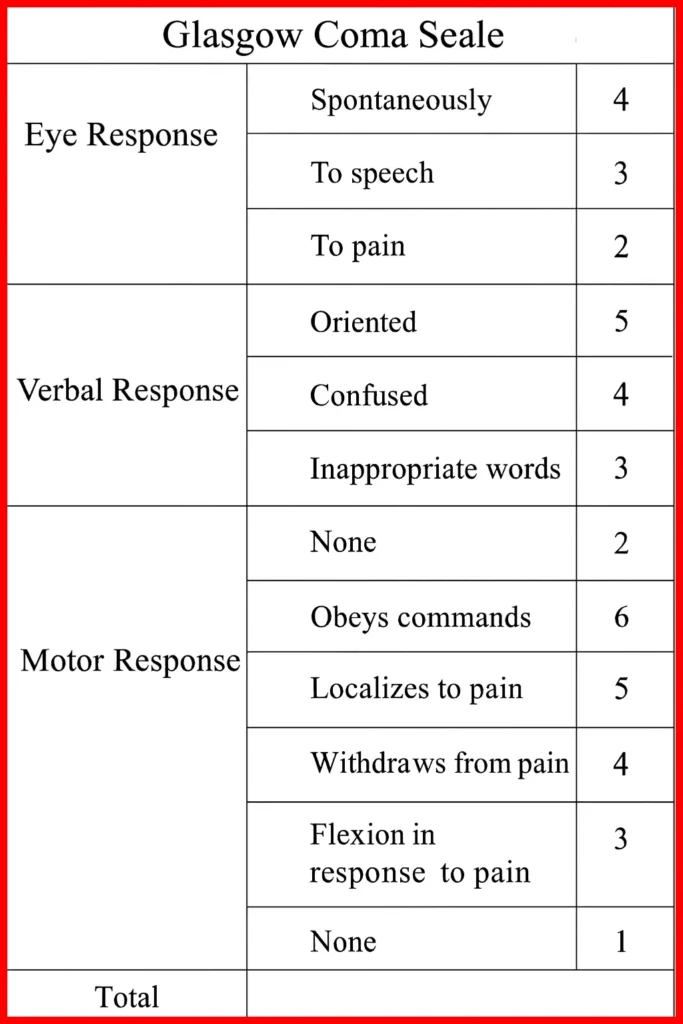
    glasgow coma scale (Neurological examination)

    Step 2: Cranial nerve examination

    There are 12 pairs of cranial nerves in total. The key points of examination include ptosis (III), facial drooping or asymmetry (VII), clarity of speech (V, VII, X, XII), abnormal eye position (III, IV, VI), and abnormal or asymmetrical pupils (II, III).

    In addition, the sensitivity of the sense of smell, visual acuity and visual field, fundus examination, hearing examination, palpebral fissure, changes in voice, morphology and strength of related muscles, and eye movements should also be included in the examination.

    Step 3: Musculoskeletal system examination

    The examination of the musculoskeletal system mainly consists of six parts: muscle strength, muscle tone, muscle volume, coordination, involuntary movements, posture, and gait.

    In principle, assessing muscle strength requires the patient to perform an action against external resistance, comparing both sides, and generally using a six-level grading system of 0-5.

    • Grade 0: No muscle contraction, no joint movement, indicating complete paralysis;
    • Grade 1: The muscles contract slightly, but cannot move the joints.
    • Level 2: Muscle contraction can drive joint movement, but cannot counteract the weight of the limb;
    • Level 3: Able to resist the gravity of the limbs, but unable to resist resistance;
    • Level 4: Able to partially resist resistance and allow the joint to move, but the joint is not stable;
    • Level 5: Able to resist resistance, with normal muscle strength and stable joints.

    Muscle tone usually refers to the tension of muscles at rest. Intracranial lesions can cause abnormal muscle tone . When examining muscle volume, three points should be noted: hypertrophy, atrophy, and symmetry. Coordination tests mainly include the finger-to-nose test, rapid alternating movements, heel-to-shin test, and the sign of difficulty standing with eyes closed.

    Step 4: Sensory System Check

    Before each sensory system examination, the contents and questions of the examination should be clearly explained to the patient. Unless under specific circumstances, the patient should keep their eyes closed during the examination. Special attention should be paid to whether the two sides of the body are symmetrical during the examination, and the distal and proximal parts of the limbs should be compared. If a sensory loss area is found, its boundaries should be described in detail.

    The senses tested include superficial senses (pain, temperature, touch), deep senses (kinesthetic sense, position sense, vibration sense), and complex senses (solid sense, graphic sense, two-point discrimination).

    Step 5: Reflection Inspection

    One important point to note when examining reflexes is that they need to be checked in conjunction with motor function. Reflexes mainly include superficial reflexes (corneal reflex, abdominal wall reflex, cremasteric reflex, anal reflex, plantar reflex ), deep reflexes (biceps brachii reflex, triceps brachii reflex, radial periosteal reflex , ankle reflex, knee reflex), and pathological reflexes. Different reflexes correspond to different nerves.

    Step 6: Examination of pathological reflexes and abnormal gait –

    In clinical practice, we often encounter patients with a neutral Babinski sign. In such cases, it is necessary to conduct further examinations of other Babinski sign equivalents to determine the specific situation. Commonly used equivalents include Chaddock sign, Oppenheim sign , Gordon sign, Gonda sign, and Pussep sign. Abnormalities in different equivalents represent different types of nerve damage.

    In addition, there are other pathological reflex examinations. Such as Brucella sign, Korgny sign, sucking reflex, meningeal irritation sign, and neck stiffness.

    Gait changes are a common manifestation of nerve damage. All patients who can walk should have their gait examined. Common types include spastic hemiplegic gait, spastic paraplegic gait , ataxia gait , panicked gait, straddling gait, swaying gait, and drunken gait.

    gastric lavage
    Are you familiar with gastric lavage, an emergency first-aid technique?
    Editorial Notice & Disclaimer: All material published on this platform is curated strictly for general educational and healthcare informational purposes. Content should not be interpreted as professional medical advice, official diagnosis, or a definitive treatment protocol. We strongly advise consulting a licensed physician or qualified healthcare provider regarding any specific medical concerns or health choices.

    Admin
    Website |  + postsBio ⮌
    • Admin
      Apple Juice Benefits: 8 Proven Health Boosts and 3 Hidden Downsides
    • Admin
      5 Proven Benefits of Invokana Generic for Diabetes Care
    • Admin
      7 Powerful Reasons Why Capron DM Is a Safe Choice for Allergy Relief
    • Admin
      10 Proven Ways on How to Relax Without Stress
    Share. Facebook Twitter Pinterest LinkedIn Tumblr Email
    Previous ArticleAre you familiar with gastric lavage, an emergency first-aid technique?
    Next Article Excimer Laser Therapy: 7 Powerful Benefits for Clearer, Healthier Skin

    Related Posts

    Patient Education

    What Is a Newborn Sucking Blister? Clinical Causes and Treatment

    June 24, 2026
    Patient Education

    What Is a Zip Stitch? How It Works vs. Stitches and Butterfly Bandages

    June 22, 2026
    Patient Education

    Fiber vs. Protein: Which Is More Important for human health ?

    June 14, 2026
    View 1 Comment

    1 Comment

    1. Pingback: Excimer Laser Therapy: 7 Powerful Benefits for Clearer Skin

    Leave A Reply Cancel Reply

    You must be logged in to post a comment.

    Recent Posts
    • How Do You Know If a Heart Stent Is Blocked Again? Warning Signs
    • What Is a Newborn Sucking Blister? Clinical Causes and Treatment
    • Are Skin Tag Removal Kits Safe? Dermatologist Guidance, Risks vs. Benefits
    • Cardiologist-Recommended Diet for Heart Health: 9 Core Principles for 2026
    • What Is a Zip Stitch? How It Works vs. Stitches and Butterfly Bandages
    Top Posts

    What are the effects of smoking on the lungs?

    March 7, 2024

    What are the causes of headaches? How to prevent it in daily life?

    April 11, 2024

    cardiovascular disease, can do these 4 things, and blood vessels can stay young.

    April 18, 2024
    Latest Reviews
    Most Popular

    How Do You Know If a Heart Stent Is Blocked Again? Warning Signs

    June 25, 2026

    What Is a Newborn Sucking Blister? Clinical Causes and Treatment

    June 24, 2026

    Are Skin Tag Removal Kits Safe? Dermatologist Guidance, Risks vs. Benefits

    June 23, 2026

    Cardiologist-Recommended Diet for Heart Health: 9 Core Principles for 2026

    June 22, 2026

    What Is a Zip Stitch? How It Works vs. Stitches and Butterfly Bandages

    June 22, 2026

    Our Medical Board

    Our health platform content is written, reviewed, and vetted by a dedicated board of licensed clinicians and specialists to guarantee clinical accuracy.

    • Dr. Paul Hofmann ENT & Otolaryngology Helios Hospital ↗
    • Dr. Jacob Cote, MD Dermatology Specialist The Ottawa Hospital ↗
    • Dr. Yichen Xu Medical Oncology SYSU Cancer Center ↗
    • Dr. Sana Lodhi, MBBS General Medicine LUMHS Hospital ↗
    • Dr. Wang Zhixin Gynecology & Maternal Shenzhen Women's Hosp ↗
    • Dr. John Ma Orthopaedic Surgery Royal Brisbane Hosp ↗
    • Dr. Sarita Rao Interventional Cardiology Apollo Hospitals ↗
    • Dr. Sharmila Rathi Pediatrics & Child Care Sir JJ Hosp Mumbai ↗
    • Dr. He Feng Urology & Andrology Bohe Medical Profile ↗
    • Dr. Akram Chang Cardiovascular Care Gulab Devi Hospital ↗
    • Dr. Liping Shen Gyneclinic Oncology Peking Uni Int Hosp ↗
    • Dr. Suleman Khan Dental Surgery Govt Dental College ↗
    Our Picks

    How Do You Know If a Heart Stent Is Blocked Again? Warning Signs

    June 25, 2026

    What Is a Newborn Sucking Blister? Clinical Causes and Treatment

    June 24, 2026

    Are Skin Tag Removal Kits Safe? Dermatologist Guidance, Risks vs. Benefits

    June 23, 2026

    Cardiologist-Recommended Diet for Heart Health: 9 Core Principles for 2026

    June 22, 2026

    What Is a Zip Stitch? How It Works vs. Stitches and Butterfly Bandages

    June 22, 2026
    Facebook X (Twitter) Instagram Pinterest
    • About Us
    • Contact Us
    • Disclaimer
    • Our Medical Review Board & Expert Contributors
    • Terms and Conditions
    • Write for Us
    © 2026 Healthy Post. All Rights Reserved.

    Type above and press Enter to search. Press Esc to cancel.