


⚖️ Clinical & Coding Disclaimer
This guide has been authored and clinically reviewed by Dr. Mohanned A. Alghamdi, BDS, MS, CAGS, ABGD. The breakdown of CDT codes, dental bone graft procedures, and insurance billing practices is designed to assist dental professionals and patients with general navigation. It does not constitute formal legal, financial, or professional dental coding advice, nor does it replace official American Dental Association (ADA) documentation.
Dental billing requirements, payer policies, and clinical definitions vary significantly by insurance carrier, state regulations, and individual patient anatomy. Always verify specific coverage guidelines, pre-authorizations, and clinical necessity with your insurance provider or a certified dental billing specialist before submitting claims. Never make surgical or financial decisions solely based on information provided on this website.

🏥 Medical Review Board Member
Dr. Mohanned A. Alghamdi, BDS, MS, CAGS, ABGD
Esthetic and Restorative Dentist & Medical Director | UniDents Clinic (Jeddah, Saudi Arabia)
Dr. Mohanned A. Alghamdi, BDS, MS, CAGS, ABGD, is an accomplished Esthetic and Restorative Dentist and the Medical Director at UniDents Clinic. With a strong academic foundation from Tufts University, Dr. Alghamdi brings extensive clinical expertise and a commitment to professional excellence to his practice. He currently oversees a large multidisciplinary team of dental specialists, ensuring the highest standards of patient care, diagnostic precision, and clinical safety.
In our clinical and billing review work, the bone graft dental code is one of the most commonly misunderstood entries in the CDT manual. That matters. A small coding error can delay reimbursement, trigger a denial, or create a documentation headache for the practice.
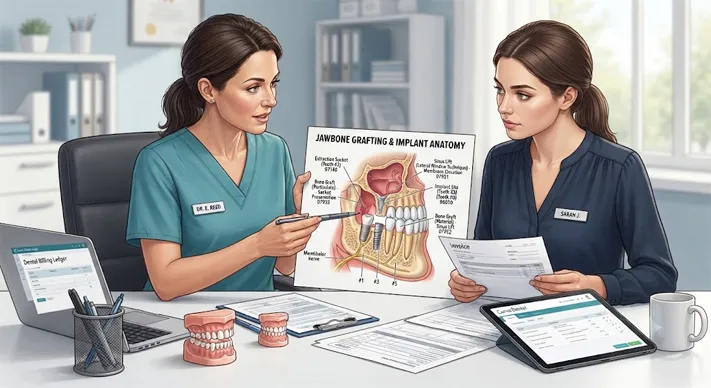
Dental bone grafting is not a single procedure. It is a category. The right CDT code for dental bone graft depends on where the graft is placed, whether an implant is being placed the same day, and whether the site is a natural tooth, extraction socket, or edentulous ridge. For practices handling dental bone grafting billing codes, precision is the difference between a clean claim and a rejected one.
1. Why the bone graft code depends on the clinical site
The most important rule is simple: the graft location drives the code. The ADA’s CDT system is designed to describe what was done, where it was done, and why.
That means a bone graft dental code is not interchangeable with another graft code just because the material looks similar. A socket preservation procedure is not the same as a sinus lift. A periodontal osseous graft is not the same as ridge augmentation. Billing teams that treat them as the same usually run into trouble.
Here is the practical breakdown:
- D7953 — bone replacement graft for ridge preservation, often used in an extraction socket
- D6104 — bone graft at time of implant placement
- D4263 / D4264 — bone replacement graft around retained natural teeth
- D7950 — osseous, osteoperiosteal, or cartilage graft of the mandible or maxilla
- D7951 / D7952 — sinus augmentation procedures
In real-world claims, the code must match the narrative. A socket graft billed as a periodontal graft is a common error. So is using the wrong code for immediate implant placement.
For related coding context, many teams also review d0220 dental code documentation when building a complete chart narrative around diagnostic imaging.
2. The core CDT code for dental bone graft in common scenarios
The CDT code family for grafting can look crowded, but the logic is manageable once you match it to the clinical situation.
D7953: ridge preservation after extraction
This is the CDT code D7953 many offices mean when they say “socket graft.” It is used when the goal is to preserve ridge height and width after extraction or implant removal.
Think of it as site maintenance. The extraction has already created a defect. The graft helps reduce collapse of the ridge so the area may better support a future prosthesis or implant.
Common use cases:
- extraction socket grafting
- implant removal site preservation
- immediate post-extraction ridge maintenance
This is often called the ridge preservation dental code or extraction site bone graft code.
D6104: graft placed with immediate implant placement
If a graft is placed at the same visit as implant placement, the claim usually points to D6104, not D7953.
This matters because payers often distinguish between a preservation graft and a graft performed around an implant body during placement. Using the wrong code can look like unbundling or duplicate reporting.
D4263 and D4264: periodontal bone grafting around natural teeth
These are the periodontal osseous graft CDT code options. They are used in periodontal surgery around retained natural teeth, not extraction sites.
- D4263 = first site in a quadrant
- D4264 = each additional site in the quadrant
This is where guided tissue regeneration dental code concepts often come into the documentation, especially when membranes or regenerative materials are used alongside the graft.
D7950: ridge augmentation in an edentulous area
When bone is added to develop a ridge in an already toothless area, D7950 is often the relevant alveolar bone grafting procedure code. It is commonly used before implant placement in more advanced site-development cases.
D7951 and D7952: sinus augmentation
The upper posterior jaw often lacks enough bone for implants. That is where the maxillary sinus augmentation code comes in.
- D7951 = lateral open approach
- D7952 = vertical/crestal approach
These are not interchangeable. The surgical access route matters.
3. What is included in dental bone grafting billing codes—and what is not
A frequent denial issue comes from assuming everything is bundled. It is not.
The base graft code often covers placement of the graft material itself. But additional steps may need separate reporting if they are distinct and billable.
Often billed separately:
- Autogenous bone graft harvesting code when bone is harvested from a separate donor site
- barrier membranes
- biologic materials, if separately reportable
- imaging and diagnostic documentation when required by payer policy
This is where practices benefit from clear charting. If the surgeon harvests autogenous bone from a separate site, that work is not automatically captured inside the graft code.
A simple example: a clinician performs ridge augmentation in the mandible using harvested bone plus a membrane. The graft placement may be one code. The harvest and membrane may need separate reporting, depending on the exact CDT description and payer rules.
This is also where teams reviewing Dental insurance codes for bone graft should check the plan language carefully. The code may be valid, but the benefit may still be excluded.
4. How insurers evaluate bone graft claims
Insurance review is usually less about the material and more about the reason for the procedure.
Most payers look for:
- clinical necessity
- exact anatomical site
- date relationship to extraction or implant placement
- supporting radiographs or CBCT images
- operative notes that describe the defect and treatment goal
Many plans still exclude implant-related services or ridge preservation unless there is a specific rider. So a valid bone graft dental code does not guarantee payment.
Common denial triggers
- using D7953 for a simultaneous implant case
- using periodontal graft codes for extraction sockets
- missing radiographic support
- weak narrative documentation
- billing a membrane as if it were included when it is separately reportable
In practice, claims that succeed usually tell a clean story. What was the defect? Why was the graft needed? What site was treated? What was the intended restorative plan?
For this reason, office teams often cross-check with Dental implant site development notes and postoperative records before submission.
5. A quick billing table for fast reference
| Clinical situation | Common CDT code | Billing note |
|---|---|---|
| Extraction socket preservation | D7953 | Often called socket graft or ridge preservation |
| Implant placed with graft same day | D6104 | Do not use D7953 for the same socket on implant day |
| Graft around natural tooth | D4263 / D4264 | Periodontal surgery, not extraction site work |
| Edentulous ridge augmentation | D7950 | Often used for site development before implants |
| Sinus lift, lateral approach | D7951 | Maxillary sinus augmentation code |
| Sinus lift, crestal approach | D7952 | Vertical access through implant osteotomy |
6. Real-world documentation that supports approval
When reviewing patient histories, we notice the strongest claims have one thing in common: they read like a clinical timeline.
A helpful note usually includes:
- tooth number or site
- reason for extraction or defect
- ridge status before grafting
- implant plan, if relevant
- graft material used
- whether the site was natural, edentulous, or peri-implant
That narrative matters because the same material can support different procedures. In other words, the graft is not the code. The clinical context is the code.
If the case involves regeneration around a periodontal defect, the team may also reference guided tissue regeneration dental code concepts and document membrane use clearly.
7. Practical examples from everyday dental coding
Example 1: extraction today, implant later
A molar is extracted and the socket is grafted to preserve bone for a future implant. The likely code is D7953.
Example 2: implant placed immediately
The tooth is removed and the implant is placed at the same appointment, with grafting around the implant body. The likely code is D6104.
Example 3: periodontal defect around a natural tooth
A retained molar has vertical bone loss and the surgeon performs regenerative surgery. The likely code is D4263 or D4264.
These distinctions sound small. They are not. They directly affect reimbursement and compliance.
8. FAQ
Is there one universal bone graft dental code?
No. The correct code depends on the site, timing, and goal of treatment.
Is D7953 the same as socket preservation?
Yes, in most billing discussions D7953 is the main CDT code D7953 used for ridge preservation after extraction.
Can membranes be included in the graft code?
Not always. Many membranes or biologics are reported separately if the CDT descriptor and payer policy allow it.
What is the alveolar bone grafting procedure code for ridge augmentation?
Often D7950, though the exact code depends on the anatomy and clinical goal.
Do dental insurance codes for bone graft always get covered?
No. Coverage depends on the patient’s plan, exclusions, and whether the service is tied to implants or major restorative benefits.
Where does the autogenous harvest fit?
If bone is taken from a separate donor site, the autogenous bone graft harvesting code may need to be reported separately.
9. Conclusion
Choosing the right bone graft dental code is really about matching code to anatomy, timing, and intent. That is why the CDT code for dental bone graft, the alveolar bone grafting procedure code, and the broader set of dental bone grafting billing codes must be reviewed carefully before a claim goes out.
For teams managing Dental insurance codes for bone graft, the safest approach is consistent documentation, correct code selection, and payer-specific verification. That reduces denials and helps the clinical record tell the same story the claim does.
Related internal topics worth connecting include d0220 dental code, Dental implant site development, Ridge preservation dental code, Maxillary sinus augmentation code, and Periodontal osseous graft CDT code.
1 Comment
Pingback: What Is an Endosteal Implant? Procedure, Benefits & Recovery