


This article has been written by Dr. Priyanka Agarwal (Dermatologist, Dakai Skin Clinic ↗), specializing in clinical dermatology, skin photoprotection, UV radiation effects, and dermatological skin health.
Medical Disclaimer: The information provided regarding what tanning oils do, how they affect UV absorption, and skin sun safety is for educational and informational purposes only. Traditional tanning oils accelerate ultraviolet radiation absorption and generally lack adequate broad-spectrum protection against sunburn, premature photoaging, and skin malignancies. Always consult a board-certified dermatologist or qualified healthcare provider regarding safe sun exposure habits and personalized photoprotection strategies for your skin type.

Dr. Priyanka Agarwal
Dermatologist | Dakai Skin Clinic
Dr. Priyanka Agarwal is an experienced Dermatologist dedicated to providing advanced medical and aesthetic skin care solutions. Practicing at Dakai Skin Clinic, Dr. Agarwal combines evidence-based dermatological care with a patient-centered approach, ensuring optimal skin health, advanced clinical treatments, and the highest standards of safety and diagnostic precision.
Below is the finished article, with the website research completed first. I found one particularly strong internal-link opportunity on HealthPage for sunscreen and sensitive-skin care, while the other discovered pages were not directly relevant enough to justify adding links. I have therefore avoided forcing weak internal links.
What Does Tanning Oil Do? How It Works, Benefits & Sun Safety
If you have ever wondered what does tanning oil do, the short answer is that it is mainly designed to condition the skin and enhance the appearance of a tan. Traditional tanning oils do not provide meaningful UV protection unless the product is specifically formulated and labeled with sunscreen protection. Some can make the skin look glossy or more bronzed, while products intended for UV tanning may be used to encourage a darker tan through sun exposure. The important distinction is that a tan is a response to UV exposure, not a sign that your skin is protected or healthier. The FDA describes tanning itself as a sign of skin damage and notes that a tan offers only minimal natural protection.
That makes tanning oil easy to misunderstand. An oil can leave your skin feeling soft and looking radiant while offering little protection from the ultraviolet radiation responsible for sunburn, premature skin aging and skin cancer.
What Does Tanning Oil Do to Your Skin?
Most traditional tanning oils contain oils, emollients and other conditioning ingredients that coat the skin and improve its feel and appearance. Depending on the formulation, they may also contain bronzers, botanical extracts, fragrances or cosmetic ingredients that make the skin look darker or more luminous.
For people using tanning oil for sun tanning, the intended effect is usually to enhance or accelerate the appearance of a tan during UV exposure.
The tanning process itself happens because UV radiation triggers biological changes in the skin. The body produces more melanin, the pigment responsible for much of the darker color associated with tanning. The FDA explains that this increase in melanin is a response to UV exposure and is a sign of damage rather than a protective adaptation that makes tanning safe.
So there are really two separate effects to consider:
- Cosmetic effect: skin may look shinier, smoother or more bronzed.
- Biological tanning effect: UV exposure stimulates increased melanin production.
- Moisturizing effect: oils and emollients can reduce the dry or tight feeling associated with exposed skin.
- Protection: ordinary tanning oil should not be assumed to provide meaningful UV protection.

How Does Tanning Oil Work?
Understanding how does tanning oil work requires separating the oil from the tanning process.
An ordinary oil does not manufacture melanin or create a completely different biological pathway for tanning. Instead, traditional tanning products are generally used while the skin is exposed to sunlight. UV radiation reaches the skin, triggering cellular responses that include increased melanin production.
The simplified process looks like this:
UV exposure → biological skin response → increased melanin production → darker-looking skin
Some tanning oils are marketed specifically to support faster or deeper-looking tanning. Their formulation may also make the skin appear immediately darker because of bronzers, pigments or reflective oils.
That immediate color is different from a true UV-induced tan. A cosmetic bronzer can make the skin look darker without producing the same biological response as UV exposure.
This distinction matters because does tanning oil help you tan faster is not the same question as whether tanning oil makes tanning safer. A product that facilitates more UV exposure does not remove the risks associated with that exposure.
Why does the skin tan in the first place?
Melanin is produced by specialized skin cells called melanocytes. After UV exposure, increased melanin can make the skin darker. The FDA notes that this change can develop over the following couple of days.
That darker color can create the appearance of healthy, sun-kissed skin, but it should not be interpreted as evidence that the skin has become resistant to UV damage.
What Are the Benefits of Tanning Oil?
The benefits of tanning oil are mostly cosmetic and conditioning rather than protective.
1. It can make skin feel softer
Many tanning oils contain emollient ingredients that help reduce the feeling of dryness. This can be pleasant after spending time outdoors, particularly when heat, wind or salt water leave the skin feeling tight.
However, moisturizing the surface of the skin does not reverse UV damage.
2. It creates a glossy appearance
Oil reflects light from the surface of the skin. That can make the skin appear smoother, more luminous and more noticeably bronzed.
This is one reason tanning oils remain popular for beach and vacation use.
3. It can enhance the appearance of an existing tan
A thin layer of oil can make existing pigmentation look richer because of the combination of surface shine and darker-looking skin.
Some formulations also contain bronzing ingredients that create an immediate cosmetic effect.
4. It can improve the feel of dry skin
Depending on its ingredients, a tanning oil may help reduce moisture loss from the skin surface. This can temporarily improve the feel of rough or dry skin.
For people specifically looking for barrier-supportive skincare rather than tanning, a dedicated moisturizer may be a more appropriate choice.
5. Some products combine tanning cosmetics with SPF
A tanning oil with SPF is different from an ordinary tanning oil. If it carries a valid SPF and broad-spectrum claim, its sunscreen system is responsible for the UV protection—not the oil itself.
That distinction should always be checked on the label.
Does Tanning Oil Protect Against Sunburn?
Usually, no.
This is perhaps the most important answer for anyone asking does tanning oil protect against sunburn.
Traditional tanning oil without an adequate sunscreen system should not be treated as sun protection. The FDA specifically states that getting a tan does not protect the skin from sunburn or other damage. The additional melanin in tanned skin provides only about SPF 2–4, which is very low protection.
So applying ordinary tanning oil and staying outside longer is not a safe way to build a tan.
A person can still develop sunburn while using tanning oil, particularly if they underestimate the strength of the sun or remain outdoors for an extended period.
What if the tanning oil contains SPF?
That changes the situation.
A product labeled with SPF has been formulated around a sunscreen system rather than relying on oil alone. Still, read the complete label. Look for:
- An SPF rating
- Broad-spectrum protection
- Water-resistance information when relevant
- Application directions
- Reapplication instructions
The American Academy of Dermatology recommends choosing sunscreen that provides broad-spectrum protection, SPF 30 or higher and water resistance.
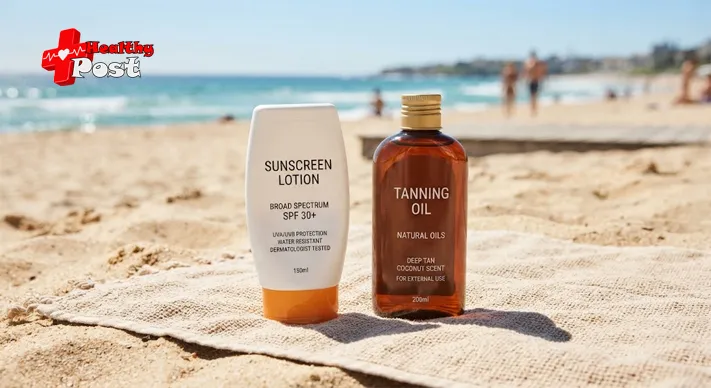
Tanning Oil vs Sunscreen: What’s the Difference?
The difference between tanning oil vs sunscreen comes down to purpose.
| Feature | Traditional Tanning Oil | Sunscreen |
|---|---|---|
| Primary purpose | Enhance tanning or skin appearance | Reduce UV exposure |
| Moisturizing effect | Often present | Depends on formula |
| UV protection | Usually little or none | Designed to provide UV protection |
| SPF | May be absent | Clearly labeled when applicable |
| Broad-spectrum claim | Not necessarily | Common in protective products |
| Prevents sunburn | Not reliably | Helps reduce sunburn when used correctly |
| Makes tanning safe | No | No sunscreen makes intentional UV tanning completely safe |
The AAD recommends broad-spectrum SPF 30+ sunscreen as part of a broader sun-protection strategy that also includes shade and protective clothing.
If your primary goal is protecting your skin, sunscreen is the appropriate product. Tanning oil should not be substituted for it.
For people with easily irritated or reactive skin, choosing a suitable sunscreen formula can also matter. For example, HealthPage’s guide to skincare steps for sensitive skin discusses sunscreen selection and practical ways to make sun protection more comfortable for sensitive skin.
Can You Use Tanning Oil and Sunscreen Together?
It depends on the specific products, but the sunscreen should remain the foundation of your sun-protection routine.
If you use tanning oil for its cosmetic or moisturizing qualities, don’t assume that applying it over sunscreen makes the sunscreen stronger. Follow the sunscreen manufacturer’s instructions for application and reapplication.
A practical approach is to:
- Apply a broad-spectrum, water-resistant SPF 30+ sunscreen as directed.
- Make sure all exposed areas receive adequate coverage.
- Reapply according to the label, particularly after swimming or sweating.
- Use tanning oil only if its label and formulation are compatible with your intended routine.
- Continue using shade, clothing and other protective measures.
The AAD recommends reapplying sunscreen approximately every two hours when outdoors and after swimming or sweating, following the product’s directions.
Most importantly, sunscreen should not be viewed as permission to stay in direct sunlight indefinitely.
Does Tanning Oil Make You Tan Faster?
Some tanning products are specifically marketed to help produce a deeper or faster-looking tan. But there is an important catch: faster tanning is not safer tanning.
If the darker color results from increased UV exposure, the skin is still being exposed to the radiation responsible for tanning and sun damage.
The FDA states that there is no such thing as a safe tan and that tanning increases skin-cancer risk.
This is why the phrase “accelerated tanning” should not be interpreted as “protected tanning.”
A tanning oil may also make the skin look darker immediately because of bronzers or cosmetic ingredients. That visual effect is different from increasing melanin through UV exposure.
Can Tanning Oil Cause Sunburn?
Tanning oil itself is not necessarily the direct cause of sunburn. The bigger concern is what happens when a person applies an oil without adequate UV protection and then spends prolonged time in the sun.
Sunburn occurs after excessive UV exposure, with UVB playing a major role in the acute burning response. UVA also contributes to skin damage and premature aging. Broad-spectrum sunscreen is designed to address both UVA and UVB radiation.
The risk can be easy to underestimate during activities such as:
- Swimming
- Walking on the beach
- Boating
- Outdoor sports
- Long vacations
- Sitting outside during peak sunlight
Water, sand and snow can also reflect UV radiation, increasing exposure.
Can Tanning Oil Increase Skin Damage?
The concern isn’t simply the oil sitting on your skin. It is the tanning behavior associated with UV exposure.
Repeated UV exposure contributes to:
- Sunburn
- Premature skin aging
- Wrinkles
- Uneven pigmentation
- DNA damage
- Increased skin-cancer risk
The AAD explains that repeated tanning damages the skin and accelerates visible aging while increasing the risk of skin cancer.
This creates an important contrast: an oil may make the skin look smoother and more radiant in the short term, while repeated UV exposure can gradually make the skin look older.
What about premature aging?
UVA radiation is strongly associated with photoaging. Over time, repeated exposure can contribute to wrinkles, age spots and changes in skin texture. UV radiation overall is also a major risk factor for skin cancer.
So the glossy appearance produced by tanning oil should not be confused with healthier skin.
Is Tanning Oil Safer Than Tanning Without Oil?
Not necessarily.
The oil does not neutralize UV radiation. If an ordinary tanning oil is being used during intentional sun exposure, the underlying UV exposure remains the key health concern.
In other words, adding oil doesn’t transform UV tanning into a safe activity.
The same principle applies to indoor tanning. UV-emitting tanning devices have been classified by the International Agency for Research on Cancer as carcinogenic to humans.
Using tanning oil does not remove that risk.
Self-Tanner vs Tanning Oil: Which Is Safer?
If your goal is simply to achieve a darker-looking complexion, the distinction between self-tanner vs tanning oil is important.
A self-tanner changes the appearance of the skin without requiring deliberate UV exposure. The AAD recommends considering self-tanning products for people who want to look tan, while continuing to use sunscreen because self-tanner does not protect against the sun.
That makes a self-tanning product a reasonable cosmetic alternative to deliberately exposing your skin to UV radiation.
It is still important to remember that a self-tanner and sunscreen perform different jobs:
Self-tanner changes skin appearance.
Sunscreen reduces UV exposure.
You may use both, but one does not replace the other.

Practical Safe Tanning Tips
If you’re outdoors and want to reduce UV exposure, focus on protection rather than trying to maximize tanning.
Useful safe tanning tips include:
- Choose a broad-spectrum, water-resistant sunscreen with SPF 30 or higher.
- Apply sunscreen generously to exposed skin according to the product directions.
- Reapply as directed, especially after swimming or sweating.
- Seek shade when sunlight is strongest.
- Wear protective clothing, a wide-brimmed hat and UV-protective sunglasses.
- Be especially careful around water, sand and snow because reflected UV can increase exposure.
- Avoid tanning beds and sunlamps.
- If you want a darker appearance without deliberate UV exposure, consider a self-tanner.
The AAD recommends combining sunscreen with shade and protective clothing rather than relying on sunscreen alone.
What about “how to tan without burning”?
There is an important limitation to that question: avoiding a sunburn does not mean avoiding UV damage.
You can receive UV exposure without becoming visibly red or burned. Therefore, deliberately staying in the sun until your skin begins to tan is not a risk-free strategy.
If your priority is appearance rather than UV exposure, a self-tanner is a better option than deliberately seeking a UV-induced tan.
What Should You Look for in a Tanning Oil?
If you decide to buy a tanning product, read the label rather than relying on the word “tanning.”
Check whether it contains:
SPF
If the product claims sun protection, look for its actual SPF rating.
Broad-spectrum protection
This indicates protection against both UVA and UVB radiation.
Water resistance
This is particularly relevant for beach, pool and outdoor activities involving swimming or heavy sweating.
Cosmetic ingredients
Oils, emollients, bronzers and botanical ingredients may affect how the product feels or looks on the skin, but these properties should not be confused with UV protection.
A product can be moisturizing and still offer inadequate protection from sunlight.
Frequently Asked Questions
Does tanning oil protect against sunburn?
Ordinary tanning oil generally should not be relied on to prevent sunburn. If a tanning product contains sunscreen, check that it provides an appropriate SPF and broad-spectrum protection and follow its application and reapplication directions.
Does tanning oil help you tan faster?
Some tanning oils are marketed to enhance or accelerate the appearance of tanning during UV exposure. However, faster tanning does not mean safer tanning. UV exposure remains the underlying cause of a conventional sun tan.
Is tanning oil better than sunscreen?
No. They have different purposes. Tanning oil is generally used to condition the skin or enhance tanning, while sunscreen is designed to reduce exposure to harmful UV radiation.
Can I get a tan while wearing sunscreen?
Sunscreen reduces UV exposure but does not create an impenetrable shield. However, its purpose is protection, not to allow longer intentional exposure to sunlight. If you want a tan-like appearance without UV exposure, a self-tanner is a safer cosmetic alternative.
Is a tanning oil with SPF safe?
A tanning oil containing SPF can provide sun protection when it is properly formulated, labeled and used according to its directions. Look for broad-spectrum protection and SPF 30 or higher when choosing a sunscreen product, consistent with AAD recommendations.
Is tanning healthy?
No. A UV-induced tan is a response to UV exposure and is considered a sign of skin damage. The FDA states that there is no such thing as a safe tan.
The Bottom Line
So, what does tanning oil do?
Traditional tanning oil primarily conditions the skin, improves its feel and gives it a glossy or bronzed appearance. Some tanning oils are intended to enhance the appearance of a UV-induced tan, while others contain bronzers or cosmetic ingredients that temporarily make the skin look darker.
What tanning oil doesn’t automatically do is protect your skin from UV radiation.
If a product does not contain an appropriate sunscreen system, don’t treat it as sun protection. And even when a tanning product includes SPF, the safest approach is still to limit UV exposure and combine sunscreen with shade, protective clothing and other sun-safety measures.
For anyone who wants the appearance of a tan without deliberately exposing their skin to UV radiation, a self-tanning product can be a practical alternative. The AAD specifically recommends continuing to use sunscreen with self-tanner because the cosmetic tan itself does not protect against sunlight.
A darker complexion may be the visual goal, but protecting the skin should remain the priority.
References
- U.S. Food and Drug Administration — The Risks of Tanning — Information on tanning, melanin, sun damage and the limited protection provided by a tan.
- American Academy of Dermatology — Sunscreen FAQs — Guidance on broad-spectrum SPF 30+ sunscreen, UVA/UVB protection, reapplication and sun-safety practices.
- IARC/WHO — Sunbeds and UV Radiation — Classification of UV-emitting tanning devices as carcinogenic to humans.
Lipo 360: Procedure, Cost, Recovery & Before-and-After Results