


This article has been reviewed by Dr. Mohammad Kamruzzaman (Plastic & Reconstructive Surgeon, Dhaka Medical / Ibn Sina), specializing in laceration repair, wound management, and surgical scar minimization techniques.
Medical Disclaimer: The information provided on Healthy Post regarding zip stitches, traditional sutures, butterfly bandages, and at-home wound closure is for educational and informational purposes only and does not constitute formal medical or surgical advice. Deep, gaping, or heavily bleeding lacerations require professional medical evaluation and treatment to prevent infection and improper healing. Always consult a qualified physician, plastic surgeon, or emergency medical provider to determine the proper closure method for any significant skin injury.

🏥 Medical Review Board Member
Dr. Mohammad Kamruzzaman, MBBS, FCPS
Plastic & Reconstructive Surgeon | Associate Professor, Dhaka Medical College & Hospital
Dr. Mohammad Kamruzzaman is a prominent plastic, reconstructive, and burn surgeon serving as an Associate Professor in the Department of Burn & Plastic Surgery at Dhaka Medical College & Hospital. With extensive clinical expertise and advanced surgical credentials, he is dedicated to providing evidence-based medical oversight and translating specialized clinical care into clear, reliable guidance. Dr. Kamruzzaman ensures that health and surgical content on Healthy Post meets the highest standards of medical accuracy, clinical integrity, and patient safety.
If you’ve seen a zip stitch mentioned in an ER discharge note, first-aid kit listing, or surgical aftercare guide, you may have wondered what it actually is. In our clinical review of wound-closure options, zip stitch comes up as a modern, non-invasive wound closure method designed to bring skin edges together without needles. It sits somewhere between tape and sutures: stronger than simple strips, but less invasive than traditional stitches. For many patients, that makes the question practical: What is a Zip Stitch and How Does it Work, and when is it a better choice than sutures or butterfly closures?
At a high level, a zip stitch uses adhesive strips and a small plastic tightening mechanism to gently approximate the skin edges. It is often discussed alongside zip skin closure, topical skin adhesives, and other forms of surgical incision care. The appeal is clear. It can be fast, less painful to apply, and easier to remove than stitches. But it is not a universal fix. Deep wounds, jagged cuts, and heavily contaminated injuries still need proper medical assessment.
For patients, parents, hikers, and anyone building emergency first aid supplies, understanding the limits matters as much as understanding the benefits.
1. What is a Zip Stitch and How Does it Work
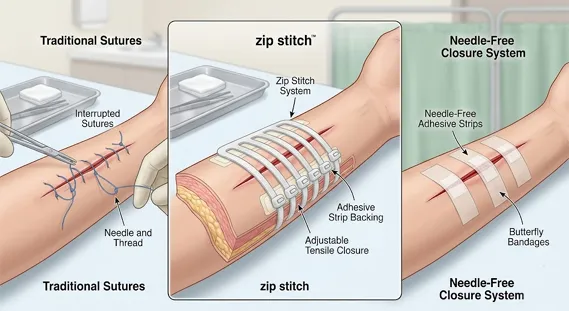
A zip stitch is a non-invasive skin closure device. It is made to pull the edges of a superficial wound together from the outside, rather than puncturing the skin with a needle and thread.
Here’s the basic process:
- Adhesive strips are placed on both sides of a cleaned wound.
- Small connecting straps or tabs bridge the gap.
- The tabs are tightened, which draws the skin edges closer.
- The result is margin approximation, with less tension concentrated at a single point.
This design aims to distribute force more evenly across the wound. That matters because uneven tension can widen scars or pull the wound apart. In that sense, the device is built to support wound edge alignment and margin eversion, two concepts clinicians care about when cosmetic outcome matters.
Most studies and manufacturer data agree on one practical point: zip-style closure can be faster to apply than sutures, especially in straightforward linear wounds. It is also needle-free, which may reduce pain and anxiety for some patients. In pediatric settings, that can make a real difference.
A common use case is a straight laceration on the forearm, knee, or scalp margin that is already cleaned and judged appropriate for external closure. It may also appear in selected postoperative settings, including some orthopedic or facial procedures, depending on surgeon preference and wound characteristics.
In our clinical practice, we think of it as a tool for the right wound, not every wound.
2. Zip Stitch vs. Traditional Stitches
The comparison people ask about most is Zip Stitch vs. Traditional Stitches. The difference is not just about comfort. It’s also about mechanics, wound type, and aftercare.
Traditional stitches, or sutures, pass through the skin with a needle. That gives the clinician precise control and makes sutures better for deeper wounds, areas under significant tension, or wounds that need layered closure. Sutures can also close dead space, which is essential when the wound extends below the superficial skin layer.
Zip stitches work externally. They do not penetrate deep tissue. That makes them less invasive, but also less suitable for complex injuries.
Key differences
| Feature | Zip Stitch | Traditional Stitches |
|---|---|---|
| Invasiveness | External, needle-free | Needle passes through skin |
| Pain on application | Usually lower | Often requires local anesthetic |
| Removal | Often easier and less uncomfortable | Requires removal by clinician in many cases |
| Best for | Superficial, straight wounds | Deeper, gaping, or high-tension wounds |
| Infection control | No puncture tracts through skin | Puncture sites can create small entry points |
| Cosmetic goal | Helpful for clean alignment | Often preferred for more complex closure |
Traditional sutures still have an important role. They are often the better option for wounds that are deep, irregular, over joints, or prone to splitting with movement. They can also be layered in a way external closure devices cannot.
That is why butterfly closures vs sutures is not a simple contest. It depends on what the wound needs. If it needs internal support, stitches remain the standard in many settings. If it is superficial and straight, a zip stitch may offer a simpler path.
For readers comparing options after an injury, the safest rule is straightforward: if the wound is gaping, bleeding heavily, contaminated, or deep enough to show fat, muscle, or bone, seek medical care.
3. Zip Stitch vs. Butterfly Bandages
The second common comparison is Zip Stitch vs. Butterfly Bandages. Butterfly bandages, also called butterfly closures, are adhesive strips that help pull wound edges together. They are familiar, inexpensive, and widely used in basic first aid.
But they are not the same as a zip stitch.
Butterfly strips rely mainly on adhesive strength. They can work well for small, shallow cuts with low tension. Yet they may loosen when the skin is sweaty, oily, stretched, or exposed to frequent movement. A knee cut, for example, often puts more stress on the closure than a small cut on the cheek.
A zip stitch usually offers more structural support. It uses a more rigid external mechanism to hold the wound edges in place. That can make it more stable than basic adhesive strips alone.
Where butterfly bandages fit best
- Small, clean cuts
- Low-tension areas
- Temporary support before medical review
- Minor pediatric injuries, when appropriate
Where a zip stitch may be stronger
- Straight superficial wounds
- Areas that move, but do not require deep closure
- Cosmetic-sensitive wounds where better edge control helps
That said, butterfly closures are still useful. They can be part of a first-aid approach, especially when the goal is to keep a minor cut closed until it heals naturally or until a clinician can evaluate it.
A practical way to think about it: butterfly bandages are simple support. A zip stitch is more like a guided closure system.
4. Safety, wound type, and when not to use a Zip Stitch
This is the section many commercial pages skip, but it matters most.
A zip stitch is intended for superficial skin approximation. It is not meant to replace layered wound repair. If a wound is deep, jagged, contaminated, or actively bleeding, the priority is medical assessment, not just closure.
There are a few reasons:
- Deep wounds may need internal sutures to eliminate dead space.
- Contaminated wounds may trap bacteria if sealed too early.
- High-motion areas can place too much force on external closure.
- Hairy skin, curved surfaces, and very moist areas can reduce adhesion.
In wilderness medicine, this caution is especially important. Closing an unsterilized wound too early can seal bacteria inside. That may raise the risk of deeper infection later. For that reason, first-aid decisions should never focus only on appearance.
If you are stocking emergency first aid supplies, think of a zip stitch as one option in a broader kit, not a universal substitute for care. It may be useful for the right injury, in the right setting, after proper cleaning and assessment.
Clinicians also consider the wound’s location. Straight surgical lines, such as certain orthopedic or maxillofacial incisions, may be better candidates than highly mobile facial areas or thick, hairy skin. The skin must be able to hold the adhesive reliably for the closure to work as intended.
For related reading on wound care basics, see cleaning a cut before bandaging, when to seek urgent care for wounds, and signs of wound infection.
5. Comfort, scarring, and recovery
One reason patients ask about zip stitch products is comfort. Another is scarring. Most evidence and clinical experience suggest that cleaner edge alignment can support better cosmetic outcomes, especially in linear wounds.
A few practical advantages stand out:
- Less needle discomfort
- No need for punctures through the skin
- Easier removal in some cases
- Reduced risk of “railroad track” scarring from suture points
That does not mean scarring disappears. Skin heals according to depth, tension, blood supply, location, and aftercare. But a device that keeps the edges aligned without puncturing them may help in selected cases.
In postoperative care, clinicians may pair external closure with guidance on keeping the area dry, reducing tension, and watching for infection. That is especially relevant in surgical incision care, where movement and moisture can affect healing.
The best outcomes usually come from good wound selection, proper cleaning, and the right closure method. Not from the closure device alone.
6. Practical table: which option fits which wound?
| Wound type | Likely best option | Why |
|---|---|---|
| Small superficial cut | Butterfly bandage | Simple, low tension, quick support |
| Straight shallow laceration | Zip stitch | Better edge control, needle-free closure |
| Deep or gaping wound | Traditional stitches | Can close deeper layers and reduce dead space |
| Heavily contaminated wound | Medical evaluation first | May need cleaning, debridement, or delayed closure |
| Over a joint or high-motion area | Often sutures or clinician-directed care | More stable repair needed |
Internal link cues to add on-page
You can naturally connect this article to first aid for cuts, how to clean a wound, types of wound dressings, how to recognize infection, and minor injury care at home.
FAQs
Is a zip stitch the same as a stitch?
No. A zip stitch is an external, needle-free closure device. Traditional stitches use thread passed through the skin.
Can a zip stitch be used on any cut?
No. It works best on clean, superficial, straight wounds. Deep, dirty, or heavily bleeding wounds need medical evaluation.
Does a zip stitch hurt less than stitches?
Often, yes. Because it does not use needles, many patients find it more comfortable during application and removal.
Are butterfly bandages enough for every small cut?
Not always. They work well for very small, low-tension cuts, but they may not hold as securely as a zip stitch.
Can I use a zip stitch on an infected wound?
No. A wound that already looks infected needs medical care, not closure over trapped bacteria.
Are zip stitches used in surgery?
In some cases, yes. Selected surgeons may use external closure systems for specific incisions, but traditional sutures are still widely used.
Conclusion
A zip stitch is a useful modern option for certain skin closures. It can be faster, less painful, and more comfortable than traditional sutures in the right situation. It may also hold better than butterfly bandages when a wound needs more structure than tape alone can provide. Still, the core rule remains unchanged: choose the closure that matches the wound, not the one that looks simplest.
If the injury is deep, irregular, contaminated, or under tension, a clinician should evaluate it. That is the safest path and often the one that leads to better healing. For straightforward superficial wounds, zip stitch products can be a practical part of non-invasive wound closure and careful recovery.
For more context, you may also want to review topical skin adhesives, butterfly closures vs sutures, and wound care after minor injury on this site.
1 Comment
Pingback: How Does Traumagel Work? 7 Life-Saving Benefits & Guide -